


Custom Tarpaulin Tanks Built to Capacity, Footprint & Fittings
DERFLEX develops custom tarpaulin tanks and flexible water bladders around the way the tank will actually be installed, filled, drained, moved and serviced—not around a one-size catalog model.
PVC or TPU coated fabric direction, usable capacity, length × width limits, valve and vent layout, seam construction, reinforcement, color, marking, accessories and export packing can be reviewed as one project specification.
What is a custom tarpaulin tank?
A custom tarpaulin tank is a flexible liquid-storage system fabricated from reinforced coated textile to a project-specific capacity, footprint, tank shape and connection layout. For a useful specification, the buyer should define the stored liquid, usable volume, maximum installation area, filling and draining method, site conditions and operating cycle before the fabric thickness or final dimensions are fixed.
“Custom” should change the engineering brief, not only the logo
Capacity is only one variable. A made-to-order flexible tank becomes more useful when the geometry, material, seam route, fittings and accessories are designed around the installation and operating workflow.
| Customization Item | DERFLEX Project Direction | Why It Matters | What the Buyer Should Send |
|---|---|---|---|
| Usable capacity | Custom / project-based; existing family references span approximately 500–500,000 L. | Nominal liters affect filled dimensions, hydrostatic load, seam layout and handling. | Required usable volume, reserve margin and fill level. |
| Footprint & geometry | Pillow / bladder, rectangular, tapered or other project-specific flexible geometry. | A tank can meet the required volume but still fail the site if it exceeds the available length, width or filled height. | Maximum L × W × H, ground plan, nearby equipment and access limits. |
| Coated fabric | Reinforced PVC coated fabric; TPU coated fabric can be reviewed for selected applications. | The coating system affects flexibility, folding behavior, welding, abrasion response and liquid-contact suitability. | Stored liquid, temperature, contact duration, cleaning method and required documentation. |
| Thickness / construction | Existing DERFLEX references include approximately 0.75–1.20 mm for selected flexible tank products; final structure by project. | Thickness alone does not define durability; base textile, tensile / tear performance, seam design and reinforcement also matter. | Tank size, service cycle, relocation frequency, abrasion and climate. |
| Inlet, outlet & vent | Custom fitting size, location, valve type, flange / thread / coupling arrangement can be discussed. | Connection design determines fill rate, drain practicality, hose compatibility and local stress around fittings. | Hose OD/ID, pump connection, fitting standard, target flow and preferred location. |
| Reinforcement | Local reinforcement can be reviewed around fittings, corners, handles and high-stress zones. | Loads are not evenly distributed across a flexible tank. | Handling method, hose weight, anchor / lifting expectations and ground condition. |
| OEM presentation | Color, logo, model marking, labels, accessories and export packing can be discussed. | Distributors need repeatable model identity and consistent packing, not one-off custom artwork. | Artwork, color reference, label language, model range and packing format. |
Choose the custom tank format by workflow
The tank structure should follow how people will fill, access, move, clean and store it. This is a more useful starting point than selecting by GSM alone.
Closed Pillow / Bladder Tank
For enclosed portable storage where compact empty volume, contamination control and custom inlet / outlet placement matter.
Useful for
- Construction and remote sites
- Irrigation reserve
- Emergency water storage
- Temporary bulk storage
Rectangular / Footprint-Limited Tank
For projects where the maximum installed length, width or height is already defined by a deck, room, vehicle area or equipment layout.
Useful for
- Plant rooms
- Containerized systems
- Equipment integration
- OEM model ranges
Open / Supported Tarpaulin Tank
For projects requiring direct access, rapid fill-and-drain workflow, visual inspection or a framed / self-supporting operating shape.
Useful for
- Aquaculture
- Wash-down water
- Temporary process water
- Field operations
For a broader tank-family overview, see DERFLEX heavy duty tarpaulin tank solutions. For very high-volume projects, review large capacity flexible water tanks.
PVC vs TPU for a custom flexible tank
Neither material should be approved from the material name alone. The stored liquid, temperature, folding cycle, abrasion exposure, weld route and required compliance documents should be reviewed together.
PVC Coated Fabric Direction
Reinforced PVC coated polyester is widely used for flexible water storage and industrial coated-fabric fabrication because it combines waterproofing, weldability, strength and commercial efficiency.
- Suitable for many general water-storage, agriculture, construction and project applications.
- Broad range of coated-fabric constructions can be discussed.
- Material selection should include base fabric, coating adhesion, thickness, flexibility and seam compatibility.
See the existing PVC coated tarpaulin water tank reference.
TPU Coated Fabric Direction
TPU coated technical fabric can be reviewed where the project requires a different flexibility profile, repeated folding behavior or another liquid-contact / abrasion route.
- Useful for selected specialized flexible bladder programs.
- Fabric chemistry, base textile and welding process should be confirmed together.
- Potable-water or other regulated suitability must be confirmed against the exact approved grade and destination requirement.
Review TPU flexible water tank fabric for the material-level direction.
Custom tank sizing starts with the filled condition
The empty tank is easy to fold; the filled tank is where geometry, ground support, fittings and seam loads become critical. A project drawing should show what happens after filling—not only the flat panel size.
Footprint-first design
When installation space is fixed, send the maximum usable length × width and any height restriction. DERFLEX can then review whether the required capacity can be achieved within that envelope and which tank form is practical.
- Available floor / ground dimensions
- Door, vehicle or container access restrictions
- Nearby pumps, pipes, walls or equipment
- Required service clearance around valves
Capacity-first design
When storage volume is the main priority, state the usable capacity and the site constraints. Larger tanks require more attention to filled dimensions, ground preparation, seam stress and fitting reinforcement.
- Target usable liters / cubic meters / gallons
- Maximum acceptable filled height
- Fill and drain rate
- One-time, seasonal or repeated deployment
Valve layout is part of the structure
Inlet, outlet and vent fittings are local stress points. Their size and position should be planned with hose loads, flow direction, access, reinforcement and drainage—not added after the tank shape has been finalized.
Inlet
Confirm hose / pump size, filling rate, coupling type and whether the inlet needs top or side access.
Outlet / Drain
Specify the lowest practical drainage point, valve orientation and how the hose will be supported during discharge.
Vent
A closed flexible tank may require a project-specific vent or air-management approach depending on the filling system and tank design.
Reinforcement
Local patches or layered reinforcement can be reviewed around fittings, corners and other concentrated load areas.
How DERFLEX develops a custom tarpaulin tank order
The most repeatable custom programs turn a project inquiry into an approved specification that can be checked again on future orders.
Requirement review
Confirm stored liquid, usable capacity, installation footprint, temperature, operating cycle, quantity and destination requirements.
Tank-format recommendation
Compare pillow / bladder, rectangular, supported or other flexible geometry against the field workflow.
Material direction
Review PVC or TPU coated fabric route, construction, thickness direction, surface and welding compatibility.
Drawing & connection layout
Define filled dimensions, seam positions, fitting size / location, reinforcement zones and accessory requirements.
Sample / prototype route where appropriate
Material swatches, an existing-size sample or a custom prototype can be discussed depending on project complexity and commercial requirements.
Production & inspection
Fabrication, seam workmanship, fittings, dimensions, accessories, marking and order-specific checkpoints are reviewed before release.
Export packing & repeat-order control
Approved model identification, labels, accessories and packing details can be carried into future OEM or distributor orders.
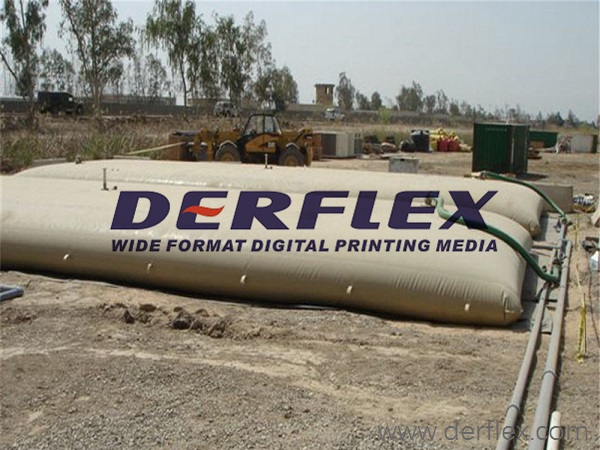
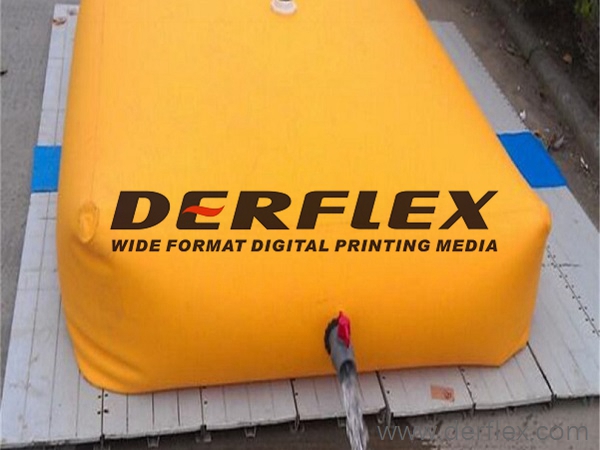
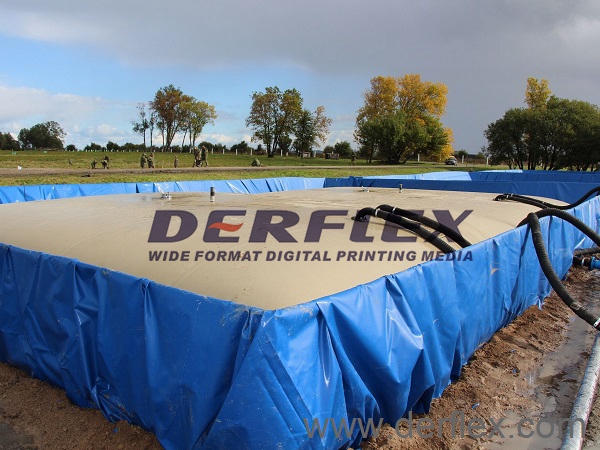
Flexible tank formats in real applications
Actual DERFLEX site images illustrate how coated-fabric tanks can change shape and installation method across pillow, field and supported containment projects.
For portability-focused models, see collapsible water storage tanks.
Match customization to the operating problem
A useful custom specification solves a real site constraint. The examples below show which details deserve attention before quotation.
| Application | Priority Custom Inputs | Recommended Design Focus | Questions to Resolve |
|---|---|---|---|
| Construction / remote site water | Capacity, site footprint, ground condition, pump connections, relocation frequency. | Closed pillow / bladder format, protected ground interface, practical fill / drain layout. | Will the tank move between sites? How will hoses be supported? |
| Agriculture / irrigation reserve | Daily demand, refill rate, UV exposure, pump size, seasonal storage. | Portable bladder or project-specific flexible tank sized around irrigation workflow. | Is the tank seasonal? What is the maximum available field area? |
| Emergency / disaster response | Packed volume, deployment speed, connection standard, transport method, accessories. | Foldable tank with standardized fittings, clear model ID and repeatable packing. | How many people will deploy it? Which couplings are locally available? |
| Industrial process / wastewater | Exact liquid, concentration / pH, temperature, contact duration, cleaning method, secondary containment. | Liquid-compatibility review before approving PVC / TPU direction and wetted fittings. | What documentation or site controls are required? |
| Distributor / private label | Model range, target capacities, branding, color, accessories, carton / bag labels. | Standardized SKU family with approved spec and repeat-order controls. | Which 3–5 core models should launch first? |
Five custom-tank mistakes that create avoidable redesign
Most preventable problems start before fabrication, when the RFQ describes only liters and ignores the installed system.
1. Quoting by liters only
The required capacity must be paired with maximum footprint and filled-height limits.
2. Treating thickness as the whole specification
Base textile, coating, weld behavior, seam geometry and reinforcement also influence the finished tank.
3. Choosing valves after the tank
Fitting size, location, hose load and local reinforcement should be set before the production drawing is frozen.
4. Ignoring the ground surface
Sharp objects, slope, settlement and vehicle traffic can damage a flexible tank regardless of fabric quality.
5. Assuming every waterproof fabric is potable / chemical compatible
Contact suitability and required certification must be confirmed for the exact approved material and fittings.
6. Launching too many OEM variants at once
For repeat-order control, distributors often benefit from a smaller initial model family with standardized fittings and packing.
What to send for a custom tarpaulin tank quotation
A complete RFQ helps the tank format, material direction and fittings get reviewed before price comparison.
Technical inputs
- Stored water / liquid and any required contact standard
- Required usable capacity
- Maximum installation length × width × height
- Indoor / outdoor environment and temperature range
- Ground surface and groundsheet requirement
- Inlet, outlet, vent, valve, flange or coupling sizes
- Fill / drain rate and pump / hose interface
- Deployment cycle and expected relocation frequency
Commercial & OEM inputs
- Order quantity and target model range
- PVC / TPU preference, if already specified
- Color, logo, model marking and label language
- Groundsheet, repair materials and other accessories
- Individual bag / carton / pallet requirements
- Sample or prototype requirement
- Destination country / port
- Required technical or compliance documentation
Copy-and-send RFQ starter
Use this short format when contacting DERFLEX. Add a drawing if the tank must fit an unusual space.
Product: Custom tarpaulin tank / flexible water bladder
Stored liquid:
Usable capacity:
Maximum installed L × W × H:
Preferred tank style (or ask for recommendation):
PVC / TPU preference:
Minimum / maximum temperature:
Inlet size & location:
Outlet / drain size & location:
Vent / overflow requirement:
Pump / hose / coupling standard:
Indoor or outdoor:
Ground condition:
Deployment / relocation frequency:
Color / logo / labels:
Accessories:
Quantity:
Destination:
Required documentation:
Target delivery date:
Related DERFLEX tank and material resources
Use these pages when your project is better defined by heavy-duty service, very large capacity, industrial-liquid compatibility, portability or a specific coated-fabric route.
Custom Tarpaulin Tank Questions
Short answers to the questions buyers usually need resolved before they request a drawing or quotation.
Can DERFLEX make a custom-size tarpaulin tank?
Yes. Custom projects can discuss usable capacity, maximum length and width, filled-height target, tank format, PVC or TPU material direction, fitting layout, color, marking, accessories and export packing. For unusual spaces, send a drawing or the maximum installation envelope.
What information is needed to design a custom flexible water tank?
Start with the stored liquid, required usable volume, available footprint, temperature, indoor / outdoor environment, ground condition, filling and draining method, inlet / outlet / vent sizes, deployment cycle, order quantity and destination market.
What capacities are available?
Existing DERFLEX flexible-bladder references span approximately 500 to 500,000 liters. The practical capacity for a custom tank depends on geometry, filled height, material construction, site footprint, seams, fittings and operating conditions, so final dimensions should be confirmed project by project.
Can the tank be made to a fixed footprint?
It can be reviewed around a maximum available length, width and height. A fixed footprint is often more useful than specifying liters alone because it allows the tank geometry to be checked against the real installation area.
Can inlet and outlet positions be customized?
Yes. Connection size, valve type, flange or coupling direction and fitting location can be discussed. Provide the pump / hose standard and intended flow arrangement so reinforcement and service access can be reviewed before production.
Should I choose PVC or TPU?
PVC coated polyester is widely used for flexible tank fabrication and can suit many general water-storage and project applications. TPU can be reviewed for selected programs requiring a different flexibility, folding or contact-performance route. The exact liquid, temperature, service cycle, welding process and required compliance documents should guide the decision.
Can a custom tarpaulin tank store drinking water or chemicals?
Only when the exact coated fabric, fittings and finished-tank construction are approved for the intended contact condition and required destination-market standard. Do not assume that a waterproof PVC or TPU tank is automatically suitable for potable water, fuel, solvents or chemicals.
Does DERFLEX support OEM and private-label tank programs?
OEM projects can discuss model capacities, dimensions, PVC or TPU direction, fittings, color, logo, labels, accessories and export packing. For repeat-order programs, an approved drawing / sample and fixed model specification can help control consistency.
Send the installation limits before asking for a generic tank price
Tell DERFLEX the liquid, usable capacity, maximum footprint, connections, operating environment, quantity and destination. The project can then be reviewed as a complete tank system—material, geometry, seams, fittings, reinforcement, accessories and packing.
Include a sketch or drawing for unusual footprints or equipment-integrated installations.