News
Company News

PVC vs PE Tarp After Months Outdoors: Aging & Durability Guide | DERFLEX

Update:2026/9/15 16:12:07 Views:
Outdoor Tarp Aging & Field Inspection Guide

PVC vs PE Tarp After Months Outdoors: What Changes?

PVC and PE tarps can both look waterproof on day one. After months of sun, heat, rain, wind movement, folding and tie-down stress, the meaningful difference is how quickly each material loses flexibility, surface integrity and structural margin.

Quick answer: standard or light-duty PE tarps are more likely to show fading, stiffness, fold-line cracking, eyelet stress and UV embrittlement sooner under hard outdoor exposure. UV-stabilized PVC-coated polyester normally retains a stronger load-bearing structure and fabrication margin for longer, but it can still chalk, stiffen, abrade, crack or lose coating performance if the formulation, fit or reinforcement is not matched to the job.
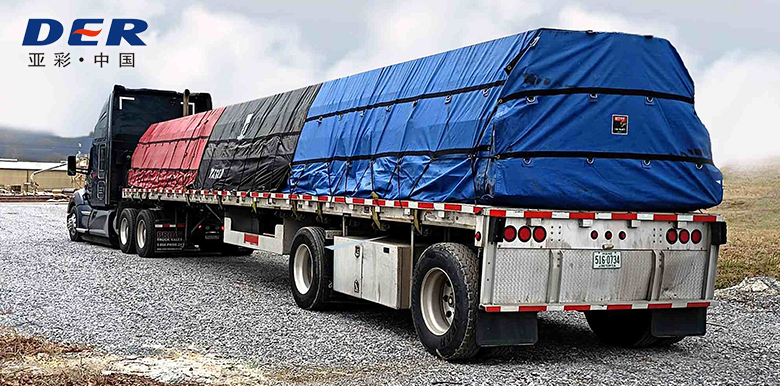
Heavy duty truck tarps exposed to outdoor sun wind and road weather
Months outdoors do not age every tarp in the same way. UV level, wind flap, abrasion, tension, drainage, formulation and reinforcement determine which failure appears first.
60-Second Answer

After months outdoors, the first warning signs are usually local—not total failure.

A tarp rarely changes from “good” to “failed” all at once. Aging becomes visible at folds, corners, contact points, seams, hems and grommets before the entire sheet stops working.

PE: flexibility can drop first Sun and heat can accelerate oxidation. A lower-grade PE tarp may become stiffer, noisier and less forgiving at creases before it obviously leaks.
PVC: surface change may appear first Outdoor PVC can fade, chalk or show local wear while the polyester reinforcement still carries load. Surface appearance alone does not define remaining strength.
Edges often reveal the problem Grommet elongation, corner distortion, hem tearing and seam stress expose a mismatch between material, reinforcement and the real load path.
Wind can age a tarp faster than rain Repeated flapping creates flex fatigue and abrasion. A heavier tarp can still fail early if loose spans keep snapping against cargo or structure.
This page is a diagnostic and procurement guide, not a guaranteed service-life chart. Two covers exposed for the same number of months can age very differently because climate, UV intensity, orientation, color, motion, contact points, installation and material grade are different.
Material Aging Mechanism

Why PVC and PE look different after the same outdoor season

The difference begins with structure. “PVC tarp” and “PE tarp” are broad material families, so the exact behavior still depends on grade, stabilization, weave or scrim, coating, reinforcement and fabrication.

PE tarp: light structure, economical protection, lower aging margin in basic grades

PE tarps are commonly built from woven polyethylene tape with polyethylene film or lamination. Their low mass makes them easy to handle, but UV, heat and oxygen can gradually change the polymer. In exposed service, the practical signs can include fading, surface dryness, increasing stiffness, crease cracking, puncture growth and stress around reinforced eyelets.

UV-treated heavy PE grades can perform far better than economy sheets, so a buyer should never compare “PE” as one universal product. Confirm weave, finished weight or thickness, UV treatment, edge construction and the intended replacement cycle.

Lightweight handling Lower first cost Grade-sensitive UV life
PVC-coated polyester: stronger reinforcement and more fabrication margin

PVC tarps normally use a polyester textile reinforcement with PVC coating or lamination. The textile carries mechanical load while the PVC system contributes waterproofing, surface protection, cleanability and weldability. Outdoor aging can still cause fading, chalking, stiffening, local cracking or coating fatigue, especially where heat, chemicals, flexing and abrasion combine.

The important difference is that a properly specified PVC-coated polyester cover can retain more structural margin under repeated tension and handling, particularly when the seams, hems, corners and attachment system are engineered with the fabric rather than added as an afterthought.

Polyester reinforcement Weldable fabrication Reusable industrial direction
Outdoor Inspection Timeline

Use 1, 3, 6 and 12 months as inspection checkpoints—not as failure promises.

The goal is to catch early material or fabrication changes before a local defect becomes a leak, tear or emergency replacement.

Around 1 Month

Establish the baseline

  • Photograph color, gloss and surface texture.
  • Record tension, sag and drainage geometry.
  • Mark sharp contact points and wear zones.
  • Check whether grommets are pulling off-axis.
Around 3 Months

Look for early weathering

  • Compare flexibility with an unexposed control sample if available.
  • Inspect creases for whitening, micro-cracking or stiffness.
  • Check hems and eyelets for elongation.
  • Inspect high spots for UV fading and low spots for water pooling.
Around 6 Months

Check retained function

  • Flex corners and repeated fold lines gently.
  • Inspect seams and welded joints for edge lift or leakage.
  • Check abrasion points for exposed reinforcement.
  • Compare attachment-zone damage across the whole perimeter.
Around 12 Months

Decide repair, redesign or replace

  • Separate cosmetic fading from structural change.
  • Look for widespread brittleness or repeated crack initiation.
  • Review whether wind, water or abrasion—not material age—caused the main damage.
  • Use the findings to update the next purchase specification.
Side-by-Side Outdoor Change Map

PVC vs PE tarp after months outdoors: what a buyer may notice first

This table compares typical field symptoms. It does not mean every PE tarp will fail early or every PVC tarp will age slowly.

Inspection Point PE / Poly Tarp PVC / Vinyl Coated Polyester Buyer Interpretation
Color & appearance Fading can become noticeable, especially in economy grades with limited stabilization. Fading, gloss change or chalking can appear depending on pigment, top finish and climate. Color change is an aging signal, but not proof of waterproof or structural failure by itself.
Flexibility Low-grade material may become stiffer or more brittle under strong UV and heat. Normally retains a stronger flex margin when correctly formulated, but can stiffen under prolonged weathering or cold. Compare exposed material with an approved control sample, especially at folds and corners.
Fold lines Repeated creases can become crack-initiation points as the material loses ductility. Repeated fold lines can wear or crack, but reinforcement and coating thickness can delay propagation. Daily folding changes the duty cycle from static weathering to fatigue loading.
Grommets & edges Reinforced eyelets may elongate or pull through if edge design is light for the wind load. Webbing, welded hems, D-rings and reinforced patches provide more design options for higher loads. Attachment failure often indicates a load-path problem, not only a sheet-material problem.
Abrasion Thin laminated surfaces can wear through faster on sharp or rough contact points. Usually better suited to repeated rubbing, but sharp steel, concrete or cargo can still cut through. Add padding or sacrificial wear patches where the tarp repeatedly contacts hard edges.
Waterproofing Can remain waterproof while intact; leaks often begin where puncture, eyelet or seam damage develops. Continuous coating plus welded fabrication can support stronger long-term waterproof cover systems. Inspect seams, penetrations, ponding and abrasion zones before blaming the center sheet.
Repairability Patch options exist, but repeated brittle cracking can make local repair less economical. Compatible patches and welded repairs can be practical when the surrounding coated fabric remains sound. Repair makes sense only when the remaining material still has enough flexibility and strength.
Field Diagnosis

Seven checks that tell you more than “the tarp looks old”

A useful inspection should separate cosmetic aging from loss of protection, strength or fit.

1. Surface touch Is the exposed face still flexible, or has it become unusually dry, hard, tacky or powdery?
2. Fold-line flex Gently flex a repeated crease. Whitening, crack opening or brittle response is more important than color fade alone.
3. Edge pull Look for elongated grommet holes, torn hems, distorted corners or webbing separating from the tarp body.
4. Contact wear Check every steel edge, timber corner, bow, rail and hard cargo point for scuffing or exposed reinforcement.
5. Water path Verify that rain runs off. Ponding and trapped water can overload even a strong tarp and distort attachment loads.
6. Seam and joint check Inspect welded or sewn seams for lift, leakage, stitch damage or coating stress alongside the joint.
7. Motion check Watch the cover in wind. Chronic flapping means the tarp is experiencing fatigue and abrasion on every gust.
Record the condition Photograph the same points at each inspection so the next RFQ is based on evidence instead of memory.
Stop-use trigger Widespread cracking, exposed reinforcement, repeated seam leakage or multiple failing attachment zones usually justify replacement or redesign.
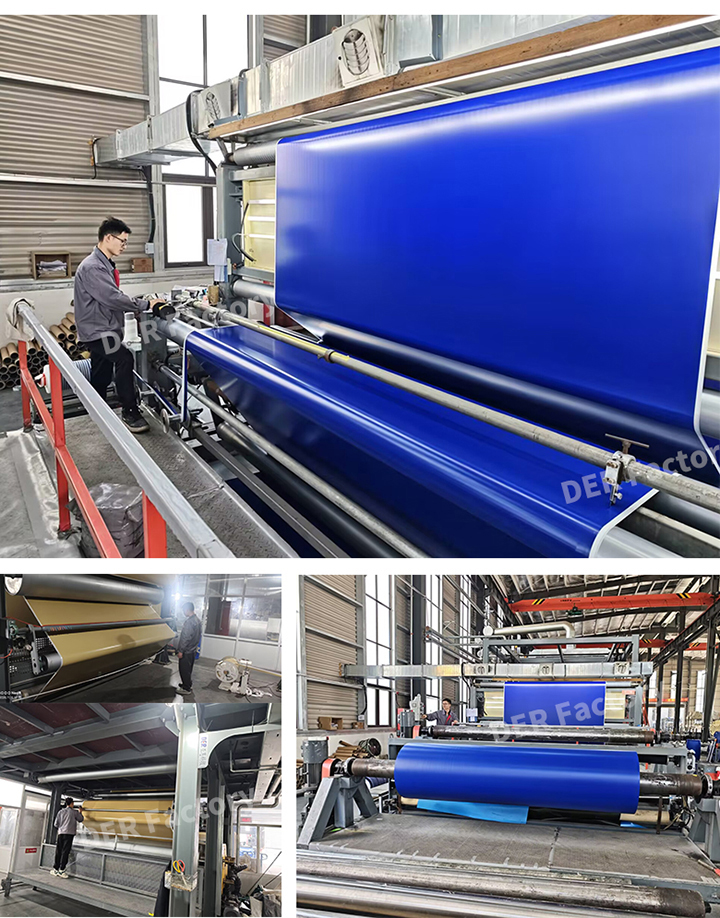
DERFLEX PVC coated fabric production for outdoor tarp material
Manufacturing Matters

Outdoor life is engineered before the tarp reaches the job site.

A long-life tarp is not created by GSM alone. Base-fabric construction, coating or lamination consistency, UV direction, surface finish, seam method and reinforcement design all affect how quickly a finished cover changes outdoors.

DERFLEX publishes PVC tarp directions in the 450–900 gsm range with custom structures available. The final construction should be matched to wind, handling, abrasion, support geometry and target service interval rather than selected from weight alone.

For a broad material comparison before specifying outdoor aging requirements, review the PVC vs PE tarpaulin selection guide.

Buyer Decision

Choose the material by failure cost and outdoor duty—not by first price alone.

The best tarp is the one whose aging pattern, replacement cycle and fabrication suit the real job.

PE is often the practical direction when…

  • The cover is temporary or seasonal.
  • Low handling weight is important.
  • Replacement is easy and does not create major downtime.
  • The load has few sharp or abrasive contact points.
  • Wind exposure is controlled and the tarp is tensioned correctly.
  • The buyer has confirmed UV treatment for the expected exposure window.

PVC-coated polyester is often the stronger direction when…

  • The tarp stays outdoors continuously or is reused over many cycles.
  • Truck, trailer, industrial, equipment or construction duty creates mechanical stress.
  • Welding, reinforced hems, D-rings, webbing or fitted fabrication are required.
  • Failure can damage high-value cargo or interrupt operations.
  • The cover will be cleaned, folded, tensioned and handled repeatedly.
  • A stable approved construction is needed for repeat OEM or B2B supply.
Need a separate service-life planning reference? DERFLEX's heavy-duty tarp outdoor lifespan guide explains why the same material can last very different amounts of time under managed, continuous, dynamic or severe exposure.
Common Misdiagnosis

Do not replace the tarp for the wrong reason.

Some visible changes are cosmetic; some hidden changes are structural. The procurement decision improves when you identify the actual failure mechanism.

Faded does not always mean failed.

A cover can lose color or gloss and still remain serviceable. Inspect flexibility, seam condition, edge strength and waterproof function before replacing solely for appearance.

Heavier does not always mean longer life.

Extra mass can help wear resistance, but a heavy tarp with weak UV stabilization, poor reinforcement or chronic flapping can still age quickly.

Grommet failure is not only a material problem.

Off-axis tension, too-wide spacing, loose fit and insufficient edge reinforcement can tear a strong sheet at the perimeter.

Leakage may begin with geometry.

Standing water, low spots and unsupported spans add load and stretch the cover. Correct slope and support before increasing tension at one attachment point.

Image Pack

Material and application images for procurement context

These DERFLEX images show why appearance alone cannot reveal construction, coating, weight, application stress or outdoor duty cycle.

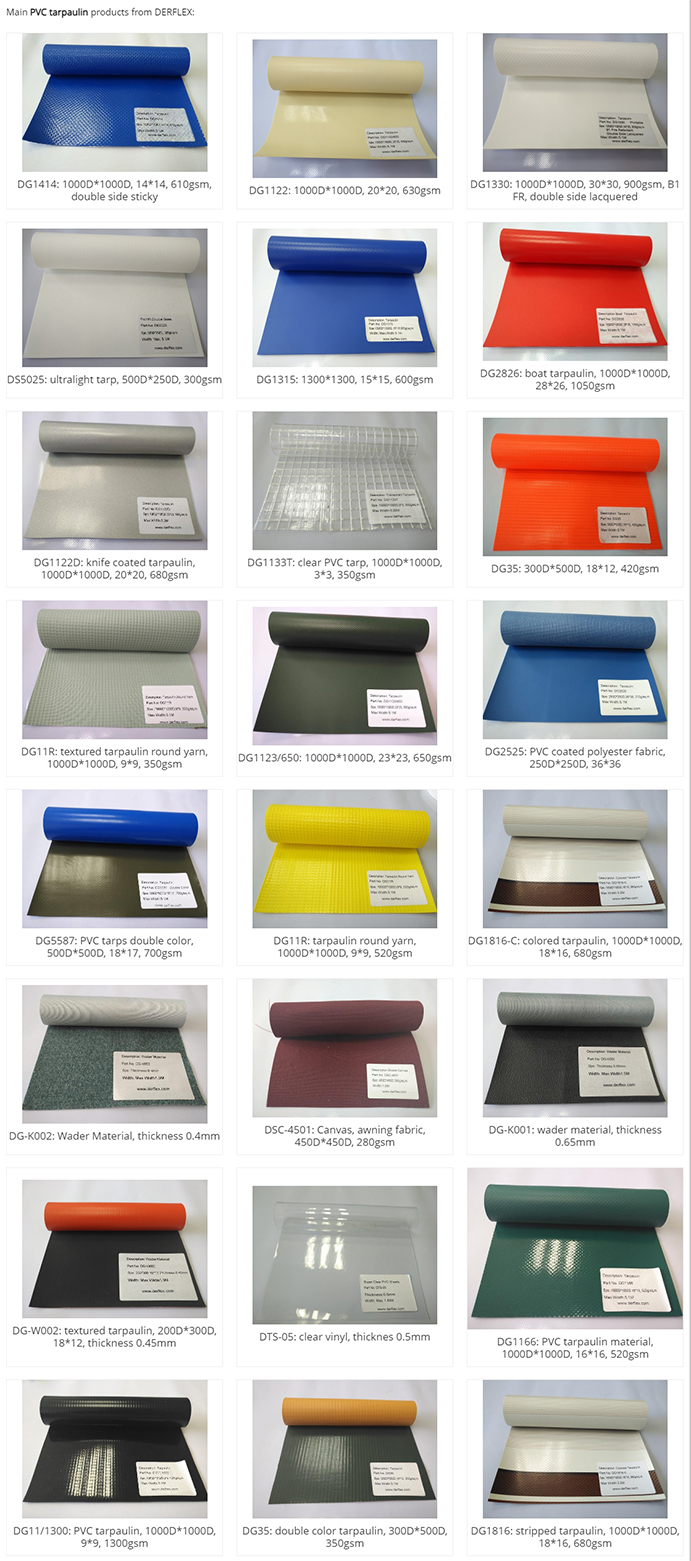
DERFLEX PVC tarpaulin sample board with different fabric weights colors and constructions
PVC tarpaulin sample board: products that look similar in a small photo can use different yarn structures, coatings, surfaces and weights. Approve the exact construction for repeat outdoor programs.
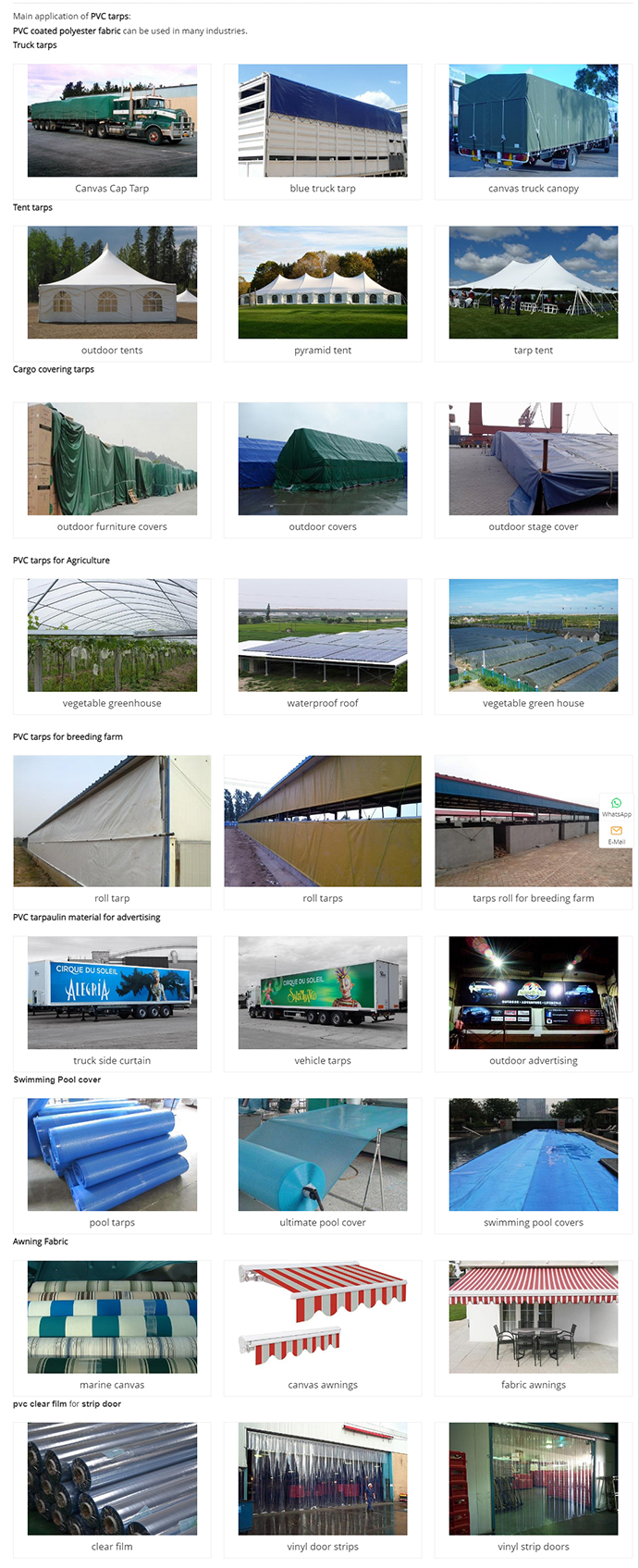
DERFLEX PVC tarpaulin applications for trucks tents agriculture storage and industrial outdoor covers
Application overview: truck, tent, agriculture, storage and industrial covers do not experience the same UV, wind, abrasion, handling or water-loading cycle.
Procurement Checklist

Ask for the conditions that control outdoor aging—not just GSM.

A useful RFQ should let the supplier understand how the tarp will actually age, move and fail.

Send DERFLEX these details

For a more accurate material and fabrication recommendation, include:

  • Application: truck, equipment, stockpile, agriculture, construction, storage or other use.
  • Exposure: continuous 24/7, seasonal, intermittent or stored between uses.
  • Climate: high UV, heat, cold, rain, snow, coastal salt or chemical contact.
  • Finished dimensions, support shape, side drops and overhang.
  • Movement: static, daily folding, rolling, vehicle vibration or transport speed.
  • Contact points: sharp steel, timber, concrete, rough cargo or ground contact.
  • Attachment map: grommets, D-rings, straps, webbing, rope edge and anchor spacing.
  • Target material/GSM if already specified, or request an application-based recommendation.
  • Quantity, branding, packaging, destination and any required test method.
Related Questions

Questions buyers ask after a tarp has been outside for months

Direct answers for inspection, replacement and specification decisions.

Does PE tarp become brittle faster than PVC outdoors?
Often, especially for economy PE grades under strong sun and heat. UV and oxidation can reduce ductility, making repeated folds and creases more vulnerable. Heavy UV-treated PE can perform much better, so compare the actual grade rather than the material name alone.
What is the first visible sign of UV damage on a tarp?
Fading, gloss change, chalking or surface dryness may appear first, but the more important check is whether flexibility and strength around folds, edges, seams and attachment points are also changing.
Can a faded tarp still be waterproof?
Yes. Color loss does not automatically mean the water barrier has failed. Inspect punctures, seams, welded joints, eyelets, abrasion zones and coating cracks before deciding that the entire tarp has lost waterproof function.
Why do tarps tear around grommets after several months?
Outdoor aging can reduce material margin, but grommet tearing is often accelerated by loose fit, uneven tension, wind flap, wide attachment spacing or insufficient edge reinforcement. The load path should be reviewed together with the sheet material.
Is PVC tarp always better for long-term outdoor use?
No material wins every application. PVC-coated polyester is commonly preferred when the cover needs repeated use, welding, reinforcement and higher mechanical durability. PE may still be the practical choice for temporary or seasonal programs where low weight and replacement cost are priorities.
Should I replace a tarp after one year outdoors?
Age alone is not enough. Replace or redesign when cracking is widespread, reinforcement is exposed, seams repeatedly leak, attachment zones are failing, or the cover can no longer maintain reliable fit and water shedding. A one-year tarp that remains flexible and structurally sound may still be serviceab, le.
What should I send a supplier if my current tarp failed too early?
Send photos of the failure zones, application, dimensions, months in service, climate, handling frequency, contact points, attachment layout, current material or GSM if known, and the business consequence of failure. This helps the supplier recommend a different material, reinforcement or installation direction instead of simply increasing thickness.

Specify the next tarp from what the old tarp actually taught you.

Share the outdoor exposure, failure photos, finished dimensions, attachment map, handling cycle and target service interval. DERFLEX can discuss a PVC-coated polyester construction, reinforcement layout and fabrication direction for sampling and repeat supply.

DERFLEX technical comparison guide · Updated 15 September 2026 · Outdoor aging descriptions are application-dependent and are not product warranties.
Consulting Services
+86-021-54361792 / 54361798
Email
sales@derflex.com