


 Technical coated textiles
OEM fabric supply
Sewing vs Welding PVC Coated Fabric
Should you sew PVC-coated fabric, join it with hot air or use high-frequency (HF/RF) welding? The right process depends on whether the seam must transfer load, stop water, accept webbing, follow a curve or run efficiently on your production line. This guide compares the joining principles, expected trade-offs, labor and rework implications, then outlines a practical test plan for fabricators. DERFLEX supplies coated textile materials for OEM converters; material choice and seam performance must be approved together using the actual machinery and fabric construction.
Process comparison · Hot air · High frequency / radio frequency · Industrial sewing
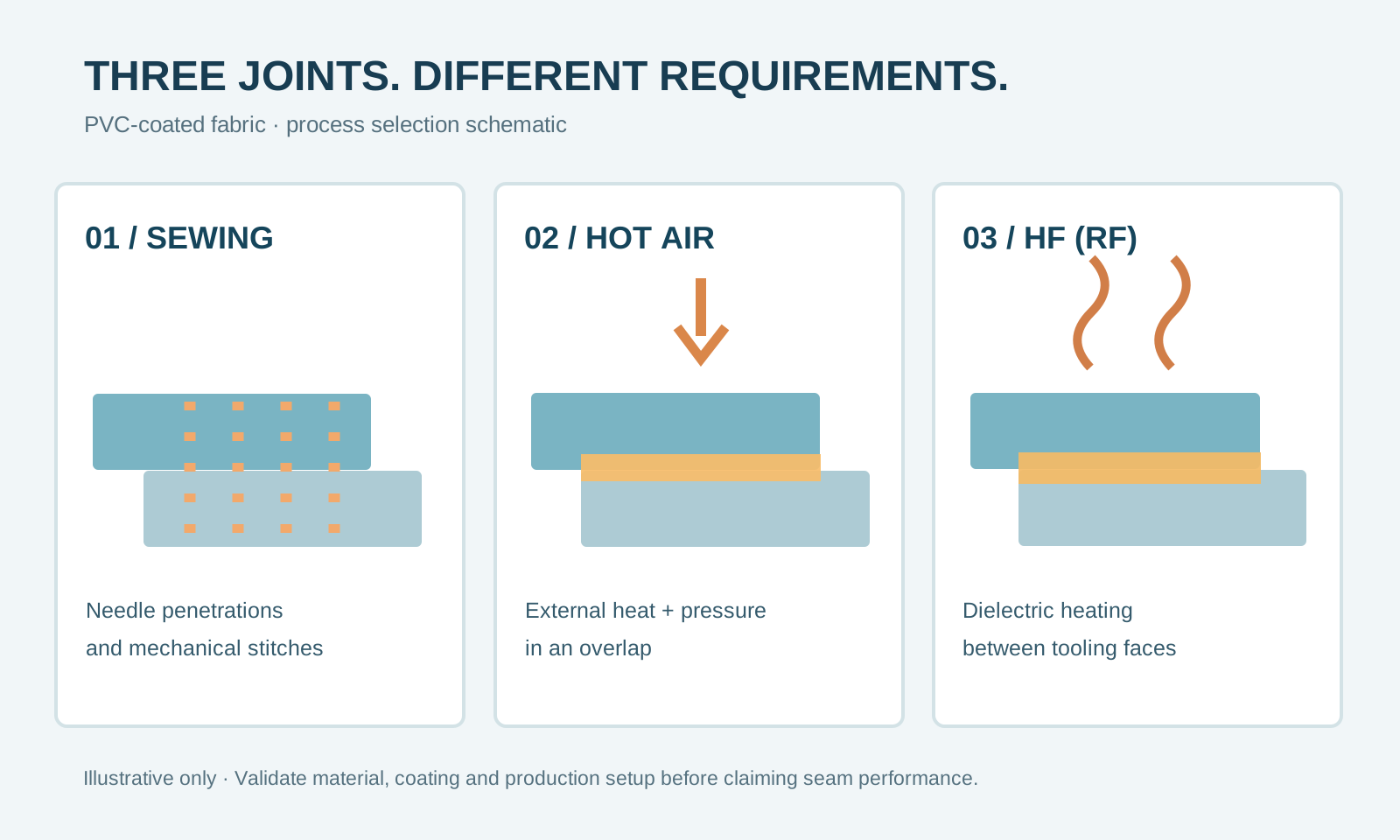
Sewing mechanically holds PVC-coated fabric layers with thread and is useful for shaped edges, webbing and mixed-material attachments, but needle holes are potential water-entry points. Hot-air welding softens compatible thermoplastic coatings using external heat and pressure, often suited to continuous panel joins. HF/RF welding heats suitable polar thermoplastic layers using an electromagnetic field and tooling, often useful for repeated shaped or sealed joints. None is automatically the strongest, fastest or waterproof in every fabric: coating formula, top finish, geometry, settings and test method determine the result.
What happens inside each PVC fabric seam?
The same coated polyester roll can behave differently with stitches and welding, and even two similar-looking PVC grades may weld differently. Start with the way the seam actually transfers force and seals the joint.
Industrial sewing
Needles carry thread through one or more textile layers. Thread and seam geometry lock the panels together; the fabric coating is pierced. Sewing handles many shapes and can attach webbing, zips or non-weldable components. Needle size, thread chemistry, stitch density, feed, edge distance and reinforcement affect strength and perforation damage.
Best starting question: Does the joint mainly carry load or attach a component, and can the design tolerate or subsequently seal needle holes?
Hot-air welding
A stream of hot air softens contacting thermoplastic surfaces. Controlled roller pressure then consolidates an overlap as the material cools. It often suits long PVC panel seams, hems or reinforcement tapes with the right setup. The weld zone depends on nozzle, air flow, temperature, travel speed, pressure, overlap and cleanliness.
Best starting question: Can the current coated faces fuse reliably at the converter's practical seam width and line speed?
HF / RF welding
High-frequency radio energy heats suitable polar thermoplastic layers between shaped electrodes. Tooling can produce repeated patterns, defined edges and some more complex sealed details. PVC is often a candidate, but coating distribution, formulation, thickness and surface finishing still affect dielectric heating, tooling and finished weld quality.
Best starting question: Is this exact construction RF-compatible, and does repeat volume justify suitable electrodes and setup?
Seam performance, speed, labor and rework—side by side
The values below are qualitative production considerations, not universal rankings. Output per hour or seam force should only be compared after the same material, geometry and acceptance conditions are defined.
| Decision factor | Industrial sewing | Hot-air welding | HF / RF welding |
|---|---|---|---|
| How joint forms | Needle and thread mechanically secure layers. | Softened compatible PVC faces bond under pressure. | Dielectric heating and electrode pressure join compatible faces. |
| Seam performance | Depends on stitch geometry, fabric tear, thread and reinforcement; creates perforations. | Can form a continuous water barrier when properly fused; weld strength requires testing. | Can form shaped sealed joints on compatible materials; tooling and weld strength require testing. |
| Speed / throughput | Flexible for detailed or changing shapes; operator handling can dominate. | Efficient on long repeatable overlaps; line speed depends on thickness and settings. | Good repeatability for defined tool shapes; positioning and cycle time can dominate. |
| Labor and tooling | Machine operator and skill in feeding, tension, edge handling. | Setup, path guiding, pressure control and process monitoring. | Electrode/tool design, alignment, press operation and material compatibility checks. |
| Rework / repair | Thread can often be removed, but needle holes remain; reinforcement may be needed. | Repair may require cleaning, stripping or patch welding; overheating can harm coating. | Patch or repeated weld possible if access and geometry permit; tooling limits repairs. |
| Typical fit | Webbing, zips, fitted covers, mixed textiles, attachment details. | Long PVC tarp seams, roof panels, hems, straight reinforcement. | Repeat-shaped patches, seals, pockets and selected airtight assemblies. |
| Critical failure risks | Stitch pullout, seam slippage, tear along holes, wicking/leaks. | Cold weld, thermal damage, surface-finish interference, inconsistent pressure. | Incomplete fusion, arcing, uneven tooling pressure, incompatible layers. |
A stitched seam is not automatically weak; a welded seam is not automatically stronger or watertight. Results depend on named fabric grade, machine parameters, seam direction, sample conditioning and the selected test method.
HF vs hot-air welding: the coating surface is part of the process
When hot air is a sensible first trial
Hot air is attractive when a fabricator must join long panels or vary length frequently. It heats the joint from outside, making nozzle access, speed, air volume, roller pressure and contact cleanliness central variables. Uneven heating can leave an underfused section; excess heat can damage the coating, reinforcement or surface finish. A parameter recipe that works on one PVC fabric should not be transferred unchanged to another.
For a PVDF-finished or lacquered PVC textile, check exactly which face contacts the overlap. Some finishes can alter the weld response. A successful test may call for a different joint orientation, special preparation or an alternative grade; do not assume that every coated surface is directly weldable.
When HF/RF is worth evaluating
HF/RF equipment can make repeatable joint shapes when the fabric chemistry is compatible with dielectric heating and tooling pressure. Its production economics depend on the footprint and cycle time of the electrode, part size, handling time, setup and repeat volume. RF suitability is not determined by “PVC” written on the invoice alone. Test the exact surface and multilayer stack, including any adhesive, reinforcement or printed treatment.
Questions the machine team should answer
- Which side is PVC-coated, lacquered or treated?
- What is the proposed overlap width and number of layers?
- Where is the seam relative to warp, weft, folding or tension?
- Can machine settings be recorded and controlled by batch?
- Are the interface faces clean, dry and accessible?
- Does the finished part require peel, tensile, leakage or fatigue checks?
When sewing is the better tool—and how to manage leakage
Sewing remains valuable when components cannot be heat fused or when the design needs webbing, zippers, complex fitted corners, adjustable reinforcements or deliberate repairability. Industrial sewing can also be the lower-risk method for mixed-material assemblies whose coating and accessory chemistries do not weld together.
However, every needle penetration is a potential channel through a waterproof PVC coating. Rain-resistant construction may require an appropriate seam tape, welded cap strip, weather flap or a seam location outside standing-water paths. A waterproof base cloth does not make an unsealed stitched joint waterproof. Test any sealing treatment with the intended needle, thread, stitch geometry and folding duty.
Build a sewing trial around the failure mode
- Choose an appropriate needle point and size for the coated textile.
- Match thread weather resistance and elongation to the outdoor use.
- Prevent edge tearing through sufficient distance and local reinforcement.
- Measure appearance and fabric damage around stitch penetrations.
- Include seam slippage, pullout and leak checks where relevant.
- Confirm whether repairs or replacement panels are expected in the field.
Run the same controlled test plan before choosing the seam
A credible comparison must use the same fabric lot and represent the real product. It should not rank different seams using unrelated pull directions, specimen widths or conditioning.
- Freeze the material identity: supplier, grade, lot, base cloth, coating system, topcoat and which side is joined.
- Define the joint: overlap or stitch geometry, seam allowance, thickness stack, reinforcement and load direction.
- Record equipment: machine model, feed settings, pressure, temperature or RF conditions, tooling and operator procedure.
- Make multiple coupons: include startup, stable production and changeover samples where applicable.
- Condition specimens: state temperature, humidity, dwell and cooling time before comparison.
- Test the actual demand: seam strength, peel, water/air tightness, fatigue, fold recovery or repairability as appropriate.
- Check failure location: coating separation, thread failure, fabric tear, edge pullout or joint delamination.
- Sign off the control plan: define production sampling, retained master samples, tolerances and requalification triggers.
How to report results responsibly
Record units, warp/weft orientation, specimen width, method and conditioning. “Seam efficiency” comparisons need a clear definition of base-fabric strength and the specific loading direction. Water penetration and strength are different acceptance tests. A process that passes a flat coupon may still fail on a curved corner, thick multi-layer weld or repeatedly folded roof panel.
If performance must satisfy a particular ASTM, ISO or EN method, obtain the correct standard and corresponding report. Mentioning a standard is not evidence of passing it.
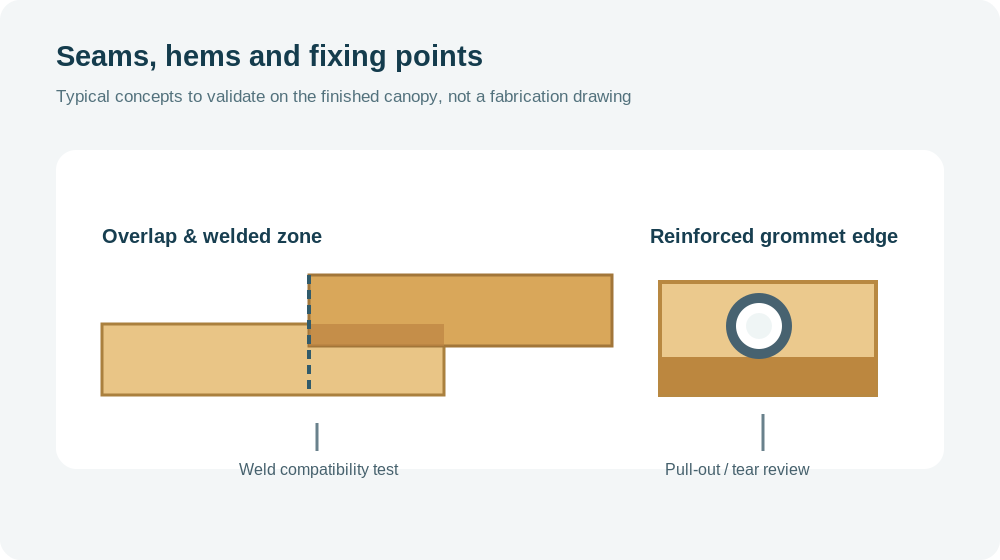
Choose by the finished product's most critical seam
| Fabricated product | Likely starting approach | Important qualification |
|---|---|---|
| Large waterproof PVC cover panel | Trial hot-air overlapping seams. | Prove water barrier and required load transfer, including cross-seam loading. |
| Fitted cover with straps and zip access | Sew attachment details; consider welded primary panels. | Protect punctures in water-sensitive locations and reinforce local loads. |
| Repeat-shaped pocket or patch | Consider HF/RF tooling if PVC stack is compatible. | Check electrode pressure, multilayer thickness and economics at volume. |
| Retractable awning or pergola panel | Trial fabric-appropriate welds and selective sewn fittings. | Fatigue-test the fold line, treated surface and guide/track edge. |
| Air-retaining or liquid barrier assembly | Evaluate a fully sealed welding method. | Pressure/leak testing of the real assembly is essential; no method guarantees a seal alone. |
Send the process constraints with your material RFQ
What a fabric converter should supply
- Final product and whether the seam must be watertight, airtight, load-bearing or easily repaired.
- Existing sewing, hot-air, hot-wedge or HF equipment model and available tool widths.
- Target coated fabric grade, GSM or thickness, coating side and surface treatment if known.
- Panel or pattern drawings, orientation, seam length, curvature and reinforcement.
- Projected quantity or annual volume and permitted processing time per part.
- Applicable performance tests, pass criteria, sample needs and destination market.
Before you release production
Check that the trial roll and future production lots use the agreed formulation and surface finish. Lock the seam process window only after approved test data. Agree who owns the finished-seam performance: the material supplier can provide material information and sample discussion, while the fabricator must validate process quality and the finished assembly.
For cost comparisons, include setup, tooling, consumables, operator handling, scrap, inspection and potential rework. Machine speed alone is not finished product throughput; a rapid seam with expensive failures may cost more than a slower controlled operation.
Frequently asked questions
Can PVC coated fabric be sewn?
Yes, many PVC-coated polyester constructions can be sewn using appropriate industrial needles, thread and reinforcement. Stitch holes can create leak paths, so consider the finished product’s water requirements.
Which is stronger: a welded seam or a sewn seam?
Neither can be ranked universally. Seam geometry, coating adhesion, thread, reinforcement, fabric direction, equipment settings and test conditions determine the result. Compare controlled coupons from the same grade.
What is the difference between HF welding and hot-air welding?
Hot air applies external thermal energy and pressure to a compatible overlap. HF/RF uses dielectric heating and electrode pressure in suitable polar thermoplastics. Their tooling, part geometry and process-control requirements differ.
Is a hot-air welded PVC fabric seam automatically waterproof?
No. Continuous fusion can form a water barrier, but cold welds, contamination, wrong overlap, topcoat incompatibility or missed corners can leak. Test the actual joint and finished assembly.
Can PVDF-coated PVC fabric be welded directly?
It depends on the specific finish, its location and the coating formulation. Confirm the weldable face, surface preparation if permitted and machine trial results for the exact fabric construction.
What details should be in a seam test report?
Record fabric grade and batch, joined face, seam type and width, sample direction, machine settings, conditioning, chosen test method, units, failure mode and acceptance decision.
Related materials and technical resources
Explore the material, application and fabrication guides relevant to your project.
Compare joining methods on your actual fabric.
Tell DERFLEX your fabric grade, sewing or welding process, seam drawing, expected output and acceptance test. Use an approved material and seam trial before specifying repeat orders.