



How Can a Buyer Verify a Tarpaulin Factory in China?
Verifying a Chinese tarpaulin factory requires more than a business card, product catalog or one impressive factory video. Buyers need to establish who the legal supplier is, where PVC tarpaulin is actually made, who controls the critical processes, and whether the material delivered can be traced to the sample and specification approved.
Use this practical verification framework before shortlisting a manufacturer, approving a private-label tarp program or committing to bulk coated-fabric rolls. It applies to importers, converters, distributors and industrial OEM teams.
What is the most reliable way to verify a tarp manufacturer?
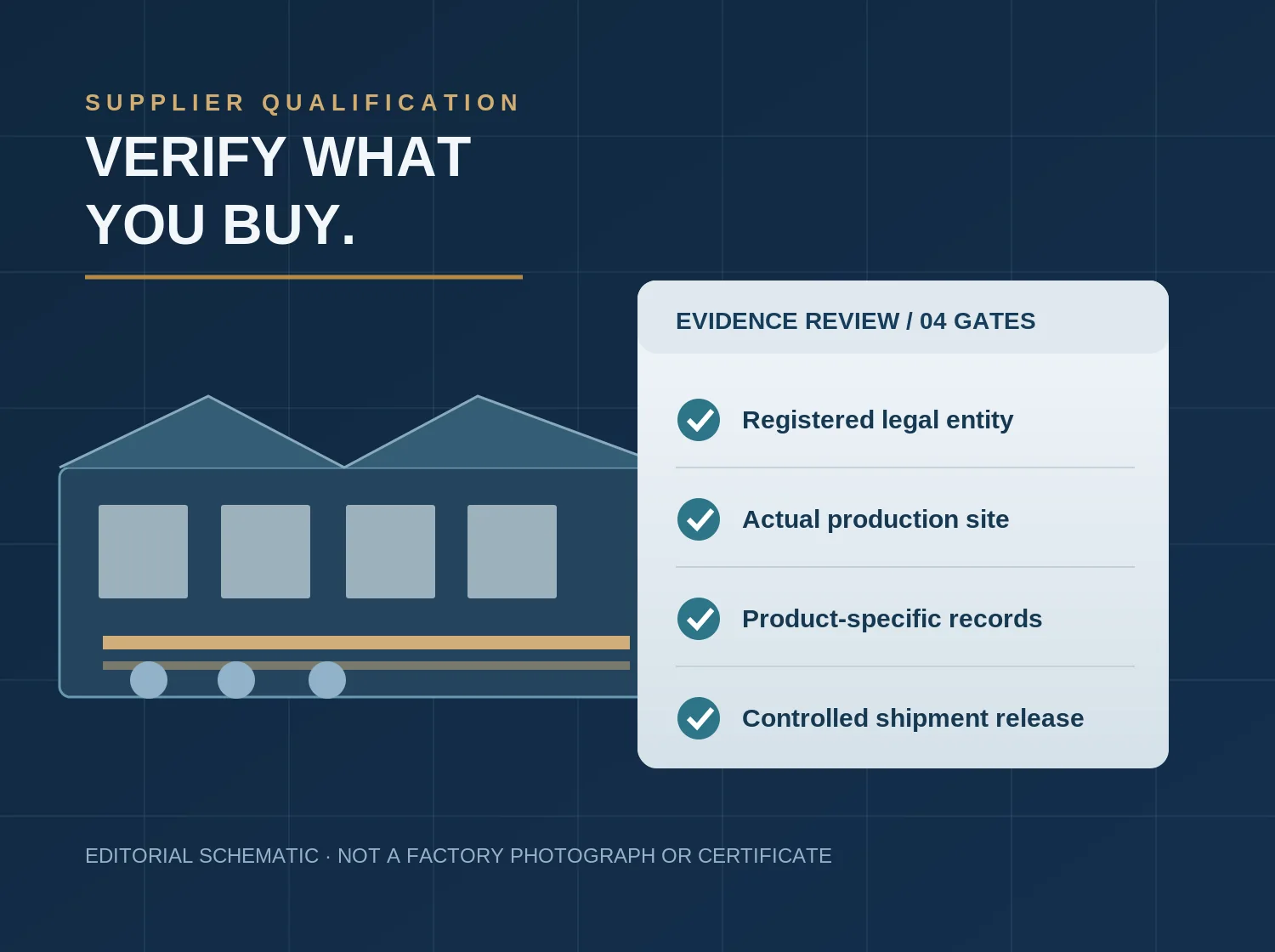
Verify the factory in four linked stages: (1) match the Chinese legal company name and unified social credit code to official registration records; (2) confirm the real production address and identify which operations are in-house or outsourced; (3) inspect product-specific samples, test reports, QC procedures and batch traceability; and (4) agree first-order inspection, change controls, payment beneficiary and shipment release. A valid license establishes legal registration—not manufacturing ownership or product conformity. Use independent verification when the order risk justifies it.
Start with the real Chinese company, not the English trade name
A branded website and a quotation are useful commercial touchpoints, but they are not substitutes for a legal-entity check. Chinese trading, manufacturing and export companies may operate under different names or through related entities. Reconcile them before purchase-order approval.
Request and compare these records
- Business license (营业执照): request a legible copy showing the Chinese registered name, unified social credit code, legal representative and registered address.
- Official registration: search the National Enterprise Credit Information Publicity System using the Chinese name or unified social credit code; review the status and available records.
- Production location: distinguish the registered office and sales office from the actual manufacturing address; ask who operates each site.
- Commercial chain: compare the name on the quotation, contract, invoice, export documents and beneficiary bank account. Seek a written relationship explanation where names differ.
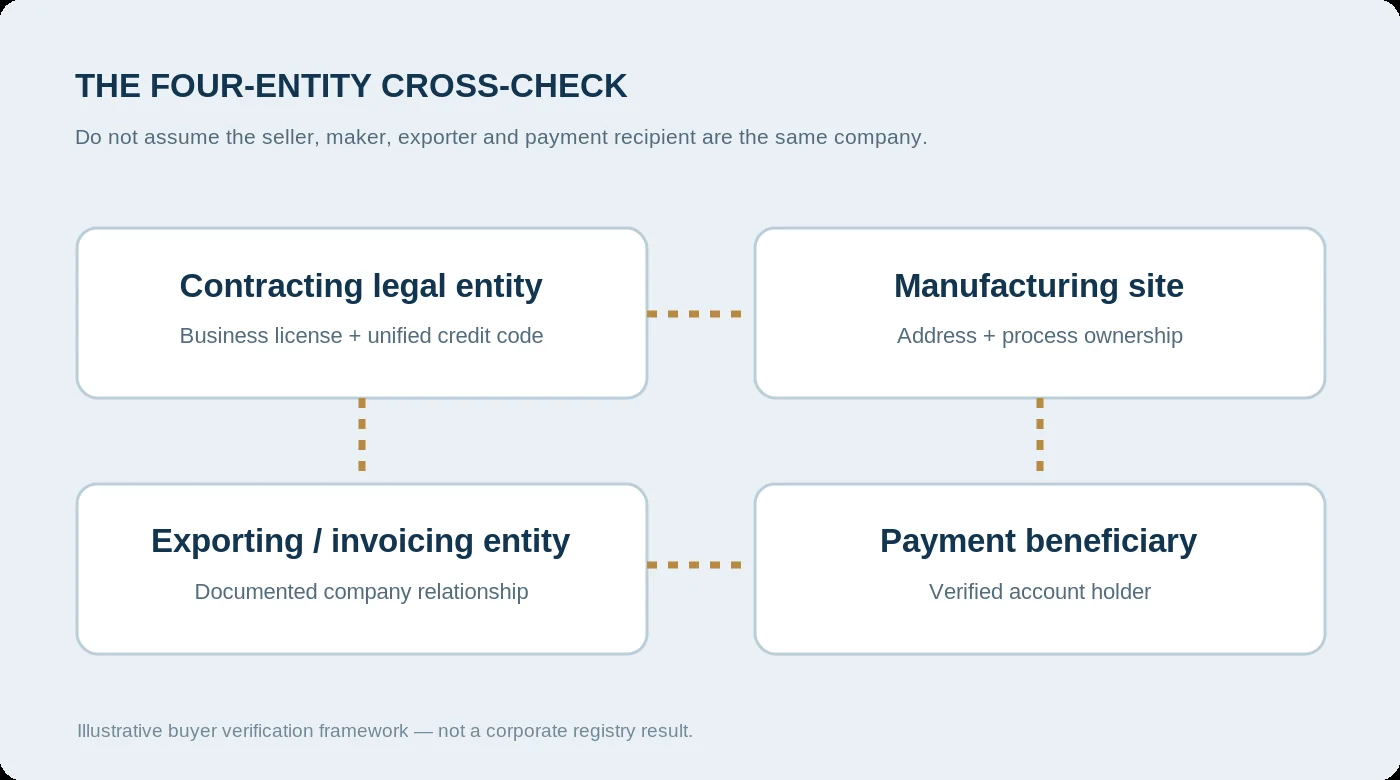
For guidance on reading the Chinese registry, see the EU IP Helpdesk company-verification resource. The official portal may require Chinese-language searching or additional access steps.
Determine who makes the PVC fabric—and who converts it into a tarp
“Factory” can describe a textile mill, coating or lamination operation, custom-cover workshop or integrated supplier. A serious buyer defines the actual scope rather than treating every manufacturing claim as equivalent.
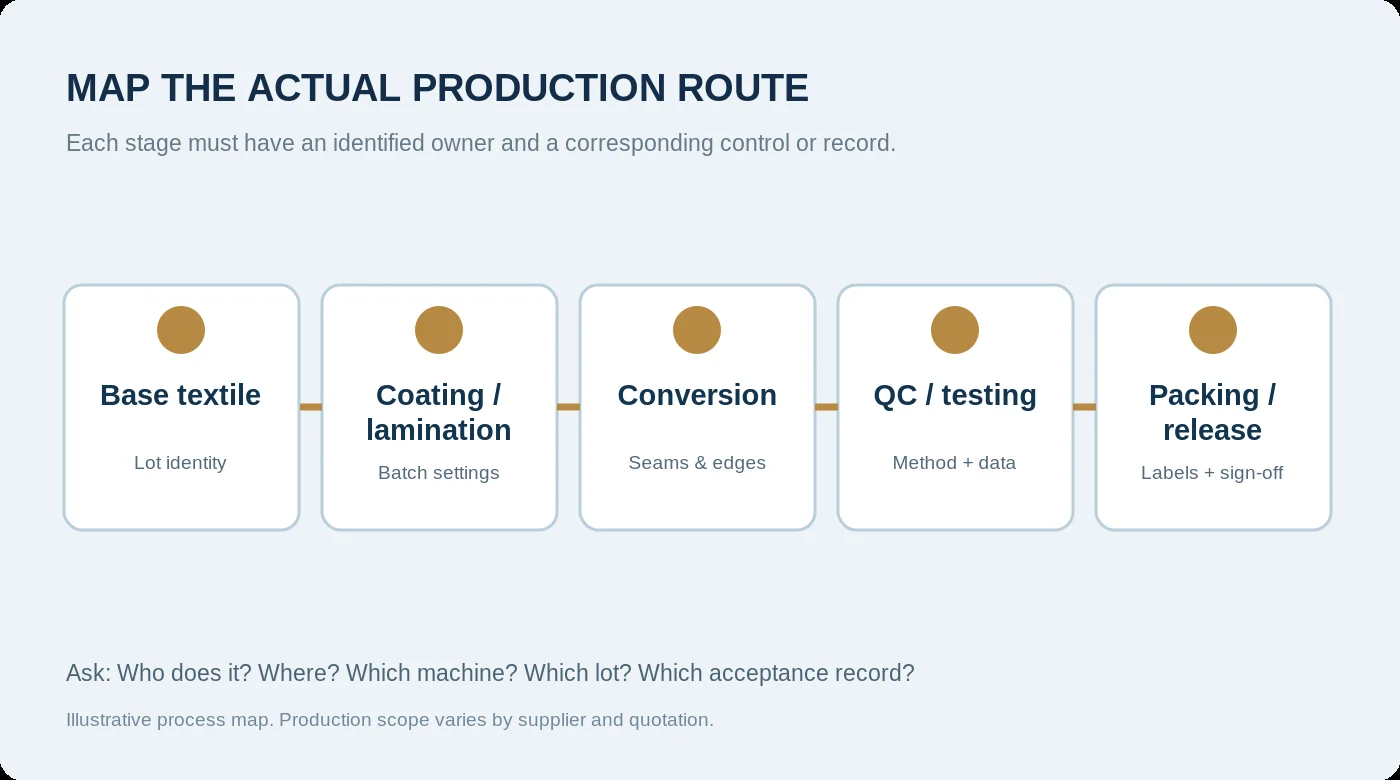
Ask the quoted supplier to identify the owner, address, equipment, inspection step and responsible person for each critical operation. Transparent subcontracting is not automatically disqualifying; unknown or unapproved subcontracting is a control risk. A coated-fabric manufacturer may be suitable for roll supply while a separate converter is responsible for welding, hems, eyelets or custom fitted cover construction.
| Manufacturing step | What to verify | Evidence to request |
|---|---|---|
| Base fabric / raw inputs | Approved reinforcement, yarn structure, coating inputs and lot identification. | Material specification, incoming labels and inspection status. |
| Coating / lamination | Actual manufacturing route, relevant machine, width and process controls. | Live equipment view, run record, process instructions and product code. |
| Slitting / winding | Usable width, length, winding condition, surface faults and roll protection. | Roll inspection report, defect record and finished roll labels. |
| Finished-tarp fabrication | Cutting, welds or sewing, edge reinforcement, grommets and packaging. | Approved drawing, first-piece review and relevant seam checks. |
| Testing / final release | Who samples, which methods apply, who approves and how holds work. | Actual QC results, instrument details, nonconformance and release records. |
For manufacturing context, compare the DERFLEX inside-factory overview with the OEM tarpaulin production and QC guide. Neither overview replaces an order-specific capability check.
How to run a useful remote factory verification
A guided live video call is more informative than a rehearsed showroom clip, provided you can select the route and ask for relevant records. For critical or higher-value programs, add an independent in-person audit.
Confirm you are at the right site
Ask the guide to begin at the site entrance or a recognizable facility point, identify the current production address and show a continuous route to relevant operations where site rules permit.
Choose an active production step
Ask the operator to show the coating or lamination line, material feed, winding or fabrication equipment used for your quoted construction, not unrelated machinery.
Challenge the inspection process
Request a live example of a roll label, current inspection sheet and an applicable measurement. Ask what happens if a sample fails an agreed requirement.
Follow an identifiable lot
Choose a finished roll or packed tarp and ask the team to retrieve its production and QC record; later cross-check the same lot in the documents supplied.
What a remote tour cannot prove on its own
A video cannot independently establish ownership, financial legitimacy, environmental or labor compliance, every machine’s available capacity, or consistent quality across future batches. Use documents and an independent site inspection when those risks are material.
Require product-specific quality evidence, not generic certificates
Start with the exact PVC tarpaulin construction offered in the quotation. A lab report for another GSM, reinforcement, coating recipe or finishing method may not establish the performance of your material.
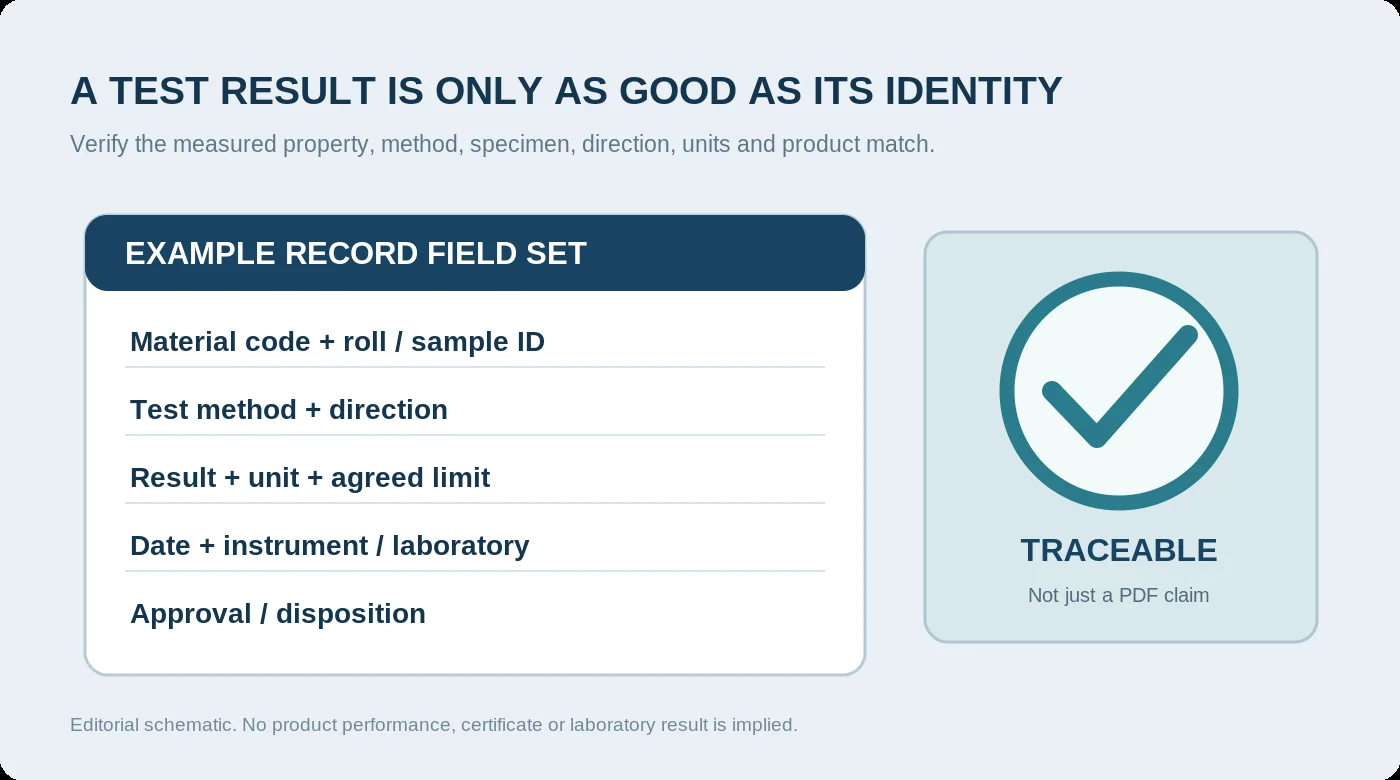
Six questions for every test document
- Does the report identify the quoted material code, specimen and batch?
- Which test method and edition were used?
- Are warp/weft direction, units and conditions recorded where relevant?
- Is there a measured result and agreed acceptance limit rather than just “pass”?
- Can the buyer identify the issuing laboratory and report authenticity?
- Would a subsequent formulation or supplier change invalidate the evidence?
Discuss the relevant properties with the PVC tarpaulin material overview and review DERFLEX’s published quality control system.
| Property / check | Why a buyer asks for it | What must be agreed |
|---|---|---|
| Mass per area (g/m², GSM) | Material identity and weight consistency for handling and costing. | Sample method, nominal mass and permitted tolerance. |
| Thickness and usable width | Conversion fit, welding clearance and roll yield. | Measurement position, width definition and tolerances. |
| Tensile and tear strength | Relevant load and damage-resistance questions. | Warp/weft, standard, specimen and actual units. |
| Coating adhesion | Layer integrity, flex and durability risks. | Method, sample condition and target acceptance. |
| Seams, hems and hardware | Finished tarp integrity beyond the fabric sheet. | Approved construction, test method and inspection points. |
| UV, cold-flex, flame or chemical behavior | Use-specific exposure or regulatory requirements. | Exact application, report scope and applicable destination rules. |
A claimed fire class or compliance standard is not evidence without a report covering the tested construction and conditions. Waterproof fabric does not automatically mean watertight finished seams or a certified complete structure.
Check the holder, site, scope, issuer and current validity
Certificates answer different questions. A management-system certification may support confidence in operating controls. A test report supports a defined property on a described sample. Neither should be represented as proof that every shipment is approved.
Management-system certificates
For ISO 9001 or similar claims, verify the certificate number, certified organization, relevant manufacturing address, listed activity, standard version, issuer and validity. Follow the certifier’s public verification channel or an applicable accredited certification database. ISO explains that it does not itself issue certificates.
Product and laboratory reports
Contact the issuing laboratory through independently obtained contact details when authenticity matters. Match the actual construction, test method, specimen reference, measured data and issuance date to your intended material. Where local Chinese certification systems apply, review the CNCA service resources and relevant issuing body's records.
Test whether a shipment can be traced back to the approved material
A batch number is useful only if it retrieves the right manufacturing and quality records. Trace one buyer-selected finished item backward to its input lot, then take one input lot forward to the finished rolls or covers it produced.
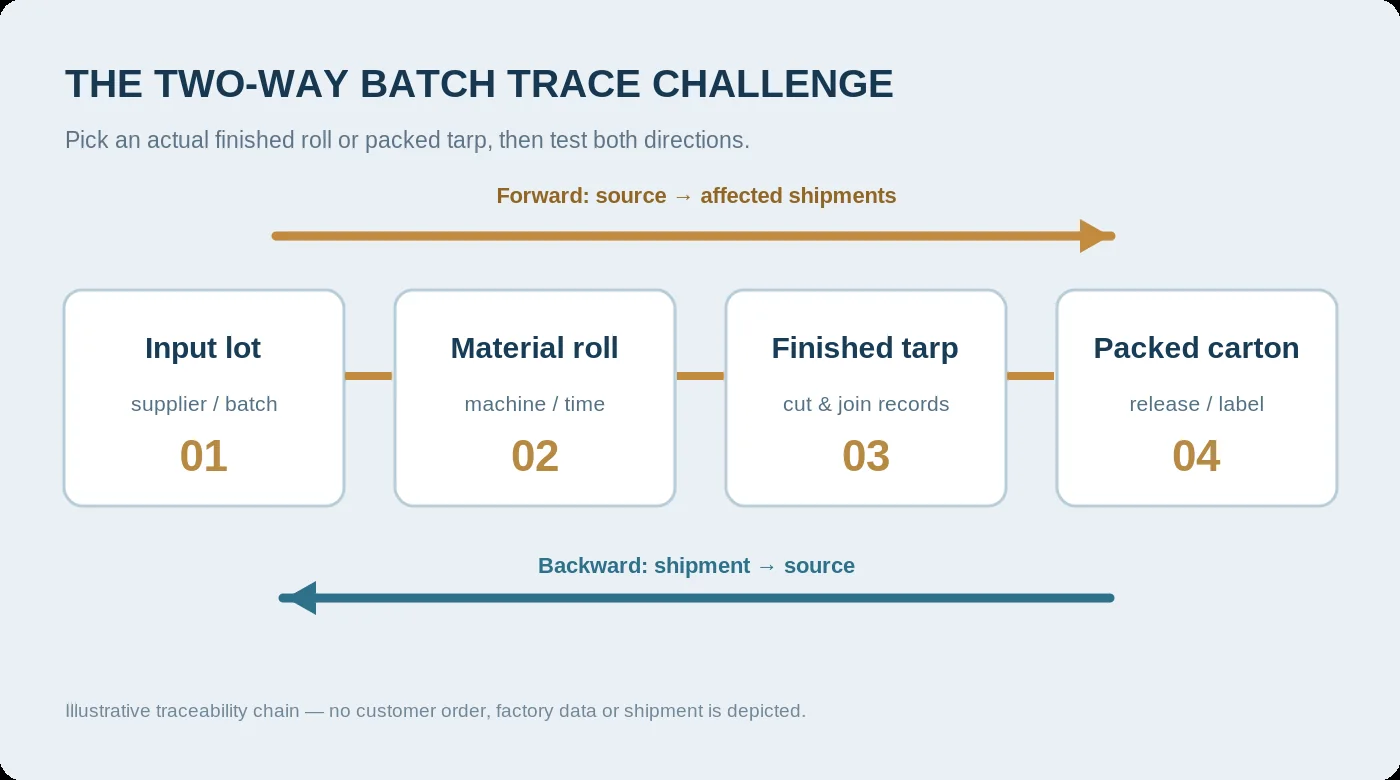
Ask for a controlled product code, specification revision, roll or carton ID, raw material trace, equipment or production date, inspection decision and shipping label. Review how quarantined or rejected goods are separated and how a nonconformity is investigated. A supplier should also explain how it prevents substitutions in coating recipe, base textile, color or subcontracted conversion after sample approval.
For a deeper audit, use the importer batch-traceability checklist or the manufacturer audit field guide. This verification page is an initial approval framework, not a substitute for their detailed on-site records review.
Approve the supplier, the sample and the shipment separately
A strong supplier selection process still needs a controlled purchase order. Treat the first bulk production as a distinct qualification stage: an approved sample alone does not ensure the finished lot meets your requirements.
| Approval gate | Minimum decision evidence | Result if missing |
|---|---|---|
| Gate A — Legal identity | Legal entity, real production site and contracting/payment chain are consistent or adequately documented. | Hold the supplier and payment approval pending independent confirmation. |
| Gate B — Manufacturing scope | Proposed material and conversion route, in-house / outsourced boundaries and accountable party are clear. | Request a qualified site/process review before committing. |
| Gate C — Product approval | Named construction, approved reference sample, specification, relevant results and acceptance criteria. | Do not release the bulk run as an approved product. |
| Gate D — Order release | Actual inspection lot, packing details, deviations and release authority linked to purchase order. | Hold shipment or obtain an agreed corrective disposition. |
Before you place the first purchase order
- Define whether you are buying fabric rolls, cut panels or finished covers; do not assume frames, installation or other systems are included.
- Approve the material construction, finish, dimensions, seams, attachments, labels, packaging and specification revision that apply to your scope.
- Agree which tests and inspection points matter, who pays for any agreed third-party checks, and how failures are handled.
- Confirm price basis, applicable trade terms, documented payment instructions, planned lead time and change authorization without relying on verbal assumptions.
- Use first-article or pilot production when fit, seam behavior, welding compatibility or repeat color matching is uncertain.
Know which mismatches require a hold—not just another email
A supplier can be qualified with a small documented process gap; serious unresolved identity or product-conformity failures demand a different decision. The examples below are buyer risk controls, not accusations against any supplier.
Different payment recipient
The requested beneficiary changes or is unrelated to the contracting entity without an independently verified explanation. Confirm through established contact channels, not the new payment email alone.
Documents do not match
License details, report holder, material code or site address conflict. Request corrected source records or verification with the issuing organization.
Factory route concealed
The supplier refuses to identify who performs coating, lamination or conversion or cannot demonstrate relevant production equipment for the item quoted.
Uncontrolled product substitution
Sample, production material or test report cannot be tied to one revision; changes can occur without buyer approval; the supplier cannot recover the production history.
An experienced independent auditor, sourcing specialist or legal adviser may be appropriate where financial, regulatory or intellectual-property exposure is significant.
Evaluate DERFLEX with the same evidence standard
DERFLEX publishes technical information about PVC tarpaulin materials, manufacturing and quality control. Buyers can use those resources for initial screening and then request records relevant to the proposed site and product. Published photographs or general company statements should not replace legal-entity checks, representative samples and order-specific inspection evidence.
A more useful factory conversation
Start by explaining whether you need roll goods for your own cutting and welding, or a supplier-managed conversion project. Ask which operations are performed for the quotation, which technical details can be documented and how the approved material will be identified in later shipments.
DERFLEX's tarp factory capability page introduces the material and fabricated-cover supply models. For comparing multiple companies on a common basis, use the tarpaulin supplier evaluation guide.
Buyer-friendly evidence request
Please identify the legal contracting entity and proposed production site; describe the process and any outsourced stages; identify the quoted material construction; and advise which relevant sample, inspection or test documents can be provided for our order.
For a repeat order, please also clarify revision control, roll labels and any pre-shipment inspection arrangements.
From factory identity to a controlled purchase decision
These DERFLEX resources support the next stages of specification, supplier comparison, manufacturing assessment and repeat-order control.
Frequently asked questions about verifying a tarpaulin factory in China
Practical answers on remote checking, manufacturing ownership, certificates, inspection and first-order documentation.
How can I verify a Chinese tarpaulin factory without traveling?
Start with the Chinese business license and official registration record. Reconcile the seller, production site and payment entity; request a live guided factory tour; examine product-specific QC and batch records; and use an independent local auditor for higher-risk orders. Remote checks support screening but do not fully replace an on-site audit.
Is a trading company always a bad choice for tarpaulin sourcing?
No. A trading company can manage legitimate sourcing, inspection and export work. The important point is disclosure: identify the material producer, finished-tarp fabricator, technical approver and party responsible for defects and changes. Do not assume that a sales company owns the plant.
How do I verify an ISO 9001 certificate from a tarpaulin supplier?
Match the certificate holder, manufacturing location, scope, standard edition and validity dates to the proposed site. Verify status with the issuing certification body or an applicable accreditation-linked registry. ISO itself does not issue ISO 9001 certificates, and a management-system certificate does not certify the quality of a specific tarp batch.
Which tests matter most for PVC tarpaulin rolls?
Agree tests based on end use. Typical candidates include mass per unit area, thickness, usable width, tensile and tear properties, coating adhesion, appearance and relevant water resistance. For outdoor, cold, fire-related or chemical exposures, request the appropriate additional evidence, with actual test method, conditions, sample identity and acceptance limit.
Does a factory visit prove that bulk production will meet my sample?
No. A visit establishes only part of the capability picture. Approve a representative sample and written specification, identify the production route, agree the inspection plan and change-control rules, and verify the shipped lot before release. Manufacturing capability, sample approval and shipment acceptance are separate decisions.
What is the biggest red flag before paying a Chinese supplier?
Treat unexplained legal-entity or bank-beneficiary changes, fabricated documents, refusal to identify the production site, concealment of critical subcontracting and inability to trace the quoted product as serious hold points. Resolve inconsistencies through independently verified contact, s before transferring funds.
What documents should I send DERFLEX for a comparable quotation?
Share whether you need PVC tarpaulin rolls, cut panels or fabricated covers; the application and exposure; sizes or drawings; material construction or reference sample; quantity, color and packaging; required tests; destination; and any inspection or repeat-order controls. Supply scope and documents should be confirmed for the specific quote.
Bring your requirement. Ask for evidence that matches it.
For PVC tarpaulin rolls, fabricated covers or an OEM sourcing program, send DERFLEX the intended application, supply format, construction, quantity, destination and any required inspection evidence. Technical and commercial scope can then be discussed against one buying brief.
Helpful information to include
- Fabric rolls, cut panels or finished tarps
- Use conditions and example / drawing
- Material code or reference sample
- Dimensions, quantity and expected repeat orders
- Required tests and destination-market criteria
- Packing, labeling and delivery destination
- Sample approval and inspection requirements