Flat Smoke Tarp
A reinforced rectangular cover for straightforward front-face protection. It is easy to fold, stock and combine with other flatbed tarps across mixed freight programs.



 Custom flatbed cargo protection
Custom flat and fitted nose tarps developed to shield the leading face of a load from exhaust soot, road spray, bugs and wind-driven debris during transport.
DERFLEX supports smoke tarp distributors, tarp fabricators, fleets and private-label buyers with PVC coated polyester material, made-to-order dimensions, reinforced tie-down zones and repeatable OEM specifications.
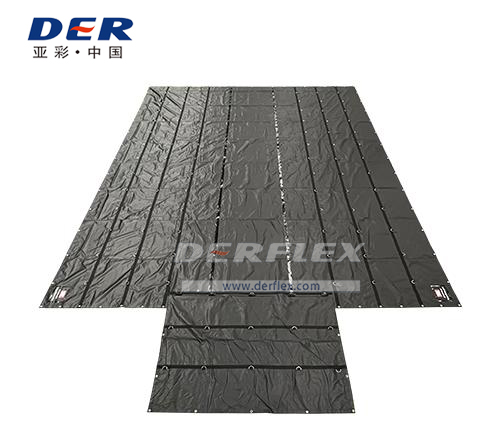 DERFLEX product reference
The visible tarp layout illustrates PVC coated fabric, reinforced rows and attachment planning used across custom flatbed tarp programs. Final smoke tarp geometry is made from an approved drawing or sample.
A smoke tarp is a compact flatbed truck cover positioned at the front, or “nose,” of the cargo. Its purpose is targeted protection: it takes the first exposure to exhaust residue, road grime, moisture spray, insects and small airborne debris before those contaminants reach the load or the larger tarps behind it.
The term nose tarp is commonly used for the same product category. A flat smoke tarp is generally a reinforced rectangular sheet, while a fitted smoke tarp includes shaped drops or corners that follow the front profile of a boxed load. Both can be used alone for limited front coverage or overlapped with lumber tarps, steel tarps or other full-load covers.
A flatbed smoke tarp does not filter air, capture exhaust emissions or function as firefighting equipment. It is a transport cover intended to help reduce surface contamination and weather exposure at the front of a cargo load.
A practical design manages three connected areas rather than treating the product as a generic square tarp.
Coverage geometry should be confirmed from the cargo profile, available tie points, required overlap and the way drivers deploy the cover.
A reinforced rectangular cover for straightforward front-face protection. It is easy to fold, stock and combine with other flatbed tarps across mixed freight programs.
Shaped corners or drops follow the front profile of a repeatable boxed load. A closer fit can reduce loose fabric and simplify consistent positioning.
A heavy-wear front section developed as part of a larger tarp set. It can coordinate with steel or lumber tarps for fleets that want common colors, hardware and branding.
The table is a procurement starting point rather than a fixed catalog promise. Final values should be confirmed against an approved material sample, drawing and order requirement.
| Item | Common Direction | Buyer Consideration |
|---|---|---|
| Primary Material | PVC coated polyester or vinyl-coated polyester | Combines a reinforced textile base with a cleanable, weldable weather barrier. |
| Fabric Weight | Approx. 550–900gsm; around 610gsm corresponds to an 18 oz/yd² reference | Heavier is not automatically more suitable. Balance abrasion exposure with lifting and folding effort. |
| Reference Sizes | 8 × 8 ft, 10 × 12 ft, 12 × 16 ft, fitted shapes or custom dimensions | Measure the leading face, required side wrap and overlap with the main tarp before confirming size. |
| Surface | Matte, semi-matte, glossy, embossed or lacquered options | Surface choice affects appearance, cleanability, friction and printing. |
| Attachment | Grommets, D-rings, webbing loops, rope hem and custom rows | Hardware spacing should match the trailer rail, load shape and preferred tie-down method. |
| Reinforcement | Double-layer hems, corner patches, wear strips and high-stress panels | Place reinforcement where wind tension, edges or repeated strap contact are expected. |
| Seam Method | Hot-air welded, high-frequency welded, sewn or combined construction | The method depends on geometry, equipment, accessory design and water-resistance target. |
| Performance Options | UV resistance, cold flexibility, anti-mildew, abrasion-focused or FR formulations when specified | Testing method, target value and required documentation should be agreed before production. |
| Color & Branding | Black, blue, red, grey and custom colors; logo or identification printing | Dark colors can make routine grime less visually prominent; fleet colors support product-line consistency. |
| Supply Model | Roll goods, panels, semi-finished components, finished tarps or private-label sets | Select the format around local fabrication capability, freight cost and quality-control responsibility. |
Finished-cover water resistance depends on material, seams, openings, overlap, installation and tensioning. Edge protectors should be used where cargo has sharp corners.
Smoke tarps sit in a high-exposure position. A successful specification therefore depends on geometry and reinforcement as much as raw fabric weight. Excess loose material can flap, poorly positioned hardware can concentrate stress, and unprotected cargo corners can cut even a heavy tarp.
DERFLEX develops each custom smoke tarp around measurable inputs: load width and height, front-face depth, trailer attachment points, route climate, deployment frequency and expected overlap with the next cover.
DERFLEX can coordinate material and finished-cover requirements for several procurement models rather than limiting buyers to one stock retail size.
Standardize dimensions, hardware location, color and replacement specifications across recurring routes and cargo profiles.
Build a wholesale smoke tarp range around common North American sizes plus custom fitted options and private-label packing.
Source PVC coated rolls, cut panels or semi-finished assemblies for local sewing, welding, repair and final hardware installation.
Coordinate the tarp dimensions and attachment layout with the vehicle’s rail, anchor and cargo-control system.
Develop repeatable construction, printed identification, labels, cartons and documentation for a branded truck tarp line.
Adapt front coverage for lumber, metal products, building materials, machinery and other freight that should arrive cleaner.
A controlled OEM program records the details needed for sampling, approval, production inspection and later repeat orders.
Confirm cargo profile, trailer type, route conditions, use frequency, quantity and buyer market.
Define finished size, drops, corners, overlap direction, tie-down rows and attachment points.
Select fabric weight, base construction, surface, color and optional performance requirements.
Review material, seams, hardware, reinforcement, dimensions, print and packaging before bulk production.
Record the approved specification for bulk orders, replacement tarps and private-label replenishment.
These covers can work together, but they solve different parts of the load-protection problem.
Complete input reduces back-and-forth and helps the factory recommend a structure that matches your load, handling method and commercial plan.
Send Project DetailsUse these six related pages to compare full-load covers, material platforms and custom manufacturing routes.
Practical answers for fleet buyers, distributors, tarp fabricators and private-label procurement teams.
Smoke tarps are placed over the leading face of flatbed cargo to help reduce exposure to exhaust soot, road grime, spray, bugs and wind-driven debris. They can be used alone for limited front protection or overlapped with a larger steel, lumber or general flatbed tarp.
In flatbed trucking, the terms are commonly used for the same front-position cover. “Nose tarp” describes where the cover sits, while “smoke tarp” refers to its role in shielding the load from exhaust residue and road contamination.
There is no single size for every load. Common market references include 8 × 8 ft, 10 × 12 ft and 12 × 16 ft, but the correct size depends on load width, front-face height, side wrap, overlap and tie-down points. A drawing or fitted sample is recommended for repeat cargo pro, files.
Approximately 18 oz/yd², or about 610gsm, is a common reference for flatbed tarp construction. Some applications may use lighter or heavier structures. Material selection should consider route exposure, abrasion, folding frequency, cold-weather handling and driver lifting effort.
Yes. DERFLEX can discuss flat sheets, fitted nose covers and custom front modules based on an approved drawing or sample. Options include custom drops, corners, D-ring rows, grommets, webbing, patches, seams, colors, printing and packaging.
No. Depending on the buyer’s production model, supply can include PVC coated fabric rolls, cut panels, semi-finished assemblies or complete smoke tarps. Final availability and minimum quantities should be confirmed during quotation.
Send DERFLEX the cargo profile, finished dimensions, material target, reinforcement map, hardware layout, quantity and destination. The team can review a practical flat or fitted smoke tarp specification for sampling and quotation.