Preserve the evidence
Photograph both sides before trimming loose material. Record the tarp orientation, anchor layout, wind direction, cargo contact points and whether the damage occurred during use, folding or storage.



 Industrial Tarpaulin Engineering Guide
A tarp rarely fails for only one reason. The visible tear, leak or pulled eyelet is usually the final symptom of an unsuitable material, a weak load path, incorrect fabrication, installation stress or accumulated ageing.
This guide helps maintenance teams, fleet operators, contractors, distributors, fabricators and OEM buyers identify what failed, trace the likely root cause, choose a practical corrective action and build a specification that reduces repeat damage.
The highest-risk areas are corners, hems, eyelets, webbing terminations, seams, folds and contact points with sharp or abrasive surfaces. A thicker fabric may delay damage, but it will not correct a poor tie-down layout, inadequate reinforcement, incompatible welding or continuous flutter.
A patch can close a hole, but it cannot prevent recurrence unless the load, contact point or ageing mechanism that created the hole is also addressed.
Photograph both sides before trimming loose material. Record the tarp orientation, anchor layout, wind direction, cargo contact points and whether the damage occurred during use, folding or storage.
Follow tension from the failed point toward straps, ropes, D-rings, eyelets, frame members and adjacent seams. Uneven deformation often identifies the direction of overload.
Check at least the surrounding panel, not only the visible opening. Look for coating whitening, yarn distortion, small cracks, lifted weld edges, polished abrasion tracks and weak neighbouring hardware.
A pulled grommet may be the symptom; the cause may be excessive spacing, no corner patch, a too-small finished size, rigid fastening or wind flutter between anchor points.
After repair, re-tension gradually, check the water barrier and inspect load sharing. For repeat orders, update the drawing, reinforcement schedule or material specification instead of relying on operator memory.
The following analysis covers PVC-coated polyester tarps, vinyl tarps, PE tarpaulins and other fabricated covers. Material compatibility and repair procedures should be confirmed for the actual product.
A round hole, V-shaped cut or clean slit with damage concentrated at one point. Yarn ends may be severed rather than stretched.
Exposed cargo corners, nails, steel edges, broken pallets, tools, debris or dragging the tarp over an unprotected projection.
Remove the sharp contact, clean and dry the area, then apply a material-matched patch with rounded corners. Weldable PVC may be repaired with compatible adhesive or controlled hot-air welding.
Add edge pads, wear strips or sacrificial patches at known contact points. Specify sufficient tear resistance and reinforcement where puncture exposure cannot be eliminated.
A long irregular tear extending from a puncture, edge cut, eyelet or old repair. The split may follow warp or weft yarns before changing direction.
Low tear propagation resistance, cyclic wind loading, concentrated tension, an unrepaired notch, poor coating-to-scrim integration or continued use after initial damage.
Unload the tarp before the tear grows. Stabilize the tear ends, remove loose material and install a patch large enough to transfer load into sound fabric. Large tears may require panel replacement.
Inspect small nicks early, compare tear-strength test methods rather than GSM alone, and use local reinforcement around corners, hardware and repeated handling zones.
Polished bands, scuff marks, coating loss, exposed base yarns or elongated holes along rails, corners, cargo surfaces or ground-contact lines.
Repeated rubbing caused by wind movement, vibration, loose installation, shifting cargo, dragging, misaligned tarp systems or rough contact surfaces.
Stop the movement, smooth or pad the rubbing surface and cover the worn zone with a larger wear panel. A thin patch over an active friction line will usually fail again.
Use abrasion-resistant coating direction, double layers or replaceable wear strips. Control slack and provide smooth interfaces where the cover repeatedly moves.
The grommet is missing, distorted or still attached to a torn ring of fabric. Radial creases and an oval hole can show the dominant pull direction.
Over-tightening, insufficient reinforcement, excessive spacing, a too-small tarp, rigid cords with no load equalization, wind shock or poorly set hardware.
Do not insert a new eyelet into weakened fabric. Install a wider two-sided reinforcement patch, then place the replacement attachment point through structurally sound layers.
Design grommet spacing around wind exposure and panel size. Reinforce high-load corners, use webbing or D-rings where loads are high, and tension progressively across multiple points.
The folded edge unfolds, stitching releases, a welded hem peels, rope shifts inside the edge or the coating frays along the perimeter.
Insufficient fold width, weak seam or weld, poor alignment, edge abrasion, water trapped in a pocket, incompatible thread or concentrated load between attachments.
Remove the load, cut back to stable material and rebuild the hem over a longer section. Reinforce the transition between repaired and original construction to avoid a new hard point.
Specify hem type, fold width, weld or stitch pattern, rope or webbing structure and termination details. Inspect edge transitions rather than only the middle of a long seam.
A weld peels along its overlap, a seam splits under tension, thread breaks, needle holes leak or water tracks through a poorly sealed transition.
Incorrect welding temperature, speed or pressure; contamination; insufficient overlap; coating incompatibility; thread ageing; poor seam orientation; or load applied across the seam.
Identify whether the failure is adhesive, cohesive or fabric rupture. Clean and reweld compatible PVC where practical, or add an engineered cover strip. Stitched repairs may need waterproof sealing.
Approve welding parameters and seam samples for the actual material. Keep seam direction out of peak load paths where possible and verify finished seam strength and water tightness.
Bubbles, blisters, lifted film, peeling layers, exposed textile or a soft pocket between coating and base fabric. Damage may begin near folds or edges.
Weak coating adhesion, contamination during production, incompatible repair chemicals, moisture or heat exposure, repeated folding, poor lamination or long-term ageing.
Small isolated zones may be sealed or covered after loose material is removed. Widespread delamination is difficult to restore because the original layer bond has been lost.
Evaluate coating adhesion, ageing resistance and chemical compatibility. Store dry, avoid harsh solvents and approve material samples after realistic folding, heat and outdoor exposure.
Color fading, powdery residue, stiffness, a dry or paper-like feel, micro-cracks at folds, easy tear growth and reduced waterproof performance.
Prolonged sunlight, heat build-up, insufficient UV stabilization, dark surface temperature, folding at the same line and combined wind or chemical exposure.
Local patches can restore small damaged areas only when surrounding material remains flexible and strong. Brittle panels with widespread cracking should be replaced.
Specify outdoor exposure duration, UV-resistant formulation and retained performance after ageing where required. Reduce unnecessary sun exposure and avoid storing folded covers outdoors.
A bowl-shaped depression collects rainwater, panels elongate, seams distort, anchor points creep inward or the tarp no longer returns to its original shape.
Insufficient slope, support spacing too wide, low pretension, stretch under sustained load, blocked drainage or using a flat cover design where positive drainage is required.
Drain safely without standing beneath the load. Restore slope, add support, reconfigure anchors and replace permanently deformed panels if the fabric or seams have been overloaded.
Design drainage before installation. Include crown, pitch or intermediate supports; allow adequate overhang; and select dimensional stability appropriate to sustained loading.
Repeated small tears between anchors, edge cracks, loosened fittings, noisy flapping, coating whitening along flex lines or damage that grows without a single overload event.
Excess slack, irregular anchor spacing, large unsupported spans, turbulent airflow, failed tensioning hardware or a solid tarp used where controlled airflow is required.
Reduce exposure and movement before repairing. Re-tension evenly, add anchors or supports, correct loose hardware and reinforce zones that have accumulated flex damage.
Design for dynamic load rather than static pull only. Consider mesh where airflow is acceptable, reduce unsupported span and use attachment details that share load without shock concentration.
Straight cracks at folds, stiff panels that split during deployment, whitening when bent or coating fracture around rolled edges in low temperatures.
Material used below its practical cold-flex range, plasticizer loss, UV ageing, tight folding, impact while frozen or rapid deployment without allowing the cover to warm.
Warm and relax the material before handling. Repair isolated cracks only if adjacent coating remains flexible. Replace panels with widespread fold-line fracture.
Specify expected minimum temperature, cold-flexibility direction and storage method. Roll loosely instead of creating sharp folds, especially for repeated winter use.
Odour, staining, surface growth, tackiness, swelling, softening, hardening, coating discoloration or degradation concentrated around spills and folded damp zones.
Storage before full drying, poor ventilation, organic contamination, fuel or oil exposure, fertilizers, salt, aggressive cleaners, solvents or incompatible adhesives.
Isolate the contaminant, follow material-compatible cleaning guidance and dry completely. Patch only after confirming the surface is stable and bondable; chemically softened material often requires replacement.
Define chemical exposure in the purchasing brief, clean with mild approved agents, dry before storage and separate tarps from fuels, solvents, sharp tools, rodents and wet ground.
A small defect beside a highly loaded corner can be more critical than a larger hole in a low-stress center panel. Evaluate the condition of the surrounding material and the consequence of another failure.
| Observed condition | Recommended response | Reasoning | Verification before return to service |
|---|---|---|---|
| Small isolated puncture in flexible, sound material | Field repair | Damage is local, the load path is not compromised and a compatible patch can overlap stable material. | Check bond edges, water tightness, flex response and contact-point protection. |
| Medium tear away from hardware, with no widespread ageing | Reinforced repair | A larger two-sided or welded panel can redistribute load, but the original tear trigger must be removed. | Gradually load the repaired area and inspect transitions at each end of the patch. |
| Failed grommet, hem, seam, webbing or corner patch | Workshop rework | Attachment and edge failures normally need reconstruction across a wider area, not a small cosmetic patch. | Confirm hardware setting, reinforcement overlap, load sharing and finished dimensions. |
| Repeated failure at the same location | Redesign | The repair is treating the symptom while the load path, geometry or contact condition remains unchanged. | Update the drawing, anchor spacing, wear protection or material structure before repeating production. |
| Widespread brittleness, cracking or delamination | Replace panel/tarp | Surrounding material cannot provide a reliable substrate for a durable repair. | Identify ageing or compatibility cause before selecting the replacement grade. |
| Failure could expose people, cargo or equipment to significant risk | Controlled replacement | The consequence of another failure may be greater than the value of extending the cover's remaining life. | Use an approved specification, inspection plan and installation procedure for the replacement. |
“Heavy duty” is not a complete specification. A repeatable tarp program should connect the expected failure risks to material tests, fabrication drawings, attachment design and inspection criteria.
| Risk to control | Specification questions | Typical design direction | Approval evidence |
|---|---|---|---|
| Distributed wind or tie-down load | What tensile method, direction, unit and conditioning are required? | Base-yarn strength, weave construction, dimensional stability, seam orientation and distributed attachment. | Product-specific data sheet, test method and approved sample. |
| Cut and tear propagation | Where can damage start, and which tear test reflects the application? | Tear-resistant construction, corner patches, wear panels and rapid repair procedure. | Warp/weft tear data with stated method and sample inspection. |
| Abrasion | Which zones rub, move, drag or contact rough surfaces? | Abrasion-resistant coating direction, replaceable wear strips, smooth interfaces and controlled slack. | Application mock-up, wear-zone drawing and inspection after trial use. |
| Grommet and edge failure | What loads act at each attachment, and how far apart are they? | Reinforced hems, corner build-up, webbing, D-rings, rope edges and application-specific grommet spacing. | Finished-cover drawing, pull check and hardware inspection. |
| Water leakage | Must the panel, seams and transitions remain waterproof under pooling or spray? | Compatible weld construction, controlled overlap, sealed stitching where applicable and positive drainage. | Seam sample, water test and process parameters. |
| Outdoor ageing | How long will the tarp remain outdoors, in which climate and temperature range? | UV-resistant formulation, suitable colour and coating, cold-flex direction and storage instructions. | Ageing requirement, retained-property target where needed and approved production grade. |
| Chemical and storage exposure | Will the cover contact oils, fuel, salt, fertilizers, cleaners, moisture or biological contamination? | Compatible coating, cleaning procedure, ventilation, dry storage and material segregation. | Compatibility review, care instructions and field inspection checklist. |
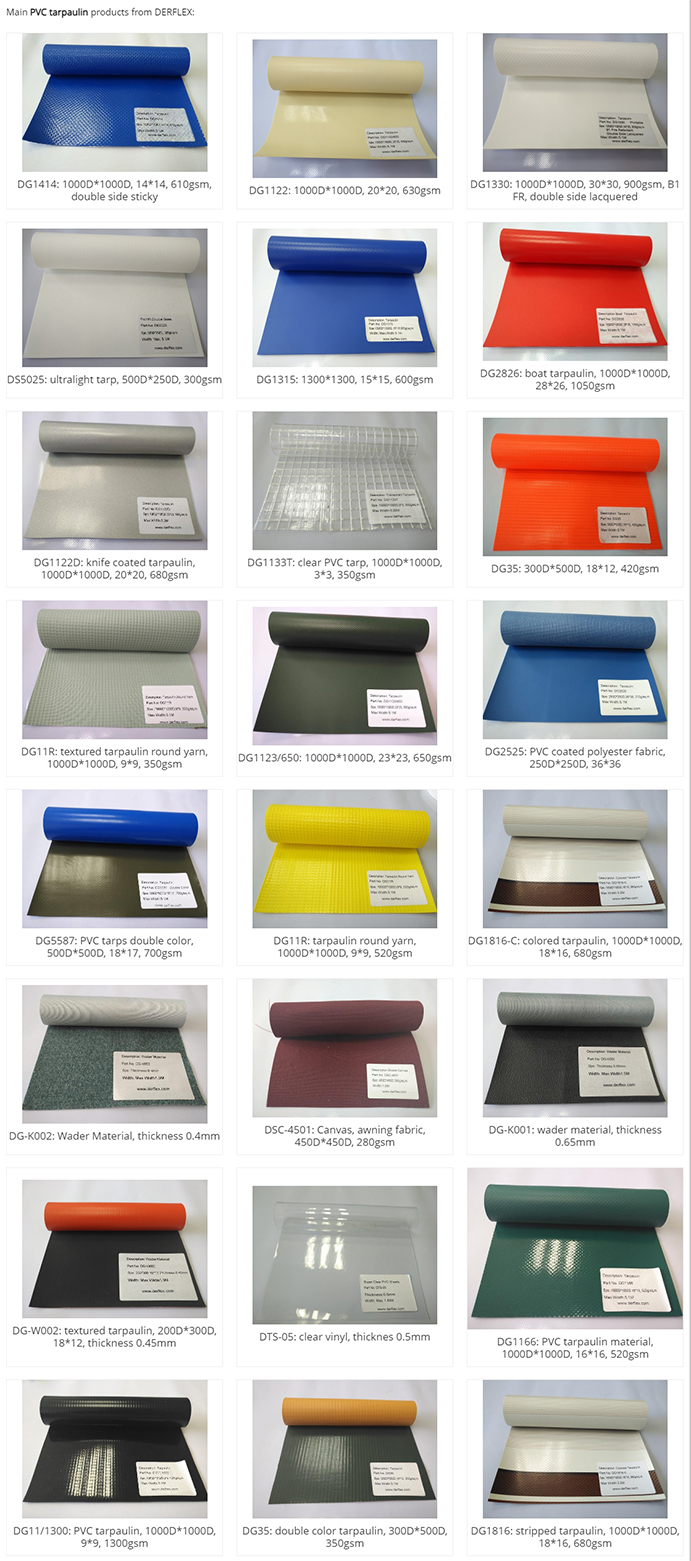
DERFLEX supports international B2B buyers with PVC-coated tarpaulin rolls, cut panels and custom finished-cover programs. Instead of selecting by colour or nominal weight alone, buyers can discuss the expected load, abrasion zones, puncture hazards, outdoor exposure, fastening method and repair strategy.
The practical goal is not to make every area equally heavy. It is to use an appropriate base fabric and coating, then place reinforcement where force enters the cover and where damage is most likely to begin.
These six pages support the same decision path without turning this failure-analysis guide into a list of unrelated product links.
Send the application, tarp dimensions, material information, failure photos, attachment layout, exposure conditions, order quantity and required service direction. DERFLEX can discuss a practical replacement material or finished-cover specification based on the observed failure mechanism.
Use these answers as a starting point. Final repair and replacement decisions depend on the actual material, construction, load and consequence of failure.
Premature failure is commonly caused by a mismatch between the application and the complete tarp system: material strength, edge reinforcement, fastening layout, contact surfaces, wind movement and maintenance. The visible damage often appears at a grommet, corner, seam or abrasion line because these are local stress concentrations.
Repeated grommet pull-out can result from over-tightening, insufficient reinforcement, wide attachment spacing, a tarp that is too small, rigid tie-downs or dynamic wind shock. Replacing the metal eyelet alone is rarely enough; the surrounding load path and reinforcement zone should also be redesigned.
Many localized tears in otherwise sound PVC-coated fabric can be repaired with a compatible PVC patch, suitable adhesive or controlled hot-air welding. A durable repair needs clean, dry surfaces, adequate overlap, rounded patch corners and removal of the original sharp edge, abrasion point or tension concentration.
Check material beyond the visible crack. Widespread brittleness, chalking, flaking, crackling when bent, easy tear growth and multiple fold-line fractures indicate that the surrounding panel may no longer hold a reliable patch. Local repair is more realistic when nearby material remains flexible and structurally sound.
No. Higher GSM can increase material mass, but field durability also depends on yarn strength, weave, coating adhesion, tear resistance, abrasion behaviour, weld or seam quality, finished dimensions, reinforcement and installation. A heavy tarp can still fail quickly at a weak attachment or sharp contact point.
Send clear photos of both sides, the damaged tarp in its installed position, material or product code, finished dimensions, anchor and grommet spacing, environmental exposure, contact surfaces, handling frequency, the sequence of events and whether the same failure has happened before. For a replacement quotation, also include quantity, colour, packaging and test requirements.