Enter finished size
Use the dimensions you expect the finished cover to measure after fabrication. Factory cut size, hem consumption and seam allowances are separate production variables.



Estimate how many grommets a rectangular tarp needs, equalize the center-to-center spacing on each selected edge, and visualize the tie-down layout before you send a custom tarp drawing or RFQ.
Use the calculator for PVC tarps, vinyl tarps, equipment covers, truck and trailer tarps, construction covers, agricultural covers and other rectangular panels. The result is a planning layout—not a wind-load or structural engineering rating.
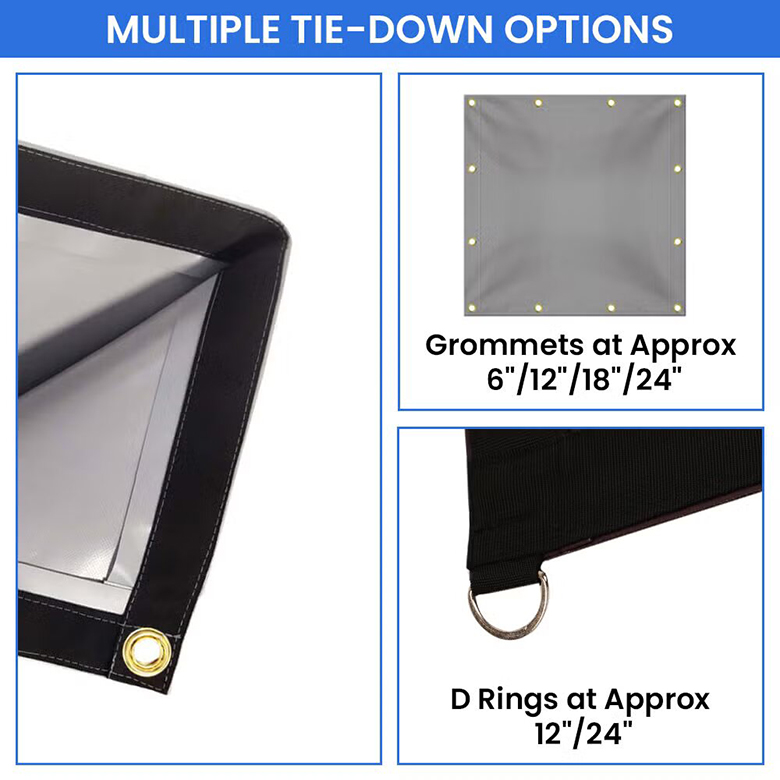
There is no single spacing for every tarp. As planning starting points, 12–18 in can provide denser perimeter control for exposed or frequently handled covers, 18–24 in is common for many general industrial layouts, and wider spacing may suit sheltered or lower-tension applications. Final spacing should follow the real anchors, edge reinforcement, pull direction, cover size and exposure.
Enter the finished tarp dimensions and your maximum target spacing. The tool divides each selected edge into equal intervals at or below that target, counts shared corner grommets once, and creates a copy-ready specification line.
Use finished tarp dimensions—not raw cut dimensions before hems or seams.
The actual equalized spacing may be slightly smaller than the target maximum so the pattern finishes cleanly at the far corner.
Visual layout is schematic. Actual eyelet center offset from the finished edge, corner patch geometry and local high-load reinforcement must be specified separately.
12 ft × 10 ft finished tarp; all four edges grommeted; maximum target spacing 1.5 ft; calculated equalized spacing 1.5 ft on length edges and 1.43 ft on width edges; estimated 30 unique perimeter grommets per tarp.
Important: This calculator is a layout estimator, not a structural or wind-load calculator. It does not determine grommet pull-out strength, fabric capacity, anchor capacity, rope or bungee rating, legal cargo securement or installation safety. Large tensioned surfaces, high-wind installations and safety-critical covers require project-specific review.
For each selected edge, the calculator treats your spacing entry as a maximum. It rounds the number of intervals upward, then divides the full finished edge length by that interval count.
Intervals = ceil(edge length ÷ target maximum spacing)
Actual spacing = edge length ÷ intervals
Grommets on one edge = intervals + 1
When two adjacent selected edges meet at the same reinforced corner point, that physical corner grommet is counted once in the total.
Use the dimensions you expect the finished cover to measure after fabrication. Factory cut size, hem consumption and seam allowances are separate production variables.
Use a planning target such as 12, 18, 24 or 36 inches, or enter a project-specific value based on the actual anchor system.
Before production, confirm grommet center positions, corner reinforcement, edge offset, metal type, hem structure, D-rings, straps and any special stress zones on a drawing.
These are procurement starting points, not guaranteed performance values. A closer pattern can add attachment points, but the hem, backing, anchors and tensioning method still control how load is transferred.
| Planning direction | Common use logic | Edge / reinforcement focus | What to verify before production |
|---|---|---|---|
| 12 in / 300 mm range | Dense perimeter control for exposed edges, irregular shapes, large panels or frequent retensioning. | Dependable hem reinforcement, larger corner support and enough real anchors to use the extra points. | Wind exposure, anchor count, pull direction and whether close holes reduce usable reinforcement width. |
| 18 in / 450 mm range | Often considered for heavy-duty transport, construction covers and covers that are opened or adjusted regularly. | Webbing or reinforced hem, corner patches and high-wear zones. | Dynamic movement, vibration, folding cycle and alignment with hooks or rails. |
| 24 in / 600 mm range | General-purpose planning direction for many equipment, storage and moderate outdoor covers. | Consistent folded or welded hem and properly supported corner points. | Unsupported edge length, tarp fit, bungee or rope behavior and local abrasion. |
| 36 in / 900 mm range | Lower hardware density for sheltered, temporary or lower-tension applications. | Useful when pockets, battens, lacing, rails or other systems carry part of the perimeter load. | Edge flutter, local pull concentration and whether fewer anchors create oversized unsupported spans. |
| Drawing-based custom layout | Best for machinery, frames, trailer rails, irregular equipment, replacement covers and OEM programs. | Place each fixing point around the real anchor coordinates and load direction. | Datum points, exact center-to-center dimensions, row height, orientation, cut-outs and repeat-order tolerance. |
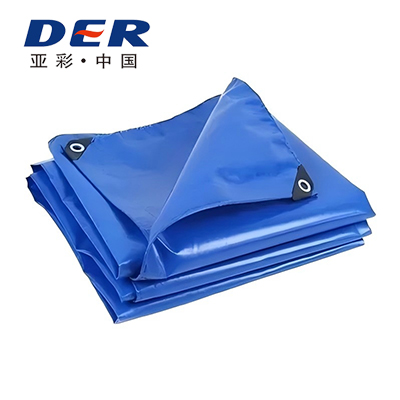
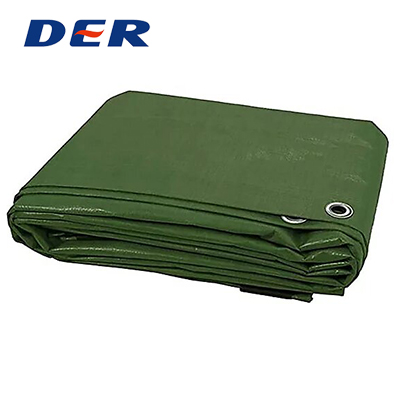
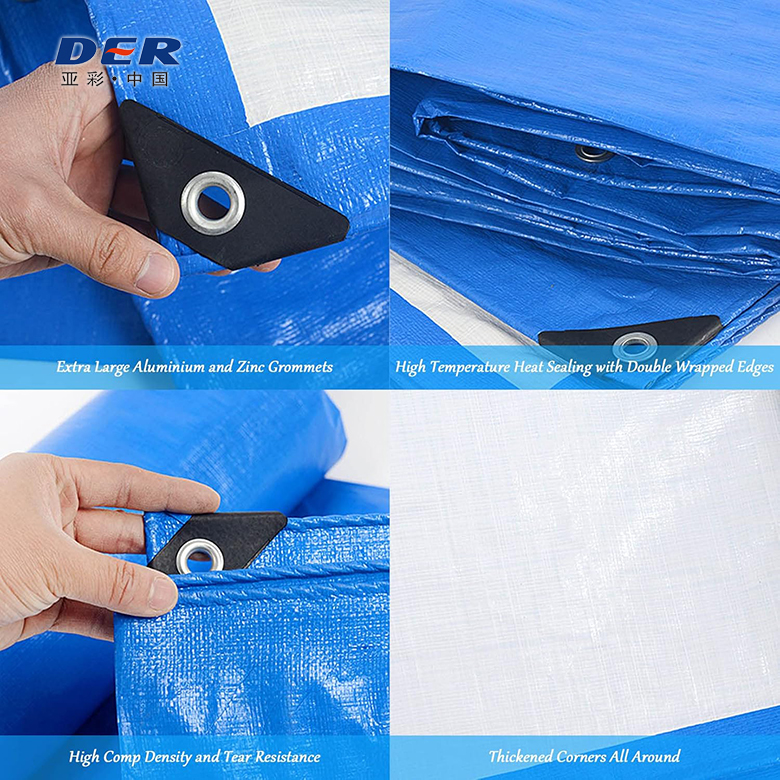
A grommet transfers force into the surrounding reinforcement, hem and main fabric. If the hardware is closely spaced but the edge is weak, anchors are misaligned or one point is over-tensioned, the cover can still tear around the eyelet.
The number of grommets is useful for early planning, but a professional custom tarp specification should define the complete fixing system.
For truck or transport use: a tarp is primarily a cover. Cargo securement must use the applicable rated restraint system and comply with the laws and operating requirements for the vehicle, cargo and jurisdiction.
Use the calculator to organize geometry, then check the real reasons tarp fastening systems fail in the field.
More grommets do not automatically mean more capacity. Pull-out performance depends on the complete eyelet zone: metal, washer, backing, hem, fabric and pull direction.
A uniform 18-inch pattern is not useful if the frame has usable hooks every 22 inches. Drawing-based positions often outperform a generic pattern for fitted covers.
Corners receive force from two edges and often see diagonal pull. Their patch design can require a different solution from regular straight-edge grommets.
Uneven rope, hook or bungee tension can leave one grommet carrying much more load than neighboring points even when the spacing is perfectly equal.
Hardware should not be placed blindly through seam transitions, access openings, pockets or thin unsupported zones. Coordinate the hardware map with fabrication details.
Retail tarp patterns are not universal engineering standards. Custom industrial covers should be specified around the real size, exposure, duty cycle and installation system.
These verified DERFLEX pages connect the calculator result with finished-tarp design and procurement.
Direct answers for buyers planning eyelet count, center-to-center spacing and custom tarp hardware layouts.
There is no single universal standard. Many commercial and custom tarp discussions use spacing around 12–24 inches, while wider spacing can be used for sheltered or lower-tension covers. The correct layout depends on tarp size, wind exposure, anchors, edge reinforcement, material structure and fixing method.
The calculator generates grommet points on each selected edge and counts the same physical corner point once when adjacent edges share it. This avoids double-counting the four corner grommets on a fully grommeted rectangular tarp.
Your spacing entry is treated as a maximum. The tool rounds the number of intervals upward and divides the full edge evenly, so the final gap stays at or below the target and the pattern reaches the far corner without a short leftover interval.
No. Closer spacing can provide more attachment points only when those points connect to usable anchors and the hem, webbing or backing can distribute the load. Weak reinforcement, diagonal pull or uneven tension can still cause eyelet pull-out.
No. It calculates layout geometry only. Wind pressure, dynamic movement, anchor strength, grommet pull-out capacity, fabric strength, tie-down rating and structural safety require project-specific data and, where appropriate, engineering review or testing.
Grommets are compact tie points for rope, bungee and hooks. D-rings can be useful for straps, buckles or directional pull when mounted on reinforced webbing tabs. Many industrial tarps combine both systems in different zones rather than using one hardware type everywhere.
DERFLEX can discuss custom finished dimensions, grommet spacing, reinforced hems, corner patches, D-rings, straps, webbing, color, printing and packaging for B2B and OEM tarp programs. Send the calculator result together with the application, quantity, anchor positions and a drawing or photo for specification review.
Send DERFLEX the finished size, application, quantity, material direction, calculated spacing, real anchor locations and reinforcement requirements. A marked drawing or installation photo helps convert the planning layout into a manufacturable sample.