Material family
PVC-coated polyester, PE laminate, canvas, mesh or another engineered fabric.



 Industrial Tarp Specification Guide
A tarp specification is more than thickness or color. It is the complete construction that determines how the cover behaves under rain, wind, abrasion, tie-down force, folding, welding and repeated outdoor use.
This guide is written for distributors, tarp fabricators, fleet suppliers, contractors, importers, OEM brands and industrial procurement teams that need to turn an application into a clear, repeatable tarp specification.
A useful tarp specification defines both the fabric and the finished cover. A material can be strong on paper yet fail in service if seams, hems, grommets, reinforcement or dimensions are not specified correctly.
Search results for tarp specifications often begin with easy-to-compare values such as material, mil thickness, ounces per square yard, denier, mesh count and grommet spacing. Those numbers are useful, but professional procurement needs one more step: every value should connect to the job the tarp must perform.
For example, a truck tarp can face wind flutter, sharp cargo edges, road spray and frequent folding. A construction cover may need rain protection, temporary installation, reinforced tie-down points and a project-specific flame-retardant route. A warehouse divider may care more about clean welding, dimensional stability and repeated handling than about grommet spacing.
That is why the most reliable way to write tarp specs is to start with the application, expected service duration, mechanical stress, weather exposure and fabrication method, then select the base fabric and finished-cover construction around those risks.
Use this sequence when comparing suppliers, approving samples or creating a repeat-order standard.
PVC-coated polyester, PE laminate, canvas, mesh or another engineered fabric.
Yarn denier, weave density, polyester scrim or woven PE construction.
GSM / oz per square yard plus actual thickness where it matters.
Coated or laminated structure, surface texture, lacquer and color direction.
Tensile, tear, adhesion, abrasion, hydrostatic, UV, low-temperature and FR needs.
Seam route, hem width, reinforcement, grommets, webbing, D-rings and pockets.
Finished size tolerance, color standard, packing, labels, batch consistency and test documents.
These ranges are screening references for purchasing discussions, not a universal product guarantee. Final values should be confirmed against the actual sample, datasheet, test method and finished-cover design.
| Specification Item | PVC / Vinyl Coated Polyester | PE / Poly Tarp | Canvas Tarp | Mesh Tarp |
|---|---|---|---|---|
| Typical structure | Woven polyester reinforcement with PVC coating or lamination | Woven polyethylene tape with PE laminated surfaces | Woven cotton or blended fabric, often treated for water resistance | Open woven / knitted structure designed for airflow and shade |
| Commercial weight language | Often specified in GSM or oz/yd2; heavy-duty industrial programs commonly use several grades rather than one fixed weight | Often listed by oz/yd2 together with mil thickness and weave | Often sold by oz fabric weight; treatment can change finished weight | Often described by GSM plus shade / openness percentage |
| Thickness | Useful but should be read with GSM, yarn and coating build | Common retail comparison field; values such as 6, 12 or 20 mil may identify duty tiers | Usually less useful than fabric weight and weave | Usually secondary to yarn, GSM and open-area design |
| Reinforcement language | 500D, 840D, 1000D, 1300D or custom polyester structures may be discussed by performance target | Denier and mesh count are frequently published together | Duck / weave and finished fabric weight are common identifiers | Yarn strength, weave / knit and shade factor are key |
| Water protection | Continuous PVC surface; welded seams can support a highly water-resistant finished cover | Laminated surfaces are commonly used for waterproof temporary protection | Usually water-resistant rather than fully sealed; breathability is part of the value | Not intended as a full rain barrier because of the open structure |
| Fabrication | Hot-air welding, HF welding where suitable, sewing, hems, webbing, grommets, D-rings and pockets | Heat-sealed seams, rope hems, grommets and reinforced corners are common | Sewn seams, folded hems and grommets | Sewn / welded hems depending on material; grommets, webbing or reinforced perimeter |
| Best-fit purchasing logic | Repeated use, truck and trailer covers, industrial protection, custom fabrication, OEM programs | Temporary cover, lighter handling, seasonal protection and price-sensitive general use | Breathable equipment / material protection where condensation control matters | Shade, debris control, ventilation and reduced wind pressure |
Reference note: DERFLEX currently publishes heavy-duty PVC tarp directions including 450–1200 gsm, approximately 0.35–1.2 mm and widths around 1.02–3.2 m on a current product page; project-specific values should be confirmed before ordering.
Each metric describes a different part of the material. Buyers get better comparisons when they know what the number actually controls.
Grams per square meter describes total material weight. It includes the reinforcing textile and coating / lamination system.
Use it for: grade control and cost / handling comparison.One mil is one-thousandth of an inch. Thickness is useful, but a thicker material is not automatically stronger if reinforcement is weak.
Use it for: film build, handling and duty-tier screening.Denier is a yarn linear-density measure. Higher denier generally means a heavier yarn, but strength still depends on yarn quality and construction.
Use it for: understanding the reinforcement foundation.Mesh or thread count describes how densely yarns are arranged. It should be read together with yarn size, not treated as a stand-alone strength rating.
Use it for: comparing scrim / woven structures.For industrial tenders and OEM programs, physical test data can be more meaningful than broad words such as “heavy duty.” Ask which test method applies and whether the reported value is typical, minimum or guaranteed.
Shows resistance to pulling force in warp and fill directions. Important for tensioned covers, trucks and large panels.
Indicates how a cut or puncture may propagate. Tie-down points and sharp cargo make this especially relevant.
Evaluates how strongly the coating bonds to the reinforcement. Poor adhesion can lead to delamination or edge failure.
Useful for truck, machinery and industrial covers that rub against cargo, frames or rough surfaces.
Helps quantify resistance to water pressure. Finished-cover waterproofing also depends on seams, holes and hardware.
Important when a tarp must fold, roll or flex in cold climates without cracking or becoming excessively stiff.
Outdoor performance depends on formulation, pigment, exposure, temperature and installation—not simply the word “UV resistant.”
If a project requires NFPA 701, B1/B2, M1/M2, CPAI-84 or another route, confirm the exact material, sample and certificate scope.
Large covers and curtain systems may need dimensional control so seams, fittings and installed geometry remain consistent.
For a finished tarp, the perimeter, seams and attachment points often determine where failure starts.
Instead of writing “reinforced tarp,” describe how the reinforcement is built and where it is located.
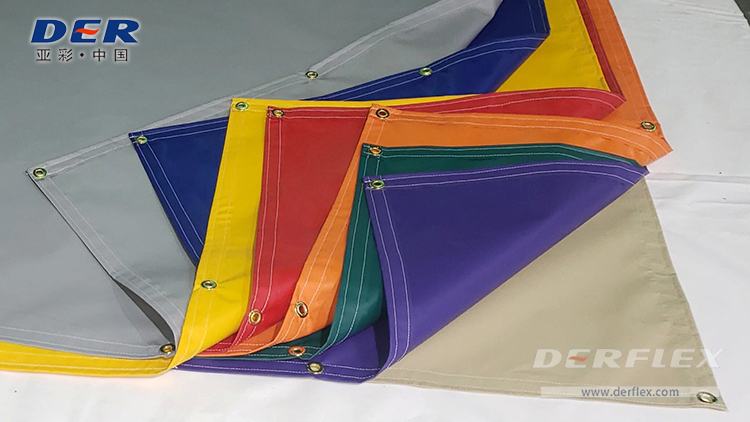
The following examples show which specification fields deserve extra attention for different purchasing scenarios.
Prioritize tear and tensile performance, abrasion, cold flexibility, seam strength, reinforced tie-down zones, hardware layout and repeat folding behavior.
Define exposure duration, waterproofing, UV direction, attachment method, edge reinforcement and any project-specific flame-retardant requirement.
Consider abrasion, oil / chemical contact where relevant, heat sources, custom shape, zipper / access design and surface compatibility.
Confirm UV exposure, wind, ground contact, moisture / mildew conditions, long-span reinforcement and practical installation spacing.
Specify handling frequency, forklift / corner abrasion, cover dimensions, labeling, reusable vs one-way logic and storage environment.
Lock the approved material code, color reference, dimensions, tolerances, accessory layout, packaging and change-control procedure for repeat orders.
Sending only “need heavy duty tarp” forces the supplier to guess. A structured RFQ allows material, fabrication and testing to be compared on the same basis.
DERFLEX, Shanghai DER New Material Co., Ltd., publishes PVC coated polyester tarp options for industrial, transport, construction and agricultural uses. Current DERFLEX product information describes more than 20 years of production experience, a manufacturing base above 30,000 m2 and export activity to more than 100 countries.
For B2B programs, the useful discussion is not “what is your strongest tarp?” but “what structure, finish and fabrication are appropriate for this operating condition?”
These related pages help buyers move from general specification language to material, weight, performance and application decisions.
Short answers to the specification questions most likely to affect sourcing, sampling and repeat-order control.
The core fields are material family, finished weight, thickness where relevant, base-fabric denier and weave, coating / lamination structure, tensile and tear performance, UV / weather requirements, seam method, hem reinforcement, grommet or hardware layout, finished dimensions and any required test or flame-retardant standard. The most important fields vary by application.
No. GSM describes finished mass, not the whole strength profile. A higher GSM can come from more coating without a proportional increase in base-fabric strength. Compare yarn, weave, tensile, tear, coating adhesion and finished construction together.
It normally describes a material weight class of about 18 ounces per square yard. In vinyl tarp markets, an 18 oz product is commonly a heavy-duty PVC coated polyester grade, but thickness, base fabric and performance vary by construction. Always request the full datasheet.
Mil is a thickness unit equal to one-thousandth of an inch. It is commonly used for polyethylene tarps and some vinyl products. Mil should not be used as a substitute for weight, denier or strength data.
Write the required center-to-center spacing and hardware material, and identify whether corners or high-load zones need extra reinforcement. Around 18 inches on center appears frequently in stock poly tarp specifications, but custom industrial covers should use spacing based on the actual load and installation method.
Specify the exact standard and class required by the project, such as NFPA 701, CPAI-84, B1/B2 or another applicable route. Confirm that the certificate or report matches the actual material construction you plan to purchase and that its validity and scope meet your project requirements.
DERFLEX supports discussions for custom PVC coated polyester weight, width, color, surface finish, performance direction and finished-tarp details such as welding, hems, grommets, webbing, D-rings, printing and OEM packing. Final feasibility, tolerances and test values should be confirmed during quotation and sample approval.
Send the application, dimensions, material direction, performance requirements, reinforcement layout and quantity. DERFLEX can review the information and discuss a suitable manufacturing route before quotation.