News
Company News

Tarpaulin Coating Adhesion Test | Peel Strength & ISO 2411 Buyer Guide | DERFLEX

Update:2026/9/13 17:02:20 Views:
PVC Tarpaulin Quality & Procurement Guide

Tarpaulin Coating Adhesion Test: Why Peel Strength Matters

Peel strength measures how strongly a PVC coating remains bonded to the textile reinforcement. For truck tarps, industrial covers, tents, side curtains and other flexed coated fabrics, this bond helps determine whether the material stays intact or begins to blister, peel and delaminate during fabrication and service.

A useful coating-adhesion requirement must include the test method, specimen direction, units, conditioning state and acceptance limit. A single number without that context is not enough to compare suppliers or release a bulk order.

A

Coating adhesion is the bond between the PVC layer and the textile substrate.

During a peel test, the coating is progressively separated from the base fabric and the force required to continue that separation is measured. Higher measured resistance can indicate a stronger bond under that specific method, but the result only becomes useful when the buyer also knows the test standard, peel direction, unit, specimen preparation, conditioning and whether the reported figure is a minimum, average or typical value.

For procurement, the practical question is not simply “Is the peel strength high?” It is: “Does this construction maintain adequate coating bond for the intended folding, welding, abrasion, weather exposure and service cycle?”

Coating adhesionBond strength between the polymer coating and reinforcing textile.
Peel strengthForce recorded while one bonded layer is progressively separated from the other.
DelaminationLayer separation that can appear as peeling, bubbles, lifting edges or coating loss.
Conditioned adhesionAdhesion checked after a defined exposure such as heat, water, cold or ageing when required.

Peel test concept: pull the coating away and measure the resistance to separation

Coating / textile interface under progressive peel loading

In a controlled test, the specimen is prepared so the coating and substrate can be gripped separately. The testing machine then advances the separation at the method-defined conditions and records the peel force over the test length.

  • Use the exact method and edition named in the purchase specification.
  • Keep machine direction / warp and cross direction / weft clearly identified where required.
  • Report the actual unit and statistic used by the method.
  • Record the observed failure mode, not only the number.
Do not confuse the properties

Peel Strength Is Different from Tensile, Tear and Weld-Seam Strength

Coated tarpaulin is a system. Different tests answer different failure questions, and one strong result cannot substitute for another.

Property What the test is asking Typical risk it helps control Procurement note
Coating adhesion / peel strength How strongly is the coating bonded to the textile substrate? Delamination, peeling, blistering, coating lift after flexing or exposure. Name the peel method, direction, condition and acceptance criterion.
Tensile / breaking strength How much distributed pulling force can the coated fabric resist before failure? Panel loading, tensioned covers, broad pull forces. Read both material directions and the stated tensile method.
Tear resistance How much force is needed to continue tearing once damage has started? Sharp edges, punctures, flapping, grommet and edge damage. Tongue, trapezoid and other tear methods are not directly interchangeable.
Weld-seam peel / seam strength How strong is the fabricated seam between coated surfaces? Hot-air, hot-wedge or HF/RF seam separation. Base-coating adhesion does not automatically prove the welding window or seam design.
Buyer rule: never approve a tarp material because “the tensile is high” if coating adhesion is undefined. Likewise, never use a strong peel number as a substitute for a production-representative welding trial.
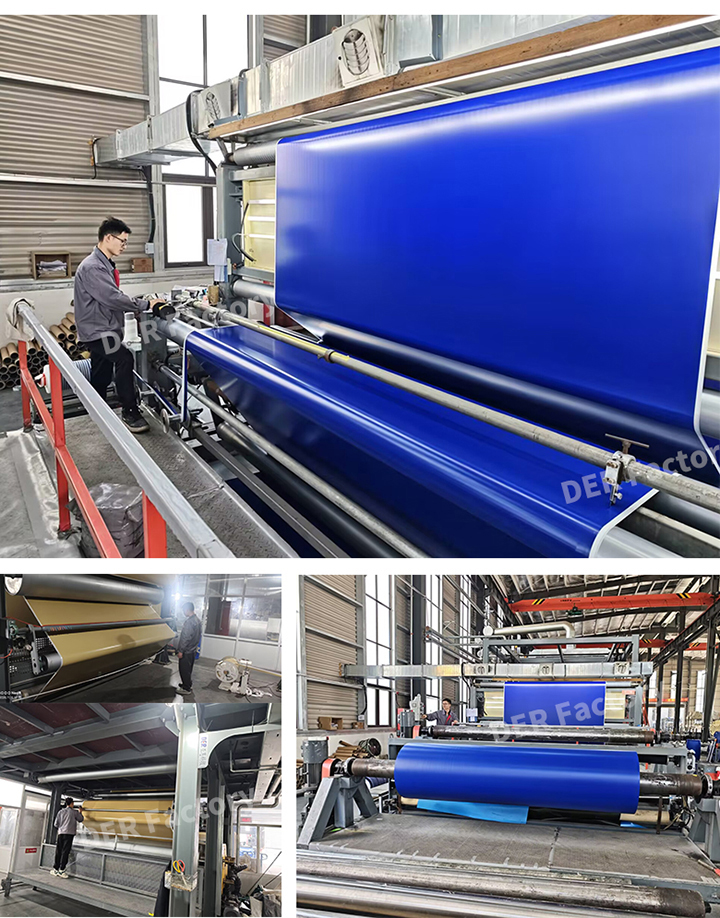
DERFLEX PVC coated fabric production line for controlled coating and tarpaulin manufacturing
Test logic

How a Tarpaulin Coating Adhesion Test Should Be Controlled

The exact specimen geometry and machine settings must follow the chosen standard. From a buyer’s perspective, the critical issue is traceability: the result must belong to the same material construction, finish, color or formulation scope, and sample revision that will be ordered.

1. Identify the material

Record article code, construction, GSM, base fabric, coating route, surface finish, color, batch or sample revision and which face is being tested.

2. Define the test condition

State the method, edition, direction, conditioning, reporting unit and any required pre-treatment or ageing.

3. Run a progressive peel

Separate the coating from the substrate using the method-defined specimen and test-machine procedure. Capture the force over the required separation distance.

4. Record the result and failure mode

Report the numeric result together with what actually failed. A fabric that tears before the interface separates tells a different story from clean adhesive separation at the coating/textile boundary.

1

Sample identity

Product code, construction, face, color, finish and revision.

2

Method setup

Named standard, direction, conditioning and specimen requirements.

3

Peel measurement

Controlled progressive separation using calibrated test equipment.

4

Release decision

Compare the result and failure behavior with the approved purchase requirement.

Testing standards

ISO 2411 and ASTM D751: Put the Method Next to the Number

The same phrase “peel strength” can represent different specimen preparation, test geometry and reporting conventions. Procurement documents should name the exact method and current edition required by the buyer or market.

ISO 2411:2024

ISO 2411:2024 is the current international standard titled Rubber- or plastics-coated fabrics — Determination of coating adhesion. It specifies a method for determining coating adhesion strength in coated fabrics.

Use the edition required in the order specification. Do not assume an older ISO 2411 report is automatically equivalent to a current buyer requirement.

ASTM D751

ASTM D751 is a coated-fabric test-method family covering multiple properties, including adhesion of coating to fabrics, as well as tensile, tear, hydrostatic resistance and seam-related testing.

ASTM revisions change over time. The purchase order should reference the buyer-approved edition and the applicable adhesion procedure rather than writing only “ASTM tested.”

Legacy references: older or supplier-specific tarpaulin data sheets may cite DIN 53357 or other historical methods. When changing from a legacy method to ISO or ASTM, cross-test an approved sample instead of converting the number mathematically and assuming equivalence.
Failure interpretation

The Number Matters—but the Failure Mode Often Tells You Why

Two samples can produce similar peel values while failing in different locations. Record the failure mode so engineering and quality teams can identify whether the weakness is at the interface, inside the coating or in the substrate.

Interface failure

Adhesive separation

The coating releases relatively cleanly from the textile interface. This can indicate insufficient interfacial bonding for the test condition and should be reviewed against the purchase requirement and application.

Coating failure

Cohesive failure in PVC layer

The coating itself splits while part of the coating remains attached to the fabric. This suggests the interface may be stronger than the local coating body under that test condition.

Textile failure

Fiber or substrate damage

Fibers pull out or the reinforcement fails before a clean coating release occurs. The result needs careful interpretation because the limiting failure may no longer be the coating interface.

Surface-layer issue

Topcoat or finish separation

A lacquer, print layer or surface treatment may separate without the primary PVC-to-textile bond failing. Keep surface-finish adhesion separate from base-coating adhesion in the inspection record.

Why it matters in service

Weak Coating Bond Can Become a Field Failure Long Before the Fabric Breaks

Tarpaulin is repeatedly folded, rolled, welded, dragged, tensioned, cleaned and exposed to changing temperatures. Coating adhesion helps the composite material stay together through those cycles.

Repeated Folding & Flexing

Truck covers, roll-up curtains and reusable tarps experience frequent bends. Weak bonding can open at creases, edges or damaged areas and grow with repeated handling.

Welding & Fabrication

Heat, pressure and surface condition influence seam formation. Good base adhesion supports a stable coated system, but the actual hot-air or HF/RF process still needs its own seam trial.

Abrasion & Edge Exposure

Once abrasion exposes an interface, local peeling can accelerate around corners, sharp cargo contact or dragged surfaces if the coating bond is insufficient for the duty cycle.

Cold Conditions

Low-temperature flexibility and adhesion should be considered together where tarps are folded or tensioned in cold climates. A room-temperature result alone may not represent the critical service state.

Water & Humidity

Water exposure can challenge some material systems and damaged interfaces. Where long wet exposure is expected, the buyer may require conditioned adhesion in addition to an initial result.

Outdoor Ageing

UV, heat, plasticizer movement, dirt, cleaning and repeated weather cycles can change flexibility and layer behavior. Critical programs may need aged or weather-conditioned peel checks.

Application decision matrix

Where Should a Buyer Place Extra Attention on Coating Adhesion?

There is no universal peel-strength target for every tarp. Set the requirement from the operating environment, conversion process and consequence of delamination.

ApplicationWhy adhesion mattersWhat to verifyPriority
Truck / flatbed tarpRepeated folding, wind movement, cargo-edge abrasion and outdoor exposure.Initial adhesion, flex behavior, abrasion zones and actual seam trial.High
Side curtainLarge moving panels, repeated tension, rolling/sliding and printed surface requirements.Directional adhesion, surface-finish compatibility and seam process.High
Tent / shelter fabricLarge welded panels, frequent folding, roof tension and weather exposure.Coating bond, welded seam performance and any aged condition required by project.High
Industrial equipment coverDragging, contact abrasion, cleaning chemicals and shaped stress points.Adhesion after relevant exposure plus reinforcement around sharp geometry.Medium–High
Temporary static coverLower handling cycle may reduce flex demand, but water and sunlight can still matter.Application-appropriate initial adhesion and weather compatibility.Project dependent
Air / liquid retention productsCoating continuity, flex cycles and seam reliability are critical to system integrity.Adhesion plus leak/pressure and welded-seam validation; flat-fabric peel alone is insufficient.Critical system check
Answer-first buyer guidance

What Is a Good Peel Strength for PVC Tarpaulin?

The useful answer is application-specific: there is no single universal peel-strength value that proves every PVC tarpaulin is “good.”

Do not buy from a number alone

Published values can use N/5 cm, N/cm or other units and may come from different test methods, specimen directions, conditioning states and reporting rules. Even when units can be converted, different procedures are not automatically equivalent.

Build a project benchmark

The most reliable route is to test an approved reference construction under the chosen method, define the minimum acceptable result and failure behavior, then use that same basis for pre-production or lot-release testing.

Practical sourcing approach: for a repeat-order program, freeze the article code, peel method, direction, unit, minimum acceptance value, sample condition and revision in the purchase specification. If any important material layer changes, revalidate the affected performance.
Procurement specification

Turn “Strong Adhesion” into a Testable Purchase Requirement

A B2B order needs a measurable acceptance rule that a supplier, factory and third-party inspector can all interpret the same way.

Field to specifyWhat the PO / TDS should stateWhy it matters
Material identityArticle code, construction, base fabric, coating route, finish and revision.Prevents a test report from being applied to a different material.
Test methodISO 2411:2024, ASTM D751 procedure, buyer method or agreed equivalent.The method defines specimen preparation and reporting basis.
DirectionMachine/warp, cross/weft, or other clearly defined orientation as required.Coated textiles can behave differently by direction.
ConditionInitial, after water, after heat, after cold, after weathering or project-specific conditioning.Service exposures can change the bond.
Unit & statisticExact unit and whether the acceptance uses minimum, mean or another defined statistic.Avoids misleading comparisons between reports.
Acceptance limitProject-defined minimum or approved-sample control value.Converts a lab result into a release decision.
Failure modeRecord interface, coating, substrate or mixed failure where relevant.Helps diagnose a borderline or changing material system.
Sampling planPre-production sample, first lot, periodic lot, change-triggered or third-party verification.Defines when the control is repeated.

For a broader framework covering GSM, thickness, tensile, tear, coating adhesion and finished-tarp details, use the DERFLEX tarpaulin technical specification guide. For sample release, color, coating and weld checks should also be connected in one controlled approval record; see how to approve tarp color, coating and weld quality.

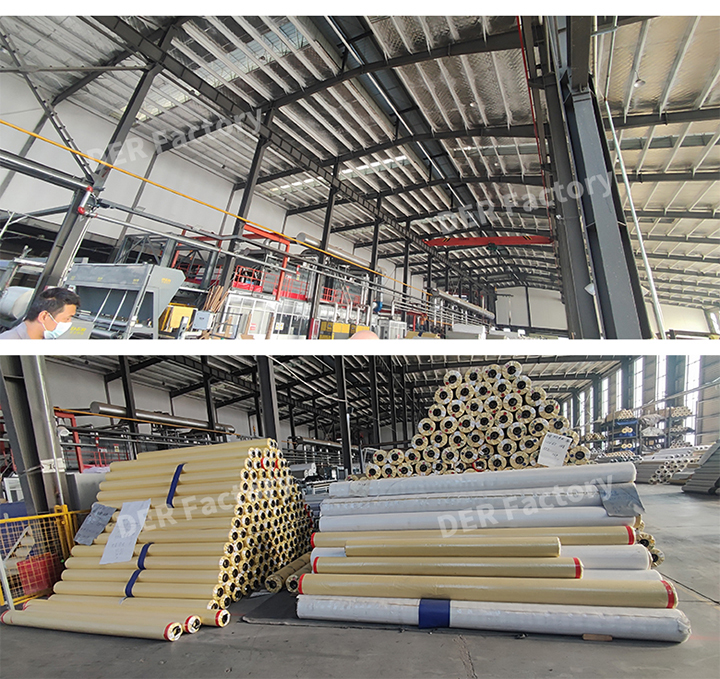
DERFLEX PVC coated tarpaulin factory production and roll-goods quality control
Factory quality control

Adhesion Control Starts Before the Peel Test

Peel strength is the measured output of a material system. The upstream variables include base-fabric preparation, coating formulation, coating route, cure or gel condition, layer uniformity, surface treatment and batch repeatability.

DERFLEX describes coating adhesion as one of the quality checks used for PVC coated fabrics and tarpaulin programs. For a specific project, the test method, acceptance value, sampling frequency and any conditioned testing should be confirmed in the quotation and final specification.

  • Match the coating route to the actual duty and fabrication process.
  • Link lab data to the exact article, finish and approved sample.
  • Recheck when formula, substrate, coating weight or surface treatment changes materially.
  • Use seam testing separately when the finished product is welded.

Review DERFLEX quality control →

Common procurement mistakes

Six Errors That Make Peel-Strength Data Misleading

Most comparison problems are caused by missing test context, not by the lack of a number.

1. Comparing different methods as if they are equal

ISO, ASTM, DIN or supplier methods can use different specimen and reporting rules. Align the method before ranking suppliers.

2. Treating GSM as adhesion

A heavier coated fabric can still have poor bonding if the coating/textile interface or process control is weak.

3. Confusing coating adhesion with seam peel

The base coating-to-fabric bond and a welded seam are two different interfaces and need separate acceptance checks.

4. Testing only a room-temperature virgin sample

For demanding environments, the critical condition may be after cold, water, heat or ageing exposure.

5. Ignoring failure mode

A clean interface peel and a substrate tear can produce numbers that require different engineering interpretation.

6. Disconnecting report, sample and PO

If the report does not identify the same article and revision as the purchase order, it may not prove the ordered material.

Buyer checklist

What to Send DERFLEX for a Peel-Strength-Controlled Tarpaulin Program

A clearer enquiry makes it easier to recommend the right coated-fabric structure, sample route and test plan without guessing.

  • End use: truck cover, tent, side curtain, industrial cover or another application
  • Target material construction, GSM or current reference sample
  • Base-fabric denier / weave requirement if already specified
  • Knife-coated, laminated or buyer-approved coating route
  • Required peel method and edition, if your company already has one
  • Minimum peel requirement or approved benchmark sample
  • Initial-only or conditioned adhesion requirement
  • Welding method: hot air, hot wedge, HF/RF or sewing
  • Surface finish: matte, glossy, lacquered, printable or other
  • Color, width, roll length and order quantity
  • Destination market and any project-specific documentation
  • Required sample approval and inspection timing

Need a tarpaulin material with a defined coating-adhesion requirement?

Send the application, current sample or target construction, peel method, acceptance limit, welding process, quantity and destination. DERFLEX can review a project-specific PVC coated fabric route and align the quotation , with the required test basis.

Buyer questions

Tarpaulin Coating Adhesion & Peel Strength FAQ

Direct answers for importers, fabricators, quality teams and procurement managers comparing PVC coated tarpaulin.

What is peel strength in PVC tarpaulin?

Peel strength is the force required to progressively separate the PVC coating from the textile substrate under a defined test method. It is used as an indicator of coating adhesion and resistance to delamination.

Why does coating adhesion matter if tensile strength is already high?

Tensile strength measures resistance to pulling the coated fabric apart as a sheet. Coating adhesion measures the bond between layers. A tarp can have strong reinforcement but still suffer coating peel or delamination if the interface is weak.

Which standard is used for coating adhesion of coated fabrics?

ISO 2411:2024 is the current international standard specifically for determining coating adhesion of rubber- or plastics-coated fabrics. ASTM D751 also includes a coating-to-fabric adhesion procedure within its coated-fabric test-method family. Always confirm the required edition and procedure in the purchase specification.

Can I compare N/5 cm and N/cm peel values directly?

Units can be mathematically normalized only when the underlying test method, specimen geometry, direction, conditioning and reporting basis are otherwise equivalent. Do not rank suppliers by converted units when the methods differ.

Is coating adhesion the same as welded seam peel strength?

No. Coating adhesion measures the PVC-to-textile bond in the material. Welded seam peel strength measures the fabricated joint between coated surfaces. Both can matter, but they answer different failure questions.

Should peel strength be tested after ageing or water exposure?

For demanding applications, it can be useful to specify conditioned adhesion in addition to the initial result. The relevant exposure—such as water, heat, cold or weathering—should come from the actual service environment and be written into the project test plan.

What information should I include in a tarpaulin adhesion requirement?

Include the exact material identity, test standard and edition, direction, conditioning, unit, reporting statistic, minimum acceptance value, failure-mode requirement if relevant, sampling frequency and whether the result applies to an initial sample or bulk-production lots.

Consulting Services
+86-021-54361792 / 54361798
Email
sales@derflex.com