


Tarpaulin Pre-Shipment Inspection: AQL, Defects & Acceptance Criteria
A practical framework for importers, distributors, OEM brands and industrial buyers who need a defensible shipment-release decision—not a vague “looks good” inspection.
Define the lot, choose the sampling plan, classify tarp-specific defects before inspection, verify critical dimensions and construction details, then compare the recorded defect count with the agreed acceptance/rejection rule.
What is AQL in a tarpaulin pre-shipment inspection? AQL is an acceptance-sampling index used with a defined sampling plan to decide how many units to inspect and which defect counts lead to acceptance or rejection of a lot. It is not a statement that “2.5% defects are allowed in the shipment.” For a tarp order, the buyer should agree the lot definition, inspection level, AQL values, defect classes and acceptance/rejection numbers before the inspector sees the goods.
A PSI should answer one commercial question: can this finished lot be released?
A pre-shipment inspection is most useful after production is substantially complete and the actual shipment lot is accessible, but before loading removes the buyer’s opportunity to contain, rework or re-inspect nonconforming goods.
Is it the ordered tarp?
Match item code, approved material, color, finish, size, hardware, artwork and packing revision to the PO and controlled specification.
Does the sample represent the lot?
Draw units across cartons, pallets, colors, sizes and identifiable production groups instead of accepting factory-preselected pieces.
What failed—and how serious is it?
Count defects under pre-agreed critical, major and minor definitions. Keep dimensional and functional nonconformities separate from cosmetic issues.
Release, hold, rework or reject?
Apply the stated Ac/Re rule, then document any deviation approval, sorting plan, corrective action and re-inspection requirement.
Do not create acceptance criteria after the inspection report arrives. “Export quality,” “heavy duty,” “same as last order,” and “no obvious defects” are not objective release standards. Put the measurable requirement, tolerance, defect class and decision rule into the PO or inspection instruction before production is finished.
How AQL works in a tarpaulin inspection
ISO 2859-1:2026 defines acceptance sampling schemes for inspection by attributes. The buyer’s inspection instruction still has to specify the lot, inspection level, AQL values and defect classification. The standard supplies the statistical decision framework; it does not decide what a “major tarp defect” means for your application.
Define the lot
State exactly which pieces are being accepted or rejected together.
Choose level
Use the agreed normal, tightened, reduced or special inspection route as applicable.
Get sample size
Use the current licensed sampling table or inspection agency calculator for the chosen plan.
Count by class
Record critical, major and minor nonconformities against the approved defect list.
Apply Ac / Re
Accept or reject according to the pre-agreed threshold—never by negotiating after the count.
What AQL does well
- Creates a repeatable random-sampling decision for a defined lot.
- Lets buyers use different risk tolerances for different defect classes.
- Reduces inspection effort compared with checking every piece.
- Creates a documented basis for pass/fail or hold/rework decisions.
What AQL does not prove
- It does not guarantee every tarp in the shipment is defect-free.
- It does not replace laboratory testing of tensile, tear, adhesion, UV or flame performance.
- It does not fix a poor drawing, vague tolerance or missing golden-sample reference.
- It does not make one generic defect list suitable for every tarp application.
Worked example—illustrative only: public ANSI/ASQ Z1.4-based AQL calculators commonly show that a 4,000-unit lot at General Inspection Level II maps to a 200-piece sample; at AQL 2.5 the example acceptance/rejection threshold is Ac 10 / Re 11. Use the current standard or your inspection provider’s licensed tables for the actual order, especially where the contract references ISO 2859-1:2026.
Critical, major and minor defects should be classified by consequence
The same visual flaw can have a different severity depending on application. A pinhole on a decorative dust cover may be cosmetic or major; the same leak path on a weatherproof equipment cover can make the product unusable. Freeze the defect catalog before inspection and include boundary photos where subjective judgment is likely.
| Defect class | Decision logic | Tarpaulin examples to pre-classify | Evidence the inspector should capture |
|---|---|---|---|
| Critical | Safety, regulatory or shipment-blocking identity issue. Many buyer plans use zero tolerance for defined critical defects. | Sharp or dangerously set hardware; prohibited/missing mandatory safety marking where contractually required; wrong product identity that creates a compliance risk; contamination or condition that makes handling/use unsafe. | Overall photo + close-up, unit/carton ID, location, applicable requirement and immediate containment status. |
| Major | Likely to make the tarp unusable, unfit for sale, materially different from the approved specification or likely to cause a return/claim. | Finished size beyond tolerance; wrong material/weight where controlled; open weld or seam; leaking joint on a waterproof cover; missing grommet/D-ring; wrong hardware position; missing reinforcement; significant coating damage; incorrect logo/SKU; wrong packing assortment. | Measurement, defect size/location, reference drawing, photo, affected unit ID and whether repair is feasible. |
| Minor | Does not materially impair intended use but falls outside the agreed workmanship or cosmetic boundary. | Small surface scuff, slight local wrinkle, minor print imperfection, light cosmetic mark or small presentation issue that remains within functional requirements. | Photo with scale where useful, frequency, location and comparison to approved visual boundary sample. |
Buyer rule: avoid classifying defects only by appearance. A grommet sitting 20 mm out of position may look minor but can become major if it prevents installation. A color shade variation may be minor for a construction cover but major for a branded fleet program. Severity follows consequence and contract—not the inspector’s personal preference.
Separate visual AQL checks from measurements, 100% controls and laboratory evidence
A strong PSI uses different verification methods for different risks. Trying to force every requirement into one AQL count creates false confidence.
Workmanship & assembly
- Surface damage, stains, pinholes and coating flaws
- Weld/seam continuity and visible workmanship
- Hem, webbing and reinforcement presence
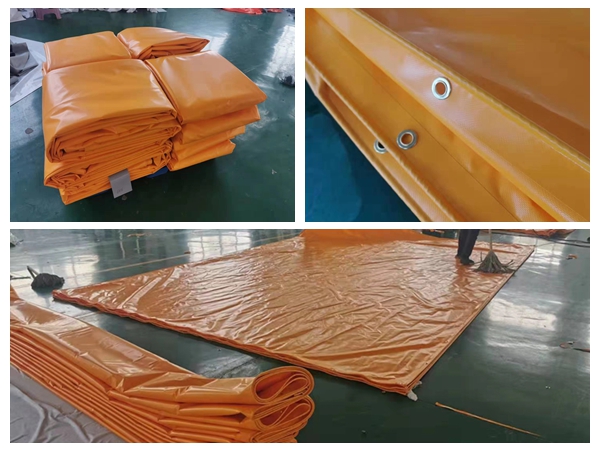
- Grommet/D-ring presence, position and setting condition
- Logo, label, color and packing presentation
Dimensions & CTQs
- Finished length × width × drop
- Feature and hardware locations
- Hem / overlap / patch dimensions
- Thickness or GSM where included in PSI scope
- Carton dimensions and weight where required
Material performance
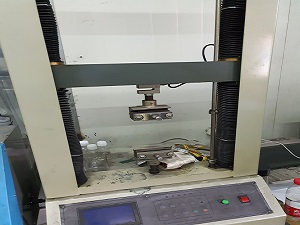
- Tensile and tear performance
- Coating adhesion
- Water penetration or other defined barrier test
- Cold, UV, flex or flame testing when contractually required
- Traceable test report or batch result linked to the ordered grade
Use selected 100% checks when the consequence justifies it. Quantity reconciliation, SKU/size assortment, required labels, critical safety features or known historical failure points may deserve full verification even when workmanship uses an AQL sample. Write the rule into the inspection instruction so scope and cost are clear.
Measure what the purchase specification actually controls
Inspection equipment does not create quality by itself. The useful chain is: approved requirement → defined method → representative sample → recorded result → acceptance decision.
Random does not mean convenient
For mixed tarp orders, the sampling plan must prevent one easy-to-reach size, color or pallet from representing the whole shipment.
Stratify the sample across the lot
- Pull from multiple cartons, bundles or pallets—not only the top layer.
- Represent each material, size, color and printed variant in the sample plan.
- Include different production dates, shifts or batches where the lot definition spans them.
- Record carton/unit identifiers so defects can be traced back to the sampled source.
- Do not allow reworked or “show” pieces to replace randomly selected units without documentation.
Decide how defects are counted
- State whether AQL is based on defective units, defect counts or another defined attribute.
- Define what happens if one tarp contains multiple nonconformities.
- Do not downgrade a severe defect because the same unit also has cosmetic defects.
- Keep measurement failures linked to the inspected unit and requirement.
- For mixed SKUs, define whether acceptance is by combined lot or separate sub-lots.
Pass / hold / fail is more useful than a one-word inspection result
Commercial release decisions should preserve the evidence and responsibility behind the result. A lot can be statistically within the agreed sampling threshold and still require a hold because a mandatory document, critical measurement or batch test is unresolved.
PASS / RELEASE
Defect counts are within the agreed Ac limits, required CTQs meet tolerance, mandatory documents are available, and no unresolved shipment-blocking issue remains.
HOLD / REVIEW
A deviation, missing record, borderline measurement, segregation issue or buyer approval remains open. Goods should not load until disposition is documented.
FAIL / REWORK
The lot reaches the rejection condition or contains a defined critical nonconformity. Contain the affected lot, correct or sort it, then re-inspect under an agreed plan.
After rework: do not simply remove the known bad pieces and reuse the first report. Define the corrective action, segregation method, rework verification and the scope of re-inspection. If the defect suggests a systemic process issue—such as wrong hardware spacing or seam construction—sampling only the repaired pieces may not represent the remaining lot.
Tarpaulin PSI acceptance brief
Send this information with the PO, controlled drawing and approved sample. Blank fields should be resolved before the inspection date.
Eight ways a tarp PSI becomes unreliable
Copying “AQL 2.5” with no defect classes
One number cannot describe the risk of safety defects, functional defects and cosmetic defects at the same time.
Treating AQL as a defect percentage
AQL indexes a sampling plan; it is not a promise that the entire lot contains no more than that percentage of defects.
Inspecting only easy cartons
A convenient sample can miss defects concentrated in one pallet, production period, color or size.
No controlled drawing
Finished size, hardware position and reinforcement cannot be judged objectively if tolerances and datum points are undefined.
Using the golden sample as the whole specification
A physical sample helps with appearance and construction reference but cannot replace measurable material and acceptance criteria.
Mixing lab tests into visual AQL
Tensile, tear, adhesion and regulated performance often need controlled specimens, methods and batch-linked evidence.
Changing severity after a defect is found
Reclassifying a major defect as minor after seeing the count destroys the objectivity of the inspection.
Shipping immediately after “pass”
Confirm unresolved documents, quantity, packing and any conditional findings are closed before loading authorization.
Continue from specification to inspection, release and failure prevention
These DERFLEX resources cover adjacent steps without repeating this AQL acceptance page.
Tarpaulin PSI & AQL questions
What AQL should I use for tarpaulin inspection?
There is no universal AQL for every tarp. Choose the defect-class limits according to application risk, customer requirements, supplier history and the consequence of failure. Many consumer-goods programs use tighter treatment for critical defects and separate AQL values for major and minor defects, but the exact plan should be agreed in the PO or inspection instruction rather than copied blindly.
Is AQL 2.5 the same as allowing 2.5% defective tarps?
No. AQL is an index used by an acceptance-sampling plan. The lot size, inspection level and AQL lead to a sample size and acceptance/rejection numbers. A passing sample does not prove that the whole shipment contains 2.5% or fewer defective units.
What is the difference between a major and minor tarp defect?
A major defect is generally one that materially affects function, saleability, fit or conformity to the approved specification. A minor defect does not materially affect intended use but falls outside the agreed workmanship or cosmetic boundary. The buyer should pre-classify examples for the actual tarp application.
Should critical tarp defects have zero tolerance?
Many buyer inspection plans use zero tolerance for defects defined as critical because they involve safety, prohibited conditions or serious compliance risk. The exact rule must be written into the inspection plan and aligned with applicable regulations and the contract.
When should a pre-shipment inspection take place?
Inspect when the production lot is sufficiently complete and packed to allow representative random sampling, while there is still time to contain, rework or re-inspect goods before loading. The exact readiness threshold should be defined by the buyer and inspection provider.
Can PSI verify tensile strength, UV resistance and flame-retardant performance?
Not reliably through ordinary visual AQL sampling. Those properties normally require a defined laboratory method, specimen preparation and batch-linked test evidence. PSI can verify that the required report, product identity and shipment lot are connected, and can perform selected on-site checks where a valid method has been defined.
What happens when a tarpaulin lot fails AQL inspection?
Place the affected lot on hold, identify the defect pattern and root cause, decide whether sorting/rework/replacement is appropriate, then define the re-inspection scope. Do not release the shipment solely because known defective units were removed; confirm the corrected lot is represented by the new inspection.
What should I send DERFLEX before requesting an inspection-controlled tarp order?
Send the application, supply format, material direction, finished dimensions and tolerances, seams/hem/reinforcement details, hardware map, color/branding, quantity, destination, required test methods, AQL/inspection expectation, packing and any third-party inspection or documentation requirement.
Send DERFLEX a quotation-ready tarp specification and PSI brief
For bulk, OEM and repeat-order tarpaulin programs, define the product and acceptance logic together. This reduces arguments at final inspection because the factory, buyer and inspector are working from the same controlled requirements.
- Application + material / construction direction
- Finished dimensions + drawing / tolerance
- Seams, hems, webbing, grommets and reinforcement
- AQL / defect catalog + on-site tests
- Quantity, packing, labels + destination
Standards note: ISO lists ISO 2859-1:2026 as the current edition for AQL-indexed lot-by-lot acceptance sampling by attributes. Public AQL examples and calculators may be based on ANSI/ASQ Z1.4 or earlier ISO 2859-1 tables; confirm the exact edition and licensed table required by your purchase contract before issuing Ac/Re values. This page is a procurement and quality-planning guide, not a substitute for the applicable standard, regulation or inspection contract.