


TPU Transfer Film Manufacturer for Premium Apparel Decoration, Stretchable Branding, and OEM Heat Transfer Programs
DERFLEX supplies TPU transfer film for buyers who need more than a basic decorative layer. We support garment brands, sportswear manufacturers, workwear suppliers, promotional product companies, transfer converters, printing houses, and OEM procurement teams looking for a more dependable source of custom TPU transfer film, printable TPU transfer film, and TPU heat transfer film solutions that combine softness, elasticity, visual consistency, wash durability, and commercially realistic delivery.
Whether the requirement involves logo transfers for performance wear, number and lettering film for team uniforms, premium matte branding for fashion garments, reflective or specialty transfer effects for safety apparel, or custom transfer film programs for private-label distribution, the real buying questions are usually the same. Buyers want to know whether the film will cut cleanly, weed efficiently, bond consistently, maintain shape under stretch, survive repeated laundering, match the intended finish, and arrive on time with the level of process stability needed for repeatable production.
That is why this page is written for commercial decision-makers rather than casual browsers. Instead of giving only surface-level product language, it explains what TPU transfer film is, why buyers choose it, how technical variables affect performance, what OEM customization options matter most, and how DERFLEX approaches project development for customers who care about quality, documentation, responsiveness, and long-term supply confidence.
What Is TPU Transfer Film?
TPU transfer film is a thermoplastic polyurethane-based film engineered for heat transfer, decoration, identification, and flexible branding applications. In practical purchasing language, it is the category of transfer film buyers choose when they want a finished graphic or logo that feels softer, stretches better, looks cleaner, and behaves more like a premium performance material than a basic rigid film. Depending on the construction, it can be used for cut-and-weed lettering, printable graphic transfer, logo lamination, patch assembly, label applications, or other specialized transfer workflows.
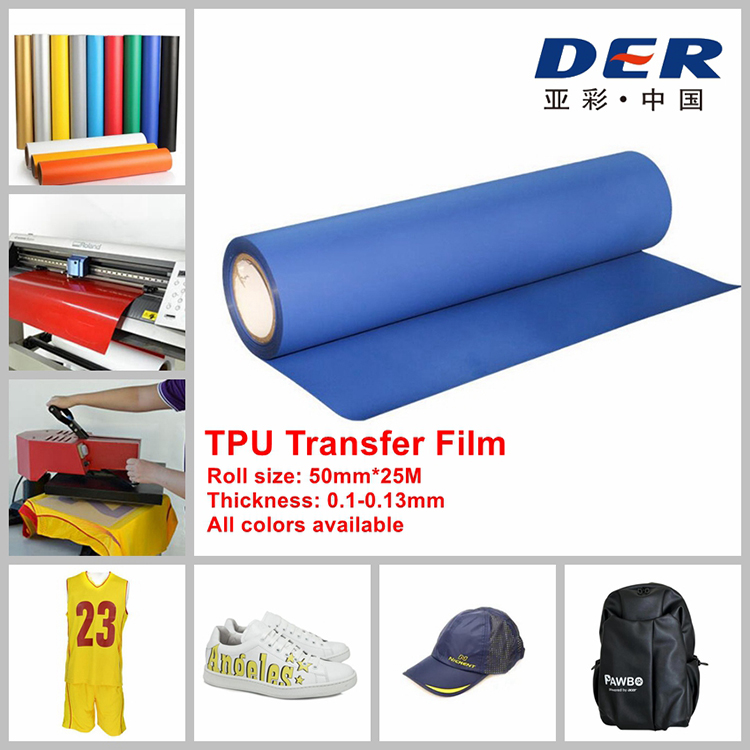
The reason TPU is commercially important is that transfer buyers are no longer judging material by color availability alone. They are evaluating the total result after application: how the transferred design looks, how it feels, how it performs after washing, whether it resists edge lift, whether it distorts on stretch fabrics, whether it supports sharp design detail, and whether it helps the finished garment look more premium in the market. A supplier offering TPU transfer film therefore needs to understand not only the film itself, but also the downstream process and the commercial expectations attached to the final product.
Compared with more basic alternatives, TPU heat transfer film is often selected for applications where flexibility, recovery, softer hand feel, and long-term appearance are important. This is especially true for sports apparel, fashion basics, branding graphics, premium uniforms, outdoor wear, and garments that need to move with the body instead of forcing the transferred area to behave like a stiffer patch. When buyers search for a TPU transfer film manufacturer or TPU transfer film supplier, they are usually looking for this combination of process performance and end-user comfort rather than simply searching for a commodity roll film.
DERFLEX approaches TPU transfer film as a commercially functional product category. That means material selection is considered in relation to cutting behavior, weeding efficiency, transfer performance, finish requirements, washing expectations, OEM needs, and the pace of real-world order fulfillment. For serious buyers, that is a more useful way to evaluate supply than generic brochure language.
Need a TPU transfer film supplier for OEM, custom branding, or transfer conversion projects?
Share your target fabric, transfer process, desired finish, thickness preference, and compliance requirements. DERFLEX can recommend a more suitable custom TPU transfer film pathway for your application.
Key Features Buyers Expect from a Competitive TPU Transfer Film Manufacturer
Soft Hand Feel and Better Garment Comfort
One of the most common reasons buyers move toward TPU transfer film is the desire for a softer result on finished garments. A softer hand feel helps branding graphics feel less intrusive and better aligned with the comfort expectations of sportswear, premium basics, and modern fashion apparel.
Stretchability and Shape Retention
High-stretch garments need transfer materials that move with the substrate. A well-developed TPU heat transfer film can support expansion and recovery more effectively than more rigid options, helping reduce cracking, distortion, or premature edge stress in active applications.
Cleaner Visual Finish
Whether the target effect is matte, semi-gloss, gloss, opaque, or a specialty finish, visual clarity matters. Buyers want branding that looks intentionally designed, not bulky, inconsistent, or obviously low grade after transfer.
Reliable Cutting and Weeding Behavior
Transfer film performance is not judged only after application. It is also judged during production. If a material cuts inconsistently or weeds poorly, time loss and quality problems increase fast. Consistent film construction helps production teams handle intricate letters, logos, and repeat jobs more efficiently.
Wash Durability and Adhesion Stability
Apparel graphics must remain commercially acceptable after laundering. That means buyers pay close attention to adhesion reliability, resistance to edge lift, and appearance retention after repeated wash cycles. A capable TPU transfer film supplier should understand these expectations and design around them.
OEM Flexibility and Project Customization
Not every buyer wants an off-the-shelf grade. Many need custom TPU transfer film development based on thickness, release liner, width, adhesive behavior, packaging, or target substrate. OEM readiness is therefore a major supplier selection factor.
These features matter because commercial buyers are not evaluating TPU transfer film in isolation. They are evaluating how the material supports manufacturing efficiency, finished-product appearance, complaint reduction, and brand positioning. DERFLEX aligns product discussion with that broader reality.
Technical Specifications for TPU Transfer Film
Exact values depend on grade selection and custom development direction. The table below shows the kinds of parameters buyers typically review when sourcing TPU transfer film for apparel, branding, and specialty transfer programs.
| Item | Typical Range / Option | Why It Matters |
|---|---|---|
| Material Base | Thermoplastic Polyurethane (TPU) | Supports softer touch, flexibility, and transfer-oriented performance. |
| Film Thickness | Approx. 50–200 microns, custom options available | Affects hand feel, opacity, cut behavior, and end-use durability. |
| Finish | Matte, semi-matte, gloss, specialty effect | Influences the visual character of the transferred graphic. |
| Color | Standard shades or custom OEM colors | Important for brand matching, seasonal collections, and distributor programs. |
| Carrier / Release Type | Customized according to hot peel, warm peel, or cold peel direction | Directly affects operator handling and process rhythm. |
| Adhesive System | Adjusted according to substrate pathway | Critical for bonding stability on cotton, polyester, blends, or specialty fabrics. |
| Application Window | Defined by grade, process, and buyer equipment | Helps align temperature, time, and pressure with production reality. |
| Roll Width | Customizable by program | Supports OEM conversion efficiency and machine compatibility. |
| Format | Roll goods, sheets, custom packed units | Useful for distributors, converters, or direct manufacturing buyers. |
| Compliance Support | According to selected grade and buyer request | Important for export, brand approval, and regulated supply chains. |
Note: Final specifications should be confirmed through sample evaluation and project-specific technical discussion.
Need custom thickness, finish, adhesive behavior, or OEM packaging?
DERFLEX can support custom TPU transfer film development for distributors, garment factories, decoration converters, and private-label transfer programs.
Applications of TPU Transfer Film
Sportswear and Team Uniforms
Numbers, player names, club marks, sponsor graphics, and premium branding elements often benefit from TPU transfer film because sports garments typically demand stretch, flexibility, and repeated wash performance.
Fashion Apparel and Lifestyle Basics
For modern fashion branding, buyers often want a cleaner, softer, less bulky transfer effect. TPU transfer film is well suited to premium hoodies, T-shirts, active basics, and design-forward casualwear where tactile quality affects perceived value.
Workwear and Industrial Garments
Uniform logos, identification markings, and selected functional graphics on workwear require dependable transfer performance. Depending on the project, TPU transfer film can support branding needs while maintaining a more comfortable hand feel on the finished garment.
Bags, Caps, Footwear, and Accessories
Transfer decoration is not limited to apparel. Many accessory brands need TPU heat transfer film for logo application on soft bags, promotional products, cap panels, and selected footwear components where flexibility and branding accuracy are important.
Label and Patch Assembly
Some transfer film programs are developed for label, emblem, or layered patch applications where bonding control and finished appearance matter as much as color itself. A supplier with OEM experience can help align material choice with the assembly method.
Distribution and Private-Label Transfer Programs
Distributors and brand owners may need custom TPU transfer film grades packaged for resale or integrated into a broader transfer product offering. OEM format flexibility becomes important here because the material must suit both technical expectations and merchandising logic.
The commercial value of TPU transfer film is that it is not tied to one narrow use case. It is a flexible material platform that can be adjusted for multiple branding, decoration, and transfer pathways when development is handled correctly.
Why Choose DERFLEX as Your TPU Transfer Film Supplier?
Commercial Understanding, Not Just Product Language
Serious buyers need a supplier that understands why the product is being purchased, not only what the product is called. DERFLEX communicates around application logic, finished-garment expectations, OEM requirements, and long-term supply practicality rather than limiting the discussion to surface-level product claims.
OEM and Custom Development Support
Many customers require custom TPU transfer film rather than a fixed standard item. DERFLEX can align development around thickness, finish, adhesive behavior, carrier type, width, and commercial format so the product fits real project requirements more closely.
Quality Consistency for Repeat Orders
Buyers evaluating a TPU transfer film manufacturer often care most about repeatability. Stable quality helps reduce the gap between initial sample approval and large-order performance, which is essential for distributors, garment factories, and decoration converters managing production deadlines.
Lead Time Awareness and Delivery Planning
In commercial sourcing, lead time is part of product performance. DERFLEX supports buyer workflows with clearer communication and planning so the transfer material program remains commercially workable, not just technically acceptable.
Documentation and Certification Pathway Support
Export-oriented and brand-sensitive buyers may need compliance or testing support. Depending on the selected grade and project direction, DERFLEX can align with documentation expectations to help make product approval smoother.
Relevant Product Range and Adjacent TPU Capability
A supplier active in related TPU and transfer material categories often brings stronger understanding to the project. That broader material perspective can be valuable when buyers compare finishes, application routes, or adjacent product systems.
For buyers searching online terms like TPU transfer film manufacturer, TPU transfer film supplier, printable TPU transfer film supplier, or custom TPU heat transfer film manufacturer, the real goal is rarely to find the lowest visible price. The real goal is to find a supplier able to support a stable, market-appropriate, production-ready material program. That is where DERFLEX aims to be useful.
TPU Transfer Film Compared with Other Common Transfer Material Pathways
Material selection should match product positioning, process reality, and budget logic. The table below gives buyers a commercial comparison framework rather than an oversimplified claim that one option is always universally better.
| Factor | TPU Transfer Film | Basic PVC-Type Transfer Alternatives | Why Buyers Care |
|---|---|---|---|
| Hand Feel | Usually softer and more premium | Often stiffer or more plastic-like | Influences comfort and perceived garment quality. |
| Stretch Behavior | Better suited to flexible garments and dynamic graphics | May be less adaptable on stretch-intensive uses | Important for activewear, compression wear, and shaped logos. |
| Visual Positioning | Often chosen for cleaner, more advanced branding appearance | Can be acceptable for basic decorative uses | Supports premium brand positioning and finished look. |
| Comfort on Wear | Generally better for apparel touch sensitivity | Can feel heavier depending on construction | Relevant in customer satisfaction and repeat purchase logic. |
| Customization Pathway | Strong opportunity for OEM project tuning | Often more standardized at lower tiers | Important for distributors and private-label transfer programs. |
| Commercial Use Logic | Favored where quality impression matters | May suit budget-sensitive, basic projects | Helps buyers align material with market positioning. |
In other words, TPU transfer film is not simply a trend category. It is a commercially logical choice for buyers serving product segments where better feel, flexibility, and visual refinement translate into stronger finished-product value.
Buying insight: The best TPU transfer film supplier is rarely the one offering the most generic catalog. It is the one able to translate your fabric type, transfer process, visual target, wash expectations, OEM requirements, and order pattern into a more commercially stable material recommendation.
How Serious Buyers Evaluate a TPU Transfer Film Manufacturer
Professional sourcing teams usually move beyond surface-level product descriptions very quickly. When a brand owner, garment factory, distributor, or converter evaluates a TPU transfer film supplier, the decision process becomes more technical and more commercial at the same time. The supplier is not just being judged on whether they can produce a film. They are being judged on whether they can support a repeatable transfer program that works in production, supports finished-product expectations, and reduces business friction over time.
1. Process Compatibility
A material that looks good on paper but behaves poorly in cutting, weeding, transfer, or peeling quickly becomes expensive. Buyers therefore assess whether the TPU transfer film fits the intended workflow, equipment, and operator experience level.
2. Application Fit
Different garments and substrates create different requirements. Activewear, fashion basics, workwear, bags, and accessories do not all require the same transfer film pathway. Good suppliers help narrow the material choice according to actual use.
3. Repeatability
A passing sample is not enough. Commercial buyers care about whether the same result can be reproduced across batches, seasons, and reorder cycles without introducing unpredictable quality changes.
4. OEM Adaptability
Custom width, finish, packaging, and release behavior can significantly improve production efficiency or resale logic. Suppliers that support adjustment often provide stronger long-term value than purely fixed-offer vendors.
5. Communication Speed
In real procurement, slow communication can damage timelines as much as slow production. Timely sample discussion, quotation clarity, and technical follow-up all affect supplier usability.
6. Documentation and Export Readiness
Many buyers need a supplier who can align with compliance requests, testing expectations, or project file requirements. This becomes especially important in brand-sensitive or export-focused programs.
This broader evaluation framework is exactly why terms such as custom TPU transfer film manufacturer, OEM TPU transfer film supplier, and printable TPU transfer film manufacturer have commercial search value. Buyers are not only searching for a product name. They are searching for a supplier profile that reduces risk.
Looking for a TPU transfer film manufacturer that can support sample development and repeat-order stability?
DERFLEX can help evaluate your target application, fabric system, finish preference, and OEM requirements before quotation is finalized.
Case Study: Building a More Commercially Stable TPU Transfer Film Program
Project Background
A buyer serving multiple mid-range sportswear and custom uniform accounts needed a TPU transfer film supplier that could support both standard logo runs and shorter custom batches. Their previous sourcing problems were typical of this segment: sample performance looked acceptable, but larger production exposed inconsistency in cut detail, release behavior, and post-wash appearance. Internal operators also reported time loss during weeding and more frequent rework on small-letter designs.
The customer was not simply buying the cheapest heat transfer film. They were trying to reduce defects, shorten operator hesitation, and improve the perceived quality of finished teamwear while still keeping the program commercially practical.
Evaluation Focus
- Need for softer transferred graphics on stretch polyester garments
- Cleaner weeding on letters, numbers, and sponsor marks
- More predictable peel behavior for production operators
- Better post-wash appearance retention and edge stability
- OEM width and packing preferences for their conversion workflow
- Supplier communication fast enough to support repeat account deadlines
DERFLEX Solution Logic
Instead of recommending a generic film immediately, the project started with a use-case review: garment composition, design detail level, application equipment, and operator preferences. A more appropriate TPU transfer film configuration was then proposed with attention to handle, release behavior, and practical production repeatability. OEM format alignment was included so that the customer could integrate the material into their own workflow rather than reorganizing production around the material.
The solution was not framed as “premium for the sake of premium.” It was framed as a better commercial fit: fewer processing interruptions, cleaner graphics, stronger buyer confidence during client approvals, and a more coherent path to repeat orders.
Commercial Outcome
The key result was not one isolated technical metric. It was a better production experience and a stronger finished product impression. The buyer gained a transfer film program that was easier for operators to manage, easier for customers to approve, and better aligned with the quality level expected in modern sportswear decoration. This is the real value of choosing the right TPU transfer film manufacturer: reducing friction between material selection, production execution, and market positioning.
Related TPU and Transfer Resources
To strengthen internal relevance around TPU transfer film, printable transfer materials, and adjacent TPU categories, the following related pages can be linked from this page and reused in your internal link strategy.
- How to choose printable TPU transfer film — useful supporting content for buyers comparing film types and selection logic.
- TPU materials manufacturer — broader category page connecting TPU film expertise with industrial material capability.
- Heat transfer film applications — application-oriented supporting page relevant to use-case intent.
- TPU laminated fabric manufacturer — adjacent TPU material page that helps build thematic depth around thermoplastic polyurethane solutions.
- TPU laminate material manufacturer — related technical page supporting broader TPU authority.
- PU fluorescent heat transfer vinyl film — relevant specialty transfer product for buyers looking at functional and visibility-oriented options.
Frequently Asked Questions About TPU Transfer Film
What is TPU transfer film used for?
TPU transfer film is widely used for logos, numbers, letters, decorative graphics, labels, and flexible branding on garments, sportswear, workwear, bags, caps, footwear components, and selected accessories. Buyers choose it when they need a better combination of softness, stretch, visual quality, and durability than more basic transfer materials can offer.
Is TPU transfer film better than PVC transfer film?
For many apparel and premium branding projects, TPU transfer film is preferred because it generally supports a softer feel, better flexibility, and a more advanced appearance. However, the right material still depends on the substrate, process, cost target, finish requirement, and durability expectation. A supplier should help evaluate the real fit rather than making universal claims.
Can TPU transfer film be customized?
Yes. DERFLEX supports OEM and custom development for thickness, finish, carrier type, peel behavior, width, roll length, packaging, and other practical variables. For private-label or distribution buyers, custom packing and branded presentation can also be considered depending on the program.
Which fabrics can TPU transfer film work with?
Depending on the formulation and adhesive system, TPU transfer film can be developed for cotton, polyester, blends, stretch fabrics, and certain nylon-oriented pathways. Because garment finishing and dye content vary, fabric testing before mass production is always recommended.
What should buyers check when choosing a TPU transfer film supplier?
Buyers should look at more than price. The critical factors include adhesion stability, wash behavior, stretch performance, visual consistency, cutting and weeding behavior, sample response speed, OEM flexibility, lot-to-lot control, lead time reliability, and documentation support. These factors determine whether the program will work commercially after sample approval.
How does DERFLEX support OEM buyers and distributors?
DERFLEX can support custom specification pathways, private-label considerations, sample development, width and package adjustment, and project-aligned communication so that buyers are not forced into a purely standard catalog approach. This is especially valuable for distributors, converters, , and growing apparel supply chains that need differentiated offerings.
Ready to source TPU transfer film from a manufacturer focused on OEM flexibility, quality consistency, and reliable delivery?
Tell us your application, target market, transfer process, finish preference, compliance requirements, and order volume. DERFLEX will help you evaluate the more suitable TPU transfer film option for your project.