Heat-Resistant Reinforcement
The fiberglass base remains dimensionally stable in hot industrial environments, but the usable limit of the coated composite must be based on the complete grade—not the fiberglass substrate alone.



DERFLEX Technical Coated Fabric Guide
Silicone coated fiberglass fabric is a heat-resistant composite textile made by coating woven fiberglass cloth with silicone rubber on one or both sides. It combines the dimensional stability and thermal reinforcement of glass fiber with a flexible protective surface suited to industrial jackets, welding protection, expansion joints, duct connectors, thermal shields and OEM fabrication.
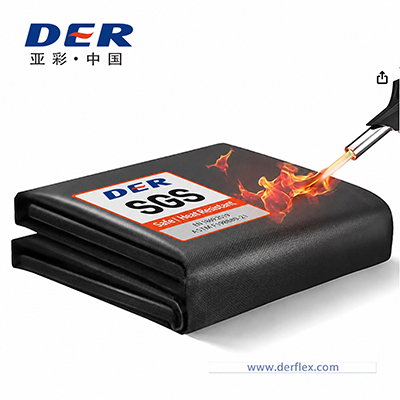
DERFLEX silicone-coated fiberglass reference image. Final weight, thickness, color, coating side, flame-performance route and temperature capability depend on the confirmed grade.
Quick Answer
Silicone coated fiberglass fabric—also called silicone fiberglass cloth, silicone rubber coated fiberglass fabric or silicone coated glass fabric—is woven fiberglass reinforced with a cured silicone coating. The glass provides strength, dimensional stability and heat resistance; the silicone adds a flexible, protective surface that better handles moisture, oil, weathering, abrasion and repeated fabrication.
These are purchasing reference ranges across current DERFLEX silicone-fiberglass programs, not a promise that every combination is available or appropriate for every application.
Material Construction
The material is a composite rather than a single homogeneous sheet. Its performance comes from the interaction between the woven fiberglass substrate and the silicone rubber coating.
Fiberglass yarns are woven into a stable textile base. Silicone compound is then applied and cured on one side or both sides. Depending on the grade, the coating amount, surface texture, color, thickness and flame-performance direction can be adjusted for the finished application.
Flexible protective coating for moisture, oil, weathering, abrasion and handling.
Heat-resistant reinforcement for tensile support and dimensional stability.
Added when both faces need stronger surface protection, cleanability or repeated handling durability.
Performance Logic
The fiberglass base remains dimensionally stable in hot industrial environments, but the usable limit of the coated composite must be based on the complete grade—not the fiberglass substrate alone.
Silicone provides a more elastomeric surface than bare glass cloth, helping converted parts wrap around pipes, valves, machinery, ducts and irregular equipment.
The coated surface is useful where rain, humidity, ozone and outdoor exposure would be undesirable for an uncoated fiberglass textile.
Silicone-coated surfaces are often selected for jackets, covers and flexible barriers that may encounter oil mist, dirty maintenance conditions and repeated removal.
The cured coating helps protect glass fibers from surface scuffing during folding, cutting, sewing, installation and reuse.
Roll goods can be cut, sewn, punched, grommeted and assembled into jackets, curtains, shields and connectors after the production conversion method is validated.
Temperature Selection
There is no universal temperature rating for all silicone fiberglass fabric. DERFLEX currently discusses selected constructions around approximately 230–287°C (446–549°F) continuous exposure at the silicone surface. The exact continuous limit, short peak exposure and finished-product suitability must be confirmed for the specific grade.
The sustained temperature the selected composite grade is approved to handle under defined operating conditions.
A brief excursion can be a separate limit. State the peak value, duration and frequency rather than treating it as a continuous rating.
Pipe, turbine, kiln or gas-stream temperature may be much higher than the temperature at the coated fabric when insulation, liners or air gaps are present.
For a deeper comparison of continuous, peak and assembly temperatures, see the DERFLEX Coated Fiberglass Temperature Rating Guide.
Specification Overview
The table below is a procurement framework based on current DERFLEX product directions. Final tolerances and availability should be confirmed against the exact requested grade, approved sample and required test documents.
| Specification Item | Current DERFLEX Direction | Why It Matters to Buyers |
|---|---|---|
| Product names | Silicone coated fiberglass fabric, silicone fiberglass cloth, silicone rubber coated fiberglass fabric | Different industries use different naming conventions for the same material family. |
| Base substrate | Woven fiberglass; E-glass or project-matched construction | Weave and yarn construction affect strength, thickness, drape and conversion. |
| Coating | Silicone rubber on one or both sides; FR direction can be reviewed | Coating side changes surface protection, weight, flexibility and cost. |
| Weight | Approx. 260–2000 g/m2 across current program directions | GSM is useful only when combined with base cloth, coating and application. |
| Thickness | Approx. 0.25–3.0 mm depending on base cloth and coating loading | Thicker is not automatically better; consider flexibility, fold radius and final assembly. |
| Common width directions | 1000 / 1200 / 1500 mm; other widths depend on product route | Width directly affects cutting yield, seams and roll conversion efficiency. |
| Color direction | Red, grey, black, white, yellow and project-based colors | Color may support identification, OEM appearance or operating requirements. |
| Supply formats | Roll goods, slit widths, cut pieces and selected OEM conversion | Choose the format that fits the converter's cutting and fabrication process. |
| Temperature | Selected grades commonly discussed around approx. 230–287°C continuous silicone-surface exposure | Exact grade, exposure time and complete assembly must be validated. |
Single-Side vs Double-Side
Application Mapping
The correct grade should be selected from the finished product duty. A welding curtain, insulation jacket and expansion-joint belt may all use silicone fiberglass cloth, but they do not necessarily need the same weight, coating loading, temperature direction or flame-performance evidence.
Outer shell material around valves, flanges, turbines, exhaust systems, pumps and process equipment that require repeated maintenance access.
Converted protective textile for sparks, spatter and radiant heat, subject to the exact welding process, orientation and required test route.
Flexible protective or functional layers where thermal movement, vibration, weathering and handling occur together.
Connector material for equipment and duct interfaces where heat, vibration and flexing must be balanced.
Flexible covers for machinery, piping and components where rigid sheet protection is impractical.
Part of a validated flame-resistant or heat-protection assembly when the material grade and system test requirements are matched.
Used around insulation systems, connectors and expansion-joint layers exposed to heat, dust, oil, weather and maintenance cycles.
Roll supply for brands and fabricators making custom covers, sleeves, pads, curtains, connectors and industrial protection products.
DERFLEX Image Pack
Buyer Selection Matrix
Start from the finished application and operating environment, then freeze the raw-material specification. Selecting only by GSM, thickness or a single temperature number can produce a technically unequal comparison.
State continuous temperature, peak temperature, peak duration, radiant heat, direct flame, spark or spatter exposure, plus distance from the heat source.
Specify whether the material becomes an insulation jacket, welding curtain, blanket, expansion joint, connector, sleeve, cover or another converted product.
Rank flexibility, abrasion resistance, tear performance, repeated folding, hanging load, cleanability and dimensional stability.
Confirm one-side or two-side coating, silicone loading direction, surface finish and any flame-retardant requirement.
Report water, oil, steam, cleaning agents, acids, alkalis, fuels or process chemicals rather than assuming generic chemical resistance.
Confirm weight, thickness, width, roll length, color, tolerance expectations, packaging, sample quantity and estimated bulk demand.
Application Decision Table
| Application Priority | Starting Direction | Confirm Before Ordering |
|---|---|---|
| Light curtain or flexible shield | Lighter, more drapable coated construction | Heat direction, hanging load, edge construction, spark/spatter exposure and flame test requirement. |
| Reusable insulation jacket | Balanced one- or two-side silicone fiberglass | Outer-shell temperature, oil/water contact, repeated handling, sewing thread, fasteners and cleaning. |
| Fabric expansion joint | Project-matched heavier silicone fiberglass or multi-layer system | Gas/layer temperature, chemical media, movement cycles, pressure, abrasion, seam/splice and clamp geometry. |
| Welding blanket or curtain | Heat/flame-oriented coated fiberglass selected to the hazard | Welding process, orientation, molten spatter, direct flame and required finished-product test. |
| Outdoor equipment cover | Silicone-coated surface with weather and handling priorities | UV/weather cycle, water ingress through seams, abrasion points, fastening and actual temperature. |
| Non-stick process surface | Consider PTFE coated fiberglass instead | Release requirement, friction, chemical exposure, contact pressure and process temperature. |
Silicone vs PTFE
Both materials use fiberglass reinforcement, but the coating chemistry changes the dominant surface behavior. Silicone is usually the stronger starting direction for flexible protective products that are repeatedly folded, handled, exposed outdoors or contaminated by moisture and oil. PTFE is usually the stronger starting direction when non-stick release, lower friction or chemical-facing process performance is central.
| Selection Factor | Silicone Coated Fiberglass | PTFE Coated Fiberglass |
|---|---|---|
| Surface feel | More elastomeric and comparatively grippy | Smoother and lower friction |
| Repeated folding & handling | Strong starting direction | Grade dependent; surface function often drives selection |
| Moisture / oil protective use | Common advantage | Good chemical direction but chosen for different process priorities |
| Non-stick release | Not usually the main reason to select it | Major advantage |
| Typical products | Jackets, blankets, curtains, connectors, expansion-joint layers | Release sheets, belts, process liners, heat-sealing surfaces |
See the full DERFLEX comparison: Silicone Coated Fiberglass vs PTFE Coated Fiberglass.
Common Procurement Mistakes
The silicone coating, seam or another exposed component can become the limiting element before the base glass cloth.
A short temperature excursion does not prove long-term service suitability.
Base weave, coating amount and surface finish can matter as much as total weight.
One-side and two-side materials solve different exposure and handling problems.
Flame resistance, burn-through, radiant heat and continuous temperature are different requirements.
Cutting, sewing, punching, clamping and seams can change finished-product performance.
Make sure suppliers quote the same base cloth, coating side, coating loading, thickness, width, color and test route.
RFQ Checklist
Related DERFLEX Resources
Related Questions
It is a composite technical textile made by coating woven fiberglass cloth with cured silicone rubber on one side or both sides. The fiberglass provides heat-resistant reinforcement and dimensional stability, while the silicone surface improves flexibility, handling durability and resistance to moisture, oil and weather.
Typical uses include removable insulation jackets, welding blankets and curtains, fabric expansion joints, flexible duct connectors, thermal shields, equipment covers and other converted industrial textile products.
There is no single temperature rating for every grade. DERFLEX currently discusses selected silicone-coated constructions around approximately 230–287°C (446–549°F) continuous exposure at the silicone surface. Exact suitability depends on the coating formulation, fiberglass base, exposure duration and complete finished assembly.
The silicone-coated surface can provide strong water resistance. A finished product is only as waterproof as its seams, needle holes, edges, joints and assembly design. If hydrostatic or liquid-containment performance matters, specify the required test.
“Fireproof” is too broad for an engineering specification. Silicone-coated fiberglass can be used in heat- and flame-resistant products, but the exact material grade, test method, orientation, exposure and complete finished assembly must be validated.
Silicone coated fiberglass is commonly selected for flexible handling, protective surface behavior, moisture or oil exposure, weathering and repeated folding. PTFE coated fiberglass is typically selected when non-stick release, low friction and chemical-facing process behavior are the main priorities.
Single-side coating works well when the exposure is mainly directional and lower coating mass or greater flexibility is desired. Double-side coating is often selected when both faces need moisture, oil, abrasion or handling protection.
Many silicone fiberglass roll goods are converted by cutting and sewing, but the thread, needle, seam geometry, edge reinforcement and temperature exposure must be selected for the finished product. A fabrication trial should be completed before bulk production.
Talk to DERFLEX
Send your application, continuous and peak temperature, coating side, weight or thickness, width, color, liquid or chemical exposure, fabrication method, quantity and required test route. DERFLEX can review a practical silicone coated fiberglass direction for sampling and quotation.