



Material troubleshooting guide
Why Does PVC Tarp Fabric Become Sticky? Causes and Prevention
A tacky surface, rolls that resist unrolling, and coating that lifts during separation need different responses. Identify the symptom before changing the cleaner—or ordering the same fabric again.
For tarp fabricators, distributors, fleet buyers and OEM cover programs, this guide connects PVC tarpaulin maintenance with material selection and batch acceptance. DERFLEX supplies PVC coated polyester fabric and custom tarp solutions; discuss the surface finish, dimensions, color and supply format against your actual application.
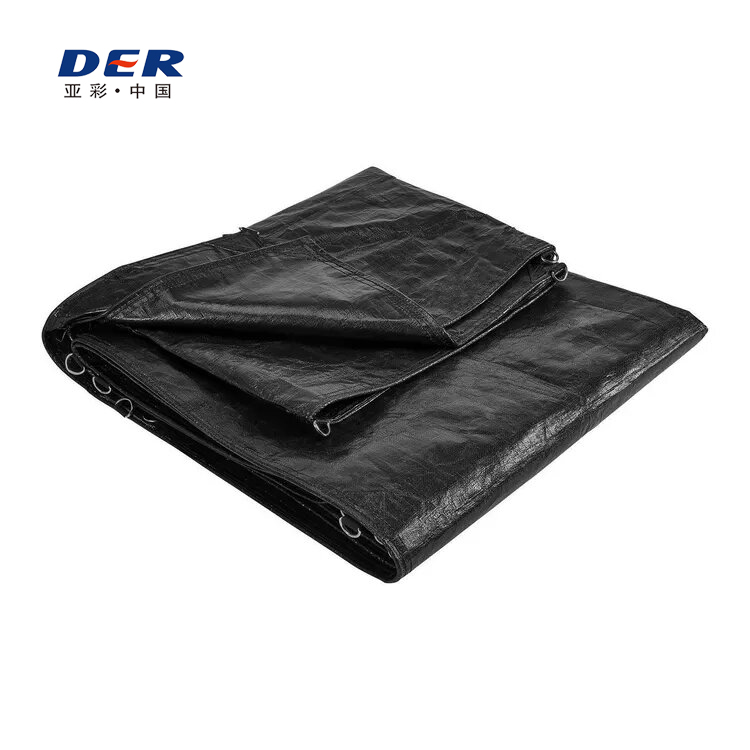
01 / Identify what is happening
Sticky, blocked or contaminated? Start with the pattern.
Surface tack is the feel of an exposed face. Blocking is adhesion between two faces held together. They can occur together, but neither proves plasticizer migration without further investigation.
| What you observe | What to investigate | Useful next action |
|---|---|---|
| Greasy or tacky film over a broad area | Plasticizer or additive exudation; widespread cleaner or oil residue. | Compare cleaned and untreated zones. Keep a sample for supplier analysis if tack returns. |
| Roll layers cling only where compressed | Blocking associated with contact time, temperature, winding pressure or the finish. | Record storage history and affected roll position. Examine both faces after gentle separation. |
| Localized sticky patch near a label, repair or machine contact | Adhesive residue, lubricant, fuel or contact-material incompatibility. | Identify the contacting substance before selecting a cleaning product. |
| Tack appeared after washing | Cleaner left behind, chemical attack or finish damage. | Record the product and dilution. Try an approved water rinse on a small area first. |
| Damp folds with odor or visible deposits | Retained moisture, organic dirt or microbial contamination. | Open, dry and inspect the folds. Moisture symptoms alone do not confirm migration. |
| Color transfer, peeling, cracks or exposed scrim | Coating, finish or print damage that may affect use. | Hold the affected material for assessment. Do not force layers apart or clean repeatedly. |
For other coating problems, compare the broader DERFLEX guide to PVC coated tarpaulin defects. The checks here are screening observations, not a laboratory identification of the chemical cause.
02 / Understand the causes
What can make PVC coated fabric tacky?
CAUSE 01
Plasticizer migration and surface exudation
Plasticizers make flexible PVC workable and pliable. In conventional plasticized PVC, these additives are dispersed within the material rather than chemically attached to its polymer chains. Some can move to a surface or into a contacting material.
A compatible formulation helps limit unwanted movement. Surface exudation can attract dirt; loss from the coating can eventually reduce flexibility. An oily feel is a clue to investigate, not proof of a particular plasticizer or formulation fault. [1]
CAUSE 02
Heat, sustained pressure and long contact
Heat can increase additive mobility and soften a surface. In a tightly wound roll or compressed folded stack, coated faces remain in contact. The combination can promote blocking, even when no visible liquid film is present.
The relevant temperature is the material's actual exposure during storage and transport. A service temperature range is not automatically an approved condition for tightly packed storage. Blocking tests assess temperature, time and pressure together. [2]
CAUSE 03
Chemicals, residues and contacting materials
Oil, adhesive residue and incompletely rinsed detergent can leave a sticky deposit. Some chemicals also affect PVC or its surface finish. Contact with a repair adhesive, foam, gasket or printed layer may create a separate compatibility problem.
Record the exact substance and contact duration. A waterproof cover is not automatically resistant to diesel, hydraulic oil or solvent cleaners. Review oil-resistant tarp selection by fluid and exposure when those contacts are part of the job.
CAUSE 04
Weathered finishes or a new-roll process issue
A surface treatment influences dirt pickup, cleaning and contact behavior. Abrasion, weathering or an incompatible cleaner can change that surface. A finish may slow additive movement; it does not establish permanent resistance to tack or blocking.
For newly delivered tacky rolls, ask the supplier to review formulation compatibility, PVC fusion or gelation, finish drying, cooling and winding. These are investigation points; the appearance alone cannot identify a production error. [3]
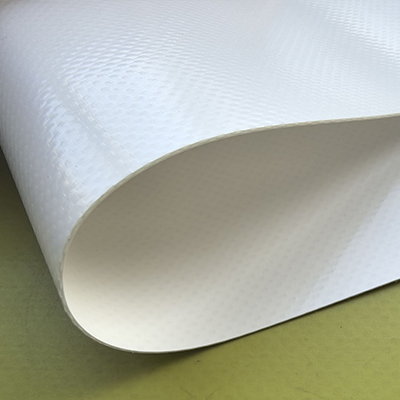
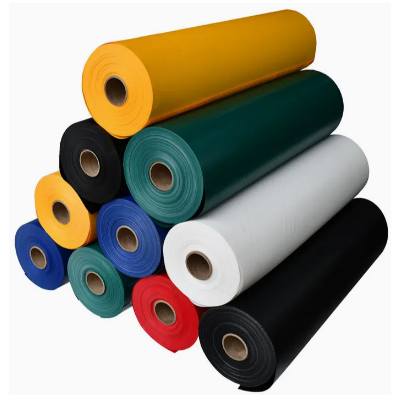
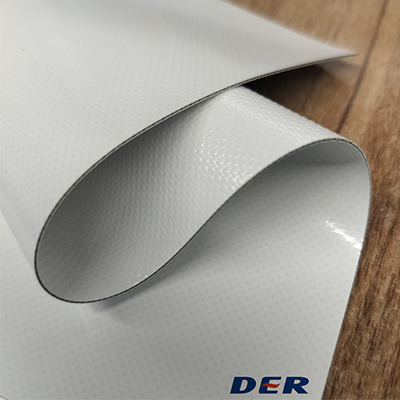
All photographs are existing DERFLEX website assets. They illustrate materials and supply formats; they do not document a failure analysis.
03 / Respond without worsening the surface
How do you clean a sticky PVC tarp safely?
Use the material supplier's approved care method on a small test area first. Cleaning may remove contamination or surface exudate, but it cannot restore missing plasticizer, rebuild a damaged coating or establish that a roll meets its specification.
Document before washing
Photograph both faces, folds, labels and any transfer. Record the roll or lot number, cleaner history and when the symptom started. Preserve an untouched sample if a claim or analysis is needed.
Remove loose debris gently
Use a soft cloth or brush on a clean work surface. Avoid spreading oil or adhesive residue across unaffected fabric. Do not pull apart firmly stuck layers.
Test an approved mild cleaner
Follow the product-specific care instructions, dilution and dwell time. Use cool or lukewarm water and a soft cloth. Stop if color, print or coating transfers, or the surface changes.
Rinse and air dry fully
Remove cleaner from both sides. Dry folds, hems and reinforced zones before packing. Do not use a heat gun, steam or hot-water treatment to soften a blocked roll.
Compare with the untouched zone
Evaluate under the same conditions after drying and again after an agreed observation period. Improvement supports a removable-deposit explanation; recurring tack calls for further investigation.
Assess before returning to use
Check coating integrity and the application's required performance. Hold peeling, cracked or transferring material for assessment. Do not judge waterproofness or seam suitability by feel alone.
For routine maintenance beyond this specific symptom, follow the DERFLEX tarp cleaning and storage guide.
04 / Match prevention to the use
How can you prevent PVC tarpaulin from becoming sticky?
Combine material selection with storage and contact control. A heavier tarp or a more expensive finish does not, by itself, resolve every source of tackiness.
| Application or exposure | Priority in the specification | Handling and verification |
|---|---|---|
| Bulk rolls in warm warehouses or long transit | Blocking behavior under defined temperature, pressure and storage duration; compatible surface and packaging. | Follow supplier roll-support instructions. Avoid added crushing loads and direct sunlight; track actual conditions. |
| Repeatedly folded truck or equipment covers | Face-to-face contact behavior, fold flexibility and coating durability. | Clean and dry before folding. Avoid storing against oily machinery or compressing dirty folds. |
| Roll-up doors and industrial curtains | Separation during repeated contact cycles, abrasion and the required operating flexibility. | Trial the actual face pairing and contact arrangement. Check both surface tack and coating transfer. |
| Printed PVC tarps or OEM graphics | Compatibility between coating, finish and ink; print drying and transfer behavior. | Check printed-to-coated contact after the defined drying period. Do not pack solely because the ink feels touch-dry. |
| Fuel, oil, repair adhesive or aggressive cleaner contact | Resistance to the named chemical and compatibility with contacting materials. | Use representative contact trials. A clean-water test cannot verify oil or solvent resistance. |
| Damp seasonal storage | Cleaning guidance, drying access and surface condition after storage. | Open and dry all layers. Keep contamination out of folds and inspect before reuse. |
Ask what “anti-sticky” means for your application.
DERFLEX's roll-up door fabric range includes a listed anti-sticky fabric option. Confirm the current grade, finish, test conditions and suitability for your contact cycle before applying that description to another tarp or storage program.
The term describes a material direction; it is not a guarantee of unrestricted heat, pressure, chemical exposure or storage life.
05 / Define the material you need
What should a PVC tarp fabric buying specification include?
Use DERFLEX PVC tarpaulin and coated polyester fabric options as the product starting point. For a tack or blocking concern, put the surface requirement beside strength, weight and dimensions.
| Field | What to state | Why it matters |
|---|---|---|
| Material and construction | PVC coated or laminated polyester; required face configuration and reinforcement. Confirm the supplied grade. | Keep the sampled structure consistent with bulk production. |
| GSM, thickness and dimensions | Target mass, thickness, roll width or finished size, and agreed tolerances. | These specify physical construction; they do not measure migration or blocking. |
| Surface finish | Required finish on each face, printing needs and easy-clean or anti-blocking objective. | Different faces and finishes may behave differently in contact. |
| Storage and service exposure | Expected material temperatures, contact duration, pressure or stack arrangement, moisture and UV exposure. | Supply conditions should represent the actual route and use. |
| Chemical and contact compatibility | Cleaner names, oils, inks, adhesives, foams, separators and repair materials. | Specify the interaction the fabric must tolerate. |
| Fabrication | Hot-air or HF welding, printing, sewing and edge construction as applicable. | Confirm the finish works with the intended joining process. |
| Acceptance and traceability | Sample reference, face pairing, test method, conditioning and allowed transfer or damage. | A shared acceptance definition makes batch comparison useful. |
| Commercial supply | Quantity, roll goods or finished tarps, packaging and destination. Confirm MOQ, price and lead time for the selected specification. | Custom supply terms depend on the order; fixed values are not assumed here. |
GSM is not a surface test
Two fabrics of the same weight can have different finishes and contact behavior. Ask for an application-matched comparison.
Approve welding with the finish
Surface sealing can change weldability. Make seam trials before bulk conversion; confirm any preparation with the supplier.
Use an agreed sample reference
Keep an identified approved sample and its specification. A new grade name or an unsupported “non-sticky” claim is not enough.
06 / Make repeat orders reviewable
A batch acceptance plan for tack and blocking
Agree the method and limits before production. ISO 5978:2023 describes blocking-resistance testing of coated fabrics under specified temperature, time and pressure. Its scope does not prove that any DERFLEX grade has been tested or passed.
Prepare a representative comparison
- Identify the material. Record lot, roll, sample position, color, finish and printed or unprinted state.
- Set the contact. Include the relevant face-to-face or face-to-back pairing and any actual packing or contact material.
- Define the exposure. Agree temperature, duration, pressure, conditioning and recovery before inspection with the supplier or laboratory.
- Compare against the approved reference. Use the same conditions and record tack, separation behavior, residue, color transfer and coating damage.
- Check the intended function. Where necessary, add suitable coating, seam, printing and waterproof-performance checks.
Keep field screening separate from the agreed laboratory method.
The observations above help document a problem. Do not substitute an improvised heated stack for a standard test or use accelerated results as an unvalidated prediction of service life.
What belongs in the acceptance record?
- Approved sample and bulk lot identification
- Both contact faces and any separator or ink layer
- Test method and exact conditioning agreed in advance
- Separation rating or measurement specified by that method
- Permitted residue, print transfer and appearance change
- Coating integrity and required seam or cover checks
- Decision: release, hold, investigate or reject against agreed limits
Separate methods may be needed to confirm plasticizer migration or chemical damage. Blocking and subjective tack checks do not identify the migrated substance.
07 / Turn the symptom into a useful enquiry
Send DERFLEX the exposure—not just “sticky fabric.”
A PVC tarp fabric manufacturer or supplier can make a more useful recommendation when the problem is tied to a specific use, storage route and surface contact. DERFLEX's custom and industrial tarp solutions cover material and finished-cover directions for B2B and OEM buyers.
For wholesale rolls or repeat OEM orders, discuss the current specification, a suitable sample, surface finish and an acceptance plan before confirming bulk supply. Share a photograph of both faces and a retained sample when available.
Questions buyers ask
Sticky PVC tarp fabric: frequently asked questions
Why does PVC tarp fabric become sticky as it ages?
One possible cause is plasticizer migration: mobile additives reach the surface and can leave a tacky residue. Weathering, chemical contact, topcoat damage and external contamination can also affect the feel. Tackiness alone does not identify the cause.
Is sticky PVC tarpaulin always a manufacturing defect?
No. Age, heat, storage pressure, cleaning products and contamination can contribute. However, new material that blocks, transfers coating or fails the agreed acceptance conditions requires a supplier investigation. Calling blocking normal does not establish that a batch meets its specification.
How do you clean a sticky PVC tarp?
First check the fabric's care instructions. Test a small area with an approved mild cleaner and a soft cloth, rinse thoroughly and air dry completely. Compare it with an untreated area. If tack returns or the coating transfers, stop repeated cleaning and ask the supplier to assess the material.
Why do PVC tarpaulin rolls stick together?
Blocking is adhesion between surfaces held in contact. Heat, pressure, contact duration, surface formulation and printing or finishing conditions can influence it. A roll can block without a visible oily film, so test separation and surface transfer as well as tack.
Does humidity directly cause plasticizer migration?
Humidity alone is not enough to diagnose migration. Damp folds can retain cleaner, organic residue and microbial deposits that change the surface feel. Record moisture conditions alongside heat, contact materials and cleaning history.
Will a heavier GSM prevent a PVC tarp from becoming sticky?
No. GSM is total mass per unit area, not a measure of plasticizer permanence or blocking resistance. Specify the surface behavior, exposure conditions, coating construction and verification method as well as fabric weight.
What should buyers request for anti-sticky PVC tarp fabric?
Request an application-matched sample, a confirmed surface finish, cleaning guidance and agreed blocking test conditions. Include temperature, pressure, duration, contact faces and acceptable separation or transfer. ISO 5978:2023 is a method to discuss with the supplier or laboratory, not proof that a specific product has passed.
Can sticky PVC fabric still be welded or used as a waterproof cover?
Do not decide from tack alone. Check coating integrity and the required waterproof performance, and make seam trials using the actual finish and process. Oils, powders and unapproved cleaning or release products can contaminate the weld zone. Hold material with coating transfer, exposed scrim or damaged seams for assessment.