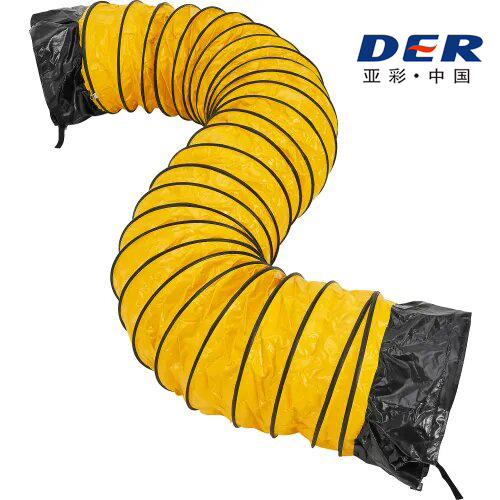
Why Coal Mine Ducting Is Different
A coal mine ventilation duct is a safety-relevant air path, not a generic industrial hose.
Underground coal mine ventilation uses fans, controls and duct routes to deliver or remove air in areas that the main ventilation circuit does not directly serve. In an advancing heading, the auxiliary duct line has to move with the work front while avoiding vehicles, cable trays, conveyors, roof supports, wet rock and changing suspension points. That makes installation geometry part of the product specification.
The duct body is only one layer of the decision. Air lost through joints or damaged seams reduces what reaches the face. A long positive-pressure line can benefit from compact layflat sections, while negative-pressure extraction normally requires a structure that resists collapse. Low-headroom sections may need an oval or shaped profile. Fan adaptors, reducers, bends and branch pieces may also need to share the same connection system.
Coal-mine safety language must be translated into testable requirements.
Terms such as flame retardant, antistatic and FRAS are useful procurement shorthand, but they do not define one universal performance level. The project should state the applicable flame test, electrical resistance / static-control test, acceptance limit, required sample format, third-party reporting requirement and any authority-specific approval route. DERFLEX can then review whether the requested construction and documentation pathway are feasible before bulk production.
This distinction is especially important for underground coal mine ventilation ducting because the site may have combustible gas or coal-dust hazards. A coated textile or flexible duct should never be described as making the whole mine or ventilation system “explosion-proof.” Duct construction is only one part of the operator's full ventilation, ignition-control, monitoring and statutory safety system.
Specification principle: state the required standard or approval route before asking for a “compliant” duct. Final legal acceptance belongs to the mine operator, responsible ventilation / safety engineer and applicable authority in the project jurisdiction.