



Collapsible Ventilation Ducting
Pack the air route down for transport. Expand it where the work starts.
DERFLEX supplies flexible collapsible ventilation ducting for portable blowers, temporary fresh-air supply, fume extraction and changing industrial work zones. The duct can be configured around the fan interface, pressure direction, route length, bends, handling frequency and storage method—so the finished assembly is specified as part of the ventilation system, not as a generic hose by diameter alone.

What “collapsible ventilation ducting” actually means
In industrial purchasing, “collapsible” can describe more than one duct architecture. The useful question is not simply whether the hose folds or compresses; it is how the airway behaves when the fan is pushing or pulling air.
Axially retractable duct
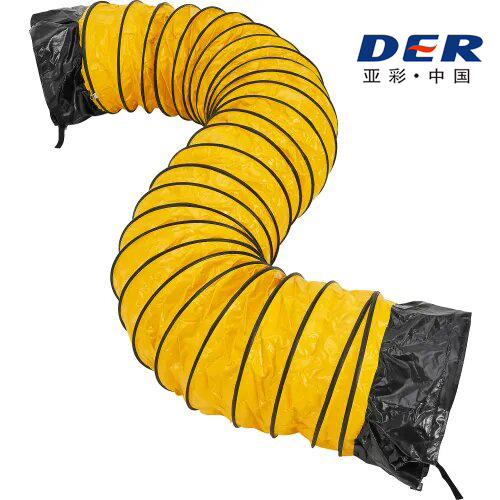
A wire-supported hose compresses like an accordion along its length for transport, then extends to create a shape-retaining air path. This is commonly considered for portable blower and extraction duties.
Layflat collapsible duct
An unsupported or lightly supported textile tube can collapse substantially flat when the fan is off. Positive internal pressure opens the bore during fresh-air supply.
“Non-collapsible” under suction
A product may be collapsible for storage yet designed not to collapse radially during extraction. A spring-steel helix helps preserve the air passage under negative pressure and bends.
From packed state to operating state—and back again
For crews that move ventilation equipment between tanks, utility spaces, production cells or temporary job zones, handling behavior can be as important as the duct textile itself.
Anatomy of a collapsible industrial air duct
A finished duct is a coordinated assembly. Changing one element—wire pitch, cuff geometry, seam construction or wear protection—can change how the hose handles pressure, bending and repeated relocation.
Which collapsible duct structure fits the job?
A flexible hose that performs well on the discharge side of a blower may not remain open on the suction side. Use the airflow mode and route as the first filter.
| Structure | Best starting point | Storage behavior | Pressure behavior | Typical purchasing scenario |
|---|---|---|---|---|
| Layflat positive-pressure duct | Fresh-air supply / blowing | Collapses substantially flat | Inflates under positive internal pressure | Long temporary supply routes, tunnels, construction, advancing work zones |
| Spiral wire-reinforced retractable duct | Extraction, suction, portable blower connection | Compresses axially like an accordion | Helix helps resist radial collapse | Confined spaces, tanks, shipyards, maintenance, mobile exhaust |
| Custom reinforced / ring-supported duct | Special clearance, bend or handling conditions | Depends on reinforcement layout | Configured for project pressure and geometry | OEM equipment kits, specialized fan interfaces, low-headroom or mixed routing |
Collapsible ventilation ducting specifications for RFQ planning
The ranges below are planning references for DERFLEX flexible duct projects. Final values are confirmed against the blower, airflow direction, pressure, route, handling conditions and agreed test method.
| Finished product | Collapsible / retractable flexible ventilation duct assembly for portable blowers, exhaust fans and temporary industrial air-moving systems. |
| Body material | Woven or knitted polyester technical textile with PVC coating; construction selected according to handling and operating environment. |
| Structure options | Layflat positive-pressure construction; spiral steel-wire reinforced suction / exhaust construction; customized reinforced format. |
| Diameter | Matched to the actual blower outlet. DERFLEX flexible duct programs use a broad project-reference range up to approximately 300–3000 mm; smaller portable-fan interfaces can be reviewed from equipment dimensions. |
| Section length | 5 m, 10 m, 15 m, 20 m or customized sections are common planning formats; handling and pressure loss influence the final section strategy. |
| Body-material weight | Approx. 300–900 g/m2 project-reference range, selected according to portability, abrasion exposure, reinforcement and pressure duty. |
| Temperature reference | Common PVC duct constructions are often discussed around approximately -20°C to +80°C. Alternative material systems should be reviewed for more severe temperature service. |
| Connections | Drawstring / rope cuff, clamp cuff, steel ring, zipper, belt-and-buckle, hook-and-loop overlap or buyer-specified connector. |
| Seams | Hot-air or high-frequency welded seams; sewn-and-sealed details can be considered where geometry or material requires them. |
| Functional options | Flame-retardant, antistatic, anti-UV, anti-cold or abrasion-focused configurations subject to agreed performance criteria and test route. |
| Color & marking | High-visibility colors plus project colors; logo, part number, airflow arrows and section identification can be printed for OEM programs. |
| Packing | Compressed bundle, storage sack, carry bag, carton or pallet according to diameter, section length and export plan. |
Applications for collapsible flexible ventilation ducting
These applications have a common operating need: the air route must be moved, extended, packed or reconfigured more often than fixed metal ductwork would justify.
Confined-space ventilation
Temporary fresh-air delivery or extraction around tanks, manholes, utility chambers, pits and access shafts as part of a controlled site ventilation procedure.
Shipyards and tank work
Portable air routes for engine-room maintenance, cargo-space work, tank cleaning and temporary extraction where equipment is frequently repositioned.
Shutdowns and plant service
Temporary fresh-air, cooling, drying or fume-removal connections during maintenance, cleaning, coating and equipment work.
Basements and temporary zones
Flexible air transfer through changing layouts where a portable blower and relocatable duct can reach rooms, shafts or enclosed work areas.
Rental and safety equipment kits
Repeatable duct sections with standard cuffs, carry bags, labels and part numbers for rental fleets, distributors and blower brands.
Mine and tunnel connections
Short reinforced connections, extraction routes or positive-pressure sections configured around equipment, clearance and the site ventilation plan.
What to send for a collapsible ventilation ducting quote
A useful RFQ describes the complete airflow task. The following eight inputs help reduce mismatch between blower, duct structure and jobsite handling.
Specify the complete duct—not just the coated fabric
DERFLEX combines coated-textile know-how with finished flexible duct fabrication. For industrial buyers, distributors and equipment programs, this allows the body material, reinforcement and installed details to be reviewed as one specification.
Continue the duct selection
Use these related pages to compare portable, layflat, spiral-reinforced and tunnel ventilation formats before finalizing the RFQ.
Collapsible ventilation ducting FAQ
What is collapsible ventilation ducting?
It is flexible ducting designed to reduce its packed volume when not in use. Depending on the structure, it may collapse flat under no pressure or retract axially with a steel-wire helix. The correct construction depends on whether the fan is supplying air or extracting it.
Can collapsible ventilation ducting be used for both blowing and extraction?
It can be configured for either duty, but an unsupported layflat tube can collapse under suction. Extraction normally calls for a wire-reinforced or otherwise shape-supported construction. Fan performance and the complete route should be checked before the product is confirmed.
How do I match the duct to a portable blower?
Provide the blower outlet outside diameter, usable attachment depth, flange or guard details, airflow direction, required length and preferred connector. A photo or dimensional sketch can help confirm the cuff design.
What is the difference between collapsible and retractable ventilation ducting?
The terms overlap in market usage. “Layflat collapsible” often describes a duct that flattens when the blower is off, while “retractable” commonly describes a wire-supported hose that compresses along its length. In an RFQ, describe the required pressure behavior rather than relying on the name alone.
Can DERFLEX supply flame-retardant or antistatic ducting?
DERFLEX can discuss flame-retardant, antistatic and other functional configurations by project. The required test method and acceptance criteria should be stated before production because performance applies to the confirmed material and finished construction.
Can collapsible ducting be customized for OEM or rental fleets?
Yes. Diameter, section length, reinforcement, cuff style, color, logo, airflow arrows, part numbers, storage bag and packaging can be configured for repeat programs subject to the approved specification.
Send the blower details. DERFLEX can review the duct configuration.
Include airflow direction, outlet dimensions, route length, connection preference and required test standard. The quotation can then be built around the actual operating conditions.