



How to Identify High-Quality PVC Tarpaulin
A good PVC tarp is more than a smooth, heavy-looking sheet. Its polyester reinforcement, PVC bond, weathering performance and finished seams must work together. This guide shows importers, fabricators and industrial buyers what to examine in a sample, which claims need test evidence, and how to compare quotations without confusing weight with quality.
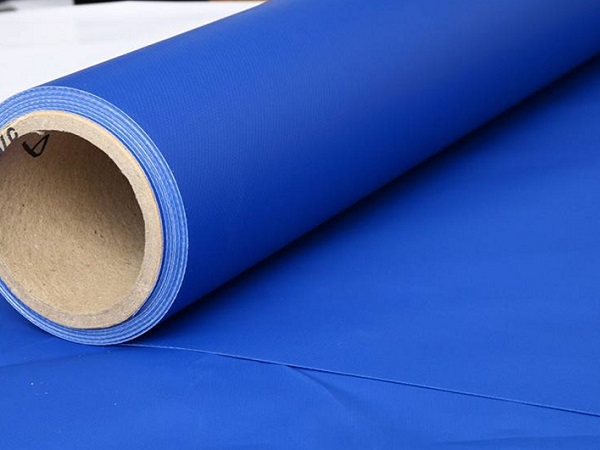
Six signs of a well-specified PVC tarpaulin
Use observation to screen a sample. Use documented tests and an approved production specification to make the final quality decision.
High-quality PVC tarpaulin has a uniform, suitable PVC coating firmly bonded to a correctly specified textile base, plus reliable resistance to its intended loads and weather. Finished covers also need sound joints and reinforced fixing points. No single touch test, GSM number or “heavy duty” label proves all of these.
Even coating
Examine both faces in consistent light. Look for pinholes, coating streaks, exposed yarn, foreign particles, bubbles or irregular gloss that conflicts with the approved finish.
Request: surface acceptance standard and coating-construction description.
Stable polyester scrim
The woven substrate carries much of the load. Compare yarn denier and warp/weft density—not merely thickness or a printed weight claim.
Request: base-fabric construction and directional strength values.
Coating bond
Watch for lifted coating at cut edges, fold damage or layer separation. A quick scratch cannot establish the adhesion value or expected outdoor life.
Request: adhesion method, result and failure description.
Suitable flexibility
Fold and unfold a conditioned specimen gently. Unusual cracking, whitening or tackiness deserves follow-up, but softness alone does not prove formulation quality.
Request: cold-flex and aging evidence when exposure requires it.
Dependable joints
For fabricated covers, examine welded or stitched seams, hems, reinforced corners and eyelets against the load path and waterproofing requirement.
Request: representative seam trials and finished-detail approval.
Traceable results
Good numbers are useful only when the report identifies the test method, grade, specimen direction and relevant sample or lot—not a generic catalog claim.
Request: coded sample, technical sheet and applicable reports.
A practical five-minute sample screening
These non-destructive checks help prioritize laboratory verification. They do not replace a formal acceptance procedure.
- Confirm the sample identity.
Photograph the label; record the product code, declared GSM, color, finish and sample date. Separate coated and laminated constructions before comparison.
- Inspect with front and back lighting.
Look for discontinuities, trapped particles, uneven coating, color bands and visible defects. A non-transparent coating may still require a specified water test.
- Handle and fold at room temperature.
Compare the feel with an approved reference, watching for coating damage, excessive stiffness or abnormal surface tack. Do not use an uncontrolled freezer trial as a cold-crack certification.
- Inspect edges and a representative joint.
Examine cut edges, weld overlap, edge reinforcement and hardware anchorage. Ask for the same fabric grade used in production.
- Match observations to data.
Request comparable tensile, tear and adhesion results; identify any decision still dependent on UV, cold, fire or hydrostatic testing.
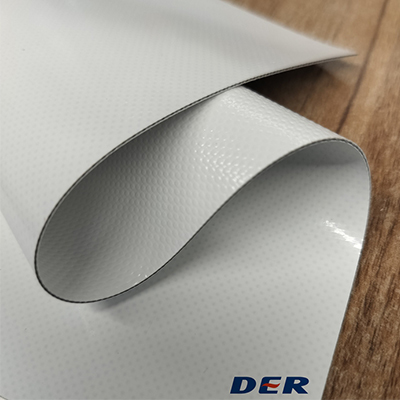
Look beneath the surface finish
Even two rolls with the same stated GSM can behave differently because the textile, coating build and finishing layers are not the same.
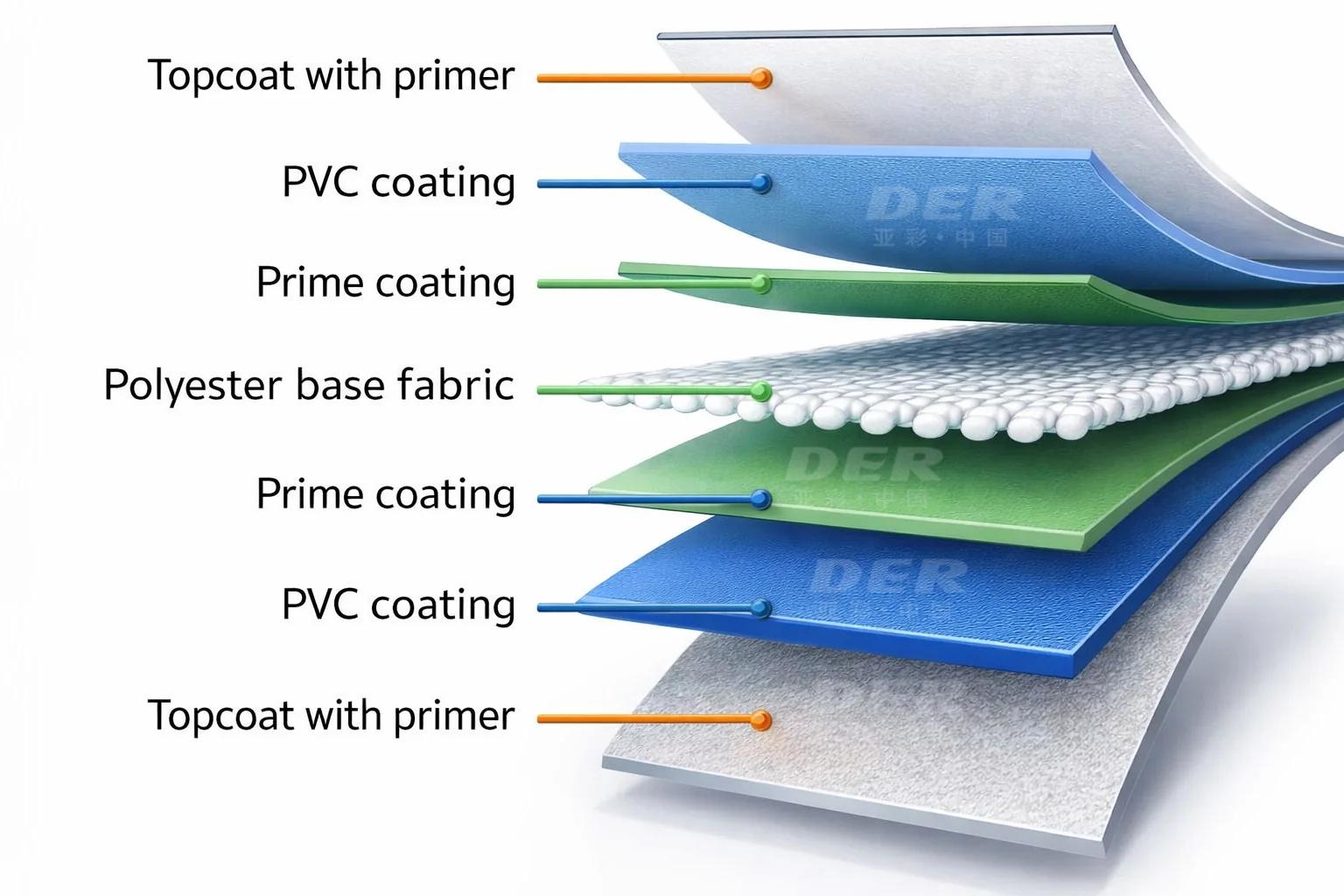
01. Polyester reinforcement
Yarn denier, weave spacing, fiber quality and the direction of loading influence tensile and tear behavior. Ask for warp and weft values under the same test method.
02. PVC coating or lamination
The polymer layer contributes water barrier properties, abrasion resistance and fabrication behavior. Bond quality, thickness uniformity and the selected production route matter.
03. Surface treatment
Matte, gloss, lacquer, embossing and print finishes can change cleanability and processing. A polished face is not evidence of UV stability or fire performance.
For the material families and sourcing options, visit DERFLEX PVC tarpaulin. For engineering-grade definitions, see the tarpaulin technical specification guide.
Quality signal → what actually proves it
Use this matrix to avoid paying for persuasive adjectives instead of comparable evidence. Limits must be set for the ordered construction and use case.
| Claim or signal | Evidence to request | What it does not prove |
|---|---|---|
| “650 GSM heavy-duty” | Finished area mass and permitted tolerance, typically assessed under the agreed ISO 2286-2 procedure. | GSM alone does not determine tear resistance, coating adhesion or service life. |
| “Strong fabric” | Tensile method, force unit and both relevant directions; ISO 1421 is a common coated-fabric reference. | A tensile number from one test geometry cannot replace a tear test. |
| “Tear resistant” | Defined tear procedure, direction, specimen conditions and limit; ISO 4674-1 is one applicable reference. | Results from different test methods are not automatically interchangeable. |
| “Excellent coating bond” | Coating adhesion report for the same grade; ISO 2411 is a relevant method. | A fingernail scratch or visual inspection is not a numeric adhesion test. |
| “Waterproof” | Appropriate water-penetration or hydrostatic evidence and separate joint verification when fabricated. | Flat-fabric waterproofing does not guarantee leak-free seams or fixing holes. |
| “UV / all-weather” | Named weathering or UV method, exposure conditions and retained performance criterion. | There is no universal outdoor lifespan based solely on an hours label. |
| “Cold resistant” | Specified cold-bend/flex test and temperature relevant to transport or operating conditions. | Room-temperature softness does not establish freezing-temperature behavior. |
| “Flame retardant” | Applicable classification, report, tested construction and target-market requirement. | One grade's report cannot automatically certify every color or formulation. |
On a phone, scroll the comparison table horizontally to view all columns.
For test-method selection, units and failure modes, continue with PVC coated fabric test methods. This guide explains screening decisions; always use the agreed full standard and purchase specification for formal testing.
“Good quality” depends on the actual job
Choosing the heaviest available roll can increase handling weight without solving the application's most important failure mode.
Repeated movement and tension
Prioritize directional strength, tear propagation, fold behavior, abrasion zones, joint design and fitting interfaces. Explore truck cover materials before specifying fabric alone.
Sunlight, rain and chafing
Specify UV/weather exposure, surface durability, drainage, seam sealing and reinforcement where the cover meets edges or straps. Compare options in the heavy-duty specification guide.
Handling, cleaning and environment
Evaluate flexibility, visible surface defects, cleanability, attachment loads and any project-specific fire or chemical requirement. Confirm the tested material construction rather than a general catalog claim.
Long-span stress and joint integrity
Assess textile and coating system, welding compatibility, tension, weather exposure and project-specific engineering specifications. Fabric quality by itself does not certify a structural system.
For GSM as a selection variable—not a quality grade—see the 300–1200 GSM PVC tarpaulin guide and the thickness and unit comparison.
What to inspect on real PVC tarpaulin products
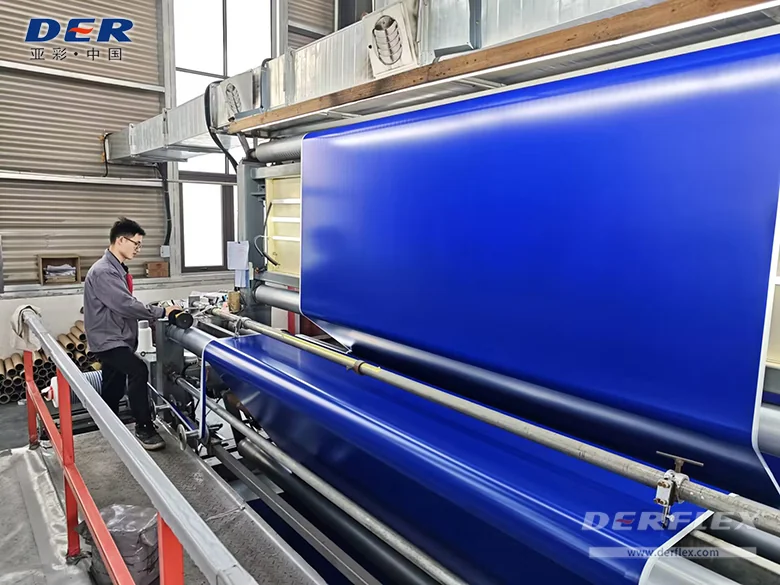
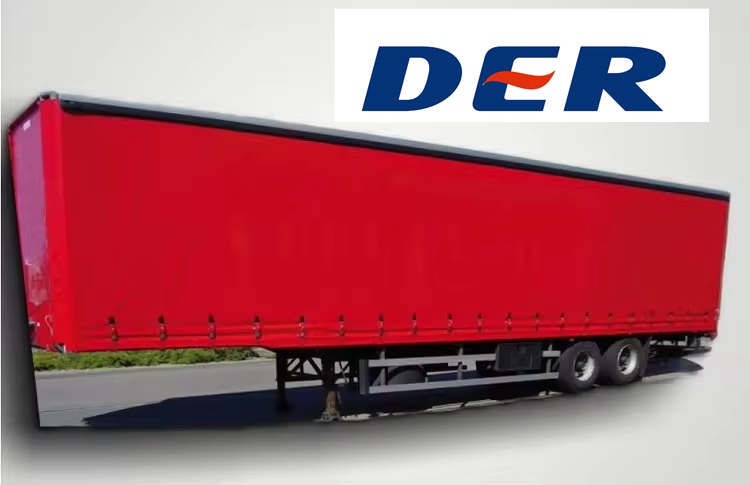
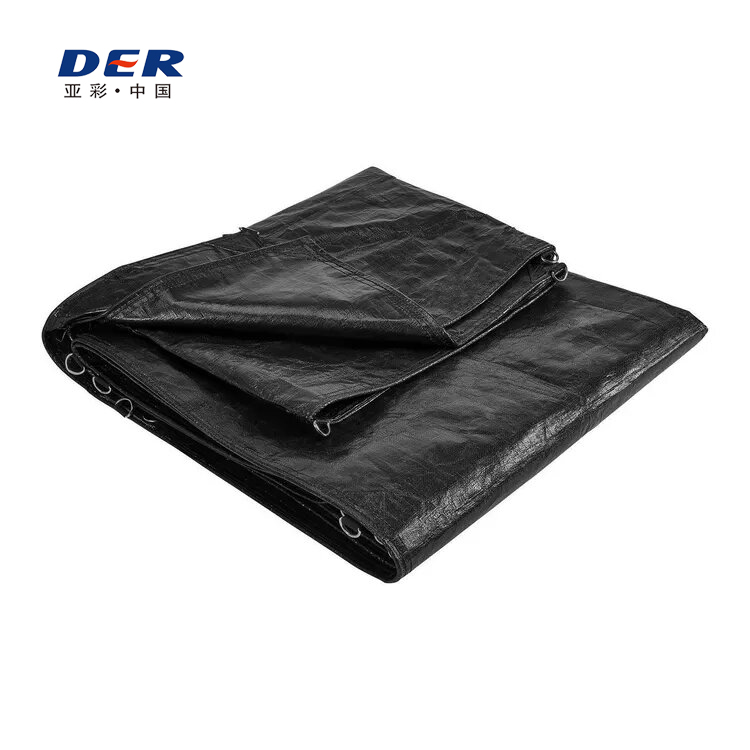
These are existing DERFLEX product and production images. They illustrate inspection locations, not certified test outcomes or examples of defects.
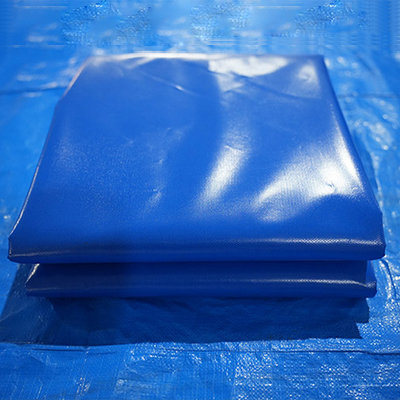
Surface and folding
Compare color, texture and flex marks against a reference sample. Do not infer coating chemistry or durability from gloss alone.
Process consistency
For repeat orders, require traceable grade codes and agreed roll inspection criteria rather than relying on a manufacturing photograph.
Application loads
Truck-side materials face movement, wind, tension and handling; seam design and attachments can govern real-life performance.
Finished construction
Check hems, reinforcement transitions and hardware on your actual submitted sample; do not assume a fabric roll includes finished-cover components.
Three decision gates before the bulk order
The most defensible supplier comparison uses one approved construction, one evidence basis and one agreed release rule.
Gate A / Compare like for like
Collect a coded reference sample and matching technical sheet. Align mass, width, construction, finish, units and test procedures before comparing prices.
Gate B / Approve processing
If you weld, cut, sew or print, trial the actual grade. Inspect seam performance, edge behavior and the condition of material after representative fabrication.
Gate C / Define release evidence
Agree the sample plan, acceptable variation, lot identification, nonconformance response and which reports or visual records accompany production.
For formal lot-level inspection and sampling, use PVC tarpaulin quality standards and bulk inspection. For supplier-process due diligence, see how to audit a tarpaulin manufacturer.
Send a specification that can be checked
DERFLEX can discuss PVC tarpaulin roll materials and project-related conversion requirements. Confirm the exact supply scope—roll goods, cut panels or finished covers—before ordering.
Material & application
- Final use: truck, cover, curtain, tent or other
- Operating conditions: UV, rain, cold, abrasion, cleaning
- Nominal GSM, base cloth and coating route if known
- Roll width or finished size; colors and finish
Commercial & verification
- Quantity, planned order frequency and destination
- Welding, sewing, printing or reinforcement method
- Required test method and target acceptance limits
- Benchmark sample, drawings or defects to avoid
Need to compare options first? Review the wider DERFLEX tarpaulin material range and how to choose a tarpaulin.
Questions buyers ask before approving a PVC tarp
Practical answers that separate a useful visual impression from reliable technical evidence.
How can I tell whether a PVC tarpaulin is good quality?
Is a heavier GSM always a better PVC tarpaulin?
Can I judge coating adhesion by scratching the surface?
Does a waterproof PVC fabric guarantee a waterproof finished tarp?
Which PVC tarpaulin test results should buyers request?
What should I send a supplier before ordering PVC tarpaulin rolls?
Continue your technical evaluation
Use these verified DERFLEX resources for the next stage of material selection and procurement.
Choose quality you can specify, test and repeat.
Share a target application, required dimensions, quantity and current benchmark. We can review the appropriate PVC tarpaulin construction and the evidence required for your purchasing process.