Collapsible / Layflat Duct
Suitable when blower pressure keeps the duct open during use and compact storage is valuable. The OEM brief should still define diameter, section length, suspension, joint method and fan connection.



 Custom airflow products · OEM project supply
Flexible industrial duct hose developed around your fan interface, airflow direction, installation route and repeat-order specification—not simply a standard hose with a new label.
DERFLEX supports blower manufacturers, ventilation-equipment brands, distributors, rental fleets and project suppliers with custom diameters, coated-textile constructions, reinforcement, cuffs, markings, packing and order-specific documentation. Final performance is confirmed against the approved product construction and the test requirements stated for the project.
In an OEM program, “same diameter” does not necessarily mean “same fit.” Fan outlet outside diameter, cuff depth, clamping space, available bend radius, suction load, operating temperature and movement can all change the finished hose architecture. A duct that works on a discharge outlet may not be suitable on the suction side because an unsupported wall can collapse under negative pressure.
DERFLEX treats the industrial duct hose as an assembly: coated textile, reinforcement, seam, end interface, suspension, identification and packing are reviewed together. This approach is useful when a buyer needs a private-label product, a replacement part for a defined machine, or a repeatable duct kit for multiple equipment models.
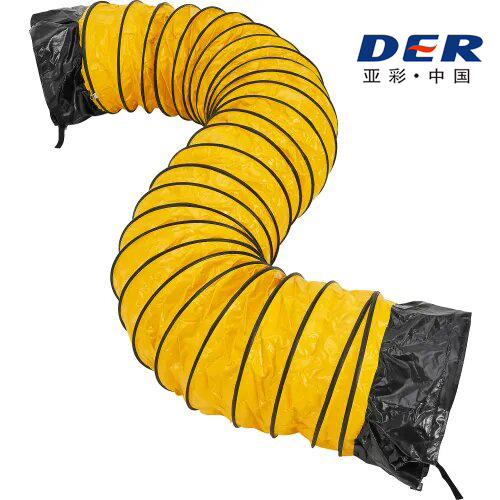
Industrial duct hose OEM projects often look similar in a photograph but behave very differently once pressure, temperature and installation geometry are considered.
Suitable when blower pressure keeps the duct open during use and compact storage is valuable. The OEM brief should still define diameter, section length, suspension, joint method and fan connection.
Helical wire or another shape-retaining structure helps resist collapse on the negative-pressure side. Wire gauge and pitch should be coordinated with diameter, fan pressure, bend route and handling.
Higher-temperature service may require silicone-coated fiberglass or another project-specific wall construction. The selected textile, seam and reinforcement should be validated for the actual duty rather than inferred from a generic hose name.
A disciplined OEM process reduces avoidable fit revisions and makes replacement orders easier to reproduce.
Define airflow direction, media, temperature, fan data, route, bends, environment and expected handling.
Record outlet dimensions, cuff depth, clamp space, flange geometry and any mating-part tolerances.
Select wall material, reinforcement, seam, ends, hanging parts, color and packaging direction.
Use a drawing, physical sample or first article to verify fit and agreed manufacturing details.
Freeze measurable fields such as ID, length, cuff style, wire pitch, labels, marks and inspection points.
Fabricate against the approved construction and check dimensions, seams, reinforcement and interfaces.
Add project codes, airflow arrows, labels, private marks, section numbers or packaging information as agreed.
Use the approved specification as the purchasing reference for replacements, service kits and future batches.
The table below is intended for quotation development. Final limits and compliance statements should appear on the approved order documents for the exact construction.
| Specification field | DERFLEX configuration direction | Why it matters in OEM purchasing |
|---|---|---|
| Product format | Flexible ventilation hose, blower duct, exhaust hose, suction duct or equipment-specific duct assembly. | Prevents dissimilar hose architectures from being compared only by size. |
| Wall material | PVC-coated polyester for many general industrial airflow duties; other technical textiles reviewed for special heat or media conditions. | Wall material influences flexibility, welding, temperature capability, chemical compatibility and abrasion behavior. |
| Pressure direction | Positive pressure, negative pressure / suction, or project-defined reversible use. | Pressure direction determines whether the duct can be collapsible or requires shape-retaining reinforcement. |
| Diameter | Approx. 100–2000 mm reference range; custom metric or imperial dimensions can be reviewed. | Diameter affects airflow velocity, pressure loss, fan matching, bend behavior and handling volume. |
| Section length | 5 m, 10 m or project-defined sections. | Long sections reduce joints while shorter sections may improve replacement, lifting and storage. |
| Reinforcement | Spring-steel helix, support rings, localized reinforcement, wear strips or no shape support depending on duty. | Reinforcement affects collapse resistance, bend radius, weight, compression and field durability. |
| Connections | Soft cuffs, drawstring cuffs, rings, zippers, belts, clamps, reducers, transitions or custom adapters. | Correct end geometry can reduce leakage, field modification and installation errors. |
| Temperature | Standard PVC ducting reference is around -20°C to +80°C; other temperature zones require separate construction review. | Continuous, peak and radiant heat should be separated because they can affect different parts of the assembly. |
| Functional options | Flame-retardant, antistatic, abrasion-focused or other specified directions subject to named test requirements. | Safety-related claims should correspond to the selected finished construction and applicable test route. |
| OEM identity | Custom color, printed marks, logo, airflow arrows, labels, buyer codes, section IDs and storage bags by agreement. | Supports private-label programs, fleet control, replacement identification and installation guidance. |
| Packing | Bag, carton, pallet or project-defined packing; section labeling and kit grouping can be discussed. | OEM packaging can reduce receiving confusion and simplify field distribution. |
Reference values are not universal performance guarantees. Pressure capability, leakage, fire behavior, antistatic performance, temperature resistance and service life depend on the confirmed material, finished construction, installation, maintenance and applicable test method.
For equipment makers and distributors, the important advantage is often repeatability: a replacement ordered months later should still match the approved interface and identification logic.
Application names provide context, but the final construction should be selected from real pressure, temperature, media and interface data.
Collapsible or reinforced duct kits matched to portable axial fans for confined-space ventilation, cooling, drying and temporary work zones.
Flexible routing between capture points and extraction equipment where suction resistance, bends, sparks, media and temperature must be reviewed.
Project duct sections, connections, suspension and identification for auxiliary ventilation routes and replacement programs.
Standardized duct kits with clear section IDs and packing so damaged hoses can be replaced without redesigning the interface.
Flexible air-transfer hoses for temporary cooling, dehumidification, restoration and industrial airflow equipment.
Custom brand presentation, color, packaging and controlled specifications for regional industrial-supply and ventilation channels.
A useful industrial duct hose OEM inquiry gives the engineering and purchasing teams enough information to compare the same construction. Photos and a simple dimensioned sketch of the equipment interface can be more useful than a generic product name.
For flexible industrial ducting, the wall material and the finished assembly are closely related. DERFLEX can discuss both when the buyer needs a repeatable custom product.
PVC-coated technical textile, seam construction, reinforcement and end interface can be reviewed as one finished assembly rather than unrelated parts.
Layflat positive-pressure duct and shape-retaining suction hose can be configured differently according to the actual fan side and route.
Equipment dimensions can be used to define cuffs, adapters, clamp zones, reducers and other connection details before repeat production.
Color, printed identification, labels, airflow arrows, buyer codes, bags and packaging can be discussed for distributor and equipment-brand programs.
Controlled dimensions and construction details help purchasing teams request the same hose format for service parts and recurring orders.
Fire, static and temperature requirements should be linked to the approved construction and requested test method rather than broad product-family assumptions.
These six internal resources cover adjacent selection paths for exhaust, PVC duct hose, ventilation systems, large diameters and portable applications.
Practical answers for equipment manufacturers, sourcing teams, distributors and project suppliers.
Send the application, pressure direction, fan or blower information, outlet dimensions, required diameter and section length, route and bends, temperature profile, conveyed air or permitted gas stream, connection style, environment, requested test standards, quantity, branding and packaging needs. Photos or a dimensioned sketch of the equipment interface can help reduce revisions.
DERFL, EX can review actual outlet dimensions, photos, drawings or an existing sample so the cuff, adapter, diameter and section format can be developed around the equipment interface. Final fit should be verified against the approved drawing or first article before repeat production.
A positive-pressure hose can use air pressure to hold its shape, allowing a lighter collapsible architecture in many applications. A suction hose must resist collapse while the fan pulls air through it, so spiral wire, rings or another shape-retaining structure is usually required. The final design depends on pressure, diameter, bends and wall construction.
Custom color, printed identification, labels, airflow arrows, buyer codes, section IDs, storage bags and packaging can be discussed as part of an OEM or private-label order, subject to the approved specification and production arrangement.
These performance directions can be reviewed when the project identifies the required standard, test method and acceptance criteria. Flame and antistatic performance should be confirmed for the selected finished construction rather than assumed from a generic material name.
Typical approval fields include wall material, diameter, finished length, reinforcement style and pitch, cuff or flange dimensions, seam construction, suspension details, markings, labels, packing and agreed inspection points. Application-specific safety or performance tests should also be defined where relevant.
Send the fan outlet, pressure direction, duct size, route, temperature, connection details, quantity and OEM requirements. DERFLEX can review a practical flexible-duct construction for quotation and sampling.
Product information is provided for procurement and specification discussion. Final suitability, pressure capability, temperature resistance, flame behavior, antistatic performance, chemical compatibility and regulatory compliance depend on the confirmed product construction, installation, operating conditions, system design and applicable test requirements.