


TRAS 120 Biogas Membrane for German & EU Biogas Holder Projects
DERFLEX supplies project-specific coated membrane fabric for biogas holders, double-membrane gas storage systems and digester covers where EPC contractors, gas-holder builders and fabricators need a material specification reviewed against TRAS 120 membrane criteria.
- Inner gas membrane direction: methane barrier, chemical exposure, weldability and cyclic flexibility
- Outer weather membrane direction: tensile/tear strength, B1 flame-retardant requirement where applicable, UV exposure, electrostatic dissipation and thermal reflectance
- PVC/PVDF coated polyester membrane options with project-defined test and documentation requirements
- OEM roll goods, custom widths and project-specific fabricated membrane discussions
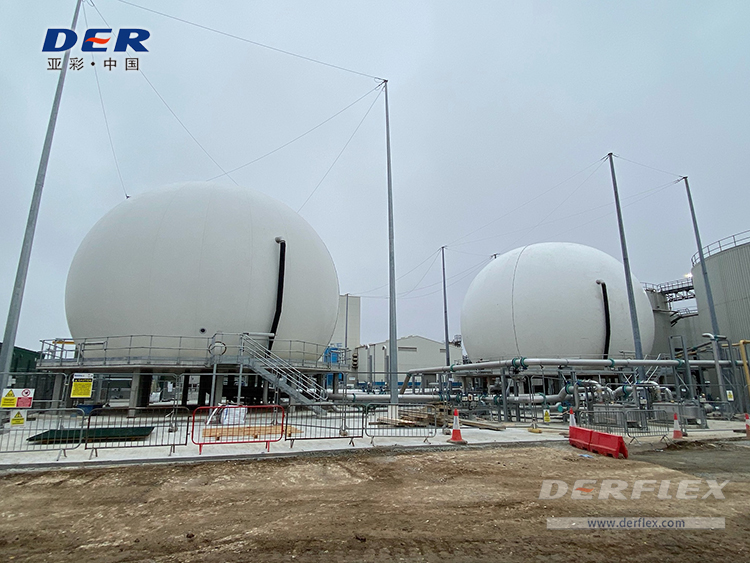
What Is a TRAS 120 Biogas Membrane?
A TRAS 120 biogas membrane is not simply a PVC fabric with a “TRAS” label. It is a membrane whose documented properties are evaluated against the membrane-related safety requirements in Germany’s TRAS 120 for biogas plants. The inner gas membrane is judged strongly on methane permeation, while the outer weather membrane has additional mechanical, fire, electrostatic and thermal-reflectance requirements.
TRAS 120 is German, not an EU-wide product certification. European projects outside Germany may adopt TRAS 120 as a client specification or engineering benchmark, but the project must still follow the applicable local legal, permitting, structural, explosion-protection and environmental requirements.
For procurement teams, the important distinction is between material evidence and complete gas-holder compliance. A membrane test report can document properties such as methane permeability, tensile strength or flame behavior, but it does not by itself certify the full gas-holder system. TRAS 120 also addresses system design, structural loads, attachments, support air, leakage monitoring, fill-level control, inspection and operating safety.
TRAS 120 Membrane Requirements Buyers Should Put Into the RFQ
The table below converts the membrane-related parts of TRAS 120 into procurement language. It is designed to help EPC contractors, system builders and technical buyers avoid vague requests such as “need German-standard biogas fabric.”
| Requirement Area | TRAS 120 Requirement / Direction | Membrane Role | What the Buyer Should Request |
|---|---|---|---|
| Mechanical / chemical / thermal suitability | Materials must withstand the expected mechanical, chemical and thermal loads; suitability must be supported by product information and documentation. | All relevant membrane materials | Approved specification, material construction, chemical exposure statement, temperature data and project-use declaration. |
| Temperature & UV | Minimum temperature resistance from -30°C to +70°C; outdoor components require documented UV resistance. | All; UV especially exposed components | Temperature test or technical data and UV/weathering evidence applicable to the supplied grade. |
| External fire exposure | Materials that can be exposed to surrounding fires, including the outer membrane, must be flame retardant to B1 according to DIN 4102. | Outer membrane and relevant exposed system components | Valid B1 test evidence for the exact material construction / color / finish where applicable. |
| Methane permeation | At 23°C, the gas membrane must not exceed 500 ml/(m²·d·1,000 hPa), using the methane partial-pressure difference between gas space and ambient air for the stated pressure. | Inner gas membrane | Methane permeability test report with temperature, pressure differential, specimen and test method clearly identified. |
| Tensile strength | Outer weather membrane minimum tensile strength: 3,000 N / 5 cm. | Outer weather membrane | Warp/weft tensile test data for the proposed production grade. |
| Tear resistance | Outer membrane tear resistance: 550 N warp / 500 N weft. | Outer weather membrane | Directional tear test data and confirmation that the tested material matches the supplied construction. |
| Electrostatic dissipation | The surfaces of the weather membrane and the outer face of the gas membrane must be conductive or dissipative in accordance with TRGS 727. | Outer membrane surface + external face of gas membrane | Surface/electrical resistance evidence under the required test conditions; do not rely on a generic “antistatic” description. |
| Thermal-radiation reflectance | The atmosphere-facing membrane should have reflectance >0.5 in the 0.8–14 μm wavelength range to reduce excessive heating. | Atmosphere-facing outer surface | Reflectance data for the exact surface/color. Light grey is a common project direction, but the test value is more important than the color name. |
| Structural loads | The complete construction requires static verification for environmental loads including wind, snow and ice; additional TRAS 320 considerations apply in relevant Major Accident Ordinance cases. | System-level | Gas-holder engineer / system integrator to provide design loads, geometry, support-air parameters, anchoring assumptions and structural calculation. |
| Leakage monitoring | TRAS 120 requires monitored tightness and an additional outer enclosure around the gas membrane so the interspace can be continuously monitored. | System-level | Confirm double-shell concept, interspace monitoring, methane detection and alarm strategy with the gas-holder system supplier. |
| Service-life documentation | Components are replaced at the end of the manufacturer-declared service life; if no service life is declared, TRAS 120 sets a six-year replacement default unless appropriately extended following a safety inspection. | System / supplied membrane component | Ask for declared service-life basis, inspection conditions, maintenance assumptions and traceable production identification. |
Inner vs Outer Biogas Holder Membrane: TRAS 120 Changes the Specification Logic
A common procurement error is to request one “heavy-duty biogas membrane” for every layer. TRAS 120 makes it clearer why inner and outer membranes must be reviewed by function.
Inner Gas-Holding Membrane
Primary job: contain methane-rich biogas while moving with changing gas volume and maintaining reliable welded seams.
- Methane permeation evidence is a first-order requirement.
- External face must meet the specified conductive/dissipative direction under TRGS 727.
- Coating chemistry should be reviewed for H2S, CO2, humidity, condensate and the project’s actual gas composition.
- Flexibility, fold behavior, seam weldability and dimensional stability matter during repeated inflation/deflation.
- Color is less important than gas barrier, electrostatic and fabrication performance unless the project specification states otherwise.
Outer Weather-Protection Membrane
Primary job: form the exposed shell and carry the weather-facing performance requirements of the gas holder.
- Minimum tensile and directional tear values must be considered.
- Flame-retardant B1 evidence is required for materials that can be exposed to surrounding fires.
- Conductive/dissipative surface behavior is required to control static ignition risk.
- Thermal reflectance matters; a light-colored surface alone is not proof of compliance.
- UV/weathering, rain, dirt, temperature cycling and system-specific wind/snow loads must be addressed.
DERFLEX TRAS 120 Project Membrane Specification Framework
DERFLEX can support project-defined PVC-coated and PVC/PVDF surface membrane directions. The exact construction should be frozen only after the buyer defines the membrane role and required evidence.
| Specification Item | DERFLEX Project Direction | TRAS 120 / Buyer Evaluation Point |
|---|---|---|
| Product | TRAS 120 biogas membrane / biogas holder membrane / double-membrane gas storage fabric | Use a layer-specific approved specification rather than a generic fabric description. |
| Base reinforcement | High-tenacity polyester woven base; yarn and weave can be selected by project mechanical target. | Outer membrane must demonstrate the required tensile and tear performance. |
| Coating direction | PVC-coated polyester; PVC/PVDF surface direction for exposed outer applications; other project constructions can be discussed. | Coating must support chemical/thermal suitability, welding and the intended membrane role. |
| Gas barrier | Low-permeability construction can be developed against a defined methane-permeation target. | Must be test-confirmed for any TRAS 120 compliance statement. |
| Flame-retardant option | Project-specific FR formulation can be discussed. | Exact B1 evidence required where TRAS 120 fire-exposure requirement applies. |
| Electrostatic surface | Conductive/dissipative project direction should be defined when required. | Verify under required conditions rather than using a generic “anti-static” claim. |
| Surface color / reflectance | Light-grey or other project color can be selected; PVDF surface can be considered for outdoor cleanability/weathering. | Thermal reflectance >0.5 must be supported by evidence for the exact outer surface/color. |
| Temperature / UV | Formulation and surface system matched to project climate and outdoor exposure. | TRAS 120 minimum temperature range and UV evidence must be documented. |
| Welding | HF/RF welding, hot-air or project-specific process depending on membrane formulation. | Buyer/fabricator should approve trial weld, seam geometry and seam test plan before production. |
| Supply form | Roll goods, project-width material, cut panels or fabricated membrane discussions depending on project scope. | Drawing revision, batch traceability and inspection hold points should be defined in the purchase specification. |
Important: PVDF surface treatment can improve exposed-surface durability and cleanability, but PVDF is not a substitute for TRAS 120 test evidence. The project still needs the required mechanical, fire, electrostatic, reflectance, temperature/UV and gas-permeation documentation applicable to the selected layer.
How to Select a Biogas Holder Membrane for Germany or an EU EPC Project
Start With Jurisdiction
Confirm the installation country, permitting authority and client specification. In Germany, TRAS 120 is part of the German plant-safety framework. Outside Germany, do not assume it automatically replaces local rules.
Define the Membrane Role
State whether the material is the inner gas membrane, outer weather membrane, bottom sealing membrane, tank-mounted cover or a replacement layer. The test package changes with the role.
Freeze the Performance Evidence
List the required methane-permeation, tensile/tear, B1, electrostatic, reflectance, UV and temperature evidence explicitly in the RFQ and purchase specification.
Match the Fabrication Process
Define HF/RF, hot-air or other welding process, seam width, overlap, reinforcement details and trial-weld acceptance. Strong roll material can still fail a project if seam fabrication is not controlled.
Connect Material to Structural Design
Share holder geometry, working pressure, wind/snow loads, support-air system assumptions, anchoring arrangement and connection details with the system engineer and fabricator.
Approve a Traceable Production Grade
Make sure the material that passed testing matches the final base fabric, coating formulation, finish and color supplied for the project. Record lot/batch identification for future replacement programs.
What to Send With a TRAS 120 Biogas Membrane RFQ
A precise technical brief shortens sampling and reduces the risk of quoting a membrane that is strong enough in one area but incomplete in another.
- Project country, site and end user / EPC specification
- Gas-holder type: tank-mounted, free-standing, dome or other design
- Membrane layer: inner, outer, bottom or replacement layer
- Tank / foundation diameter and gas storage volume
- Normal and maximum working pressure
- Gas composition, methane content and H2S level if known
- Minimum / maximum design temperature
- Wind, snow and ice design data from the project engineer
- Required methane-permeation threshold and test report format
- Required tensile and tear values
- DIN 4102 B1 requirement and exact evidence expected
- Electrostatic / TRGS 727 documentation requirement
- Thermal-reflectance requirement and desired color
- UV/weathering test requirement
- Welding equipment and seam process
- Roll width, length, panel size and quantity
- Required third-party laboratory / inspection body, if specified
- Documentation language, traceability and certificate package
- Target project service life and inspection/maintenance plan
- Delivery destination, packaging and installation schedule
Common TRAS 120 Procurement Mistakes
1. Treating TRAS 120 as a single fabric certificate
A membrane report covers material properties. TRAS 120 also covers the complete system: structural design, support air, monitoring, attachments, operation and inspection. Ask what exactly has been tested and what remains the responsibility of the system engineer.
2. Buying by GSM instead of performance
Two fabrics with similar weight can have very different tensile strength, tear behavior, coating density, gas permeability, electrostatic properties and weathering. Put measurable project criteria before GSM.
3. Assuming a light-grey color proves reflectance
TRAS 120 states a reflectance value. A color name or RAL approximation is not a test report. Confirm the exact surface/color used in production has the required thermal-reflectance evidence.
4. Forgetting the outside face of the gas membrane
The electrostatic requirement is not only about the visible outer shell. TRAS 120 also addresses the external face of the gas membrane. This should be included in the inner-membrane specification and test package.
5. Approving the roll but not the seam
Gas holders are fabricated structures. Trial welding, seam peel/shear performance, overlap geometry, contamination control and reinforcement around fittings are essential to maintaining the material’s intended performance in the finished envelope.
6. Calling a German requirement “EU certification”
This can create tender and documentation problems. State the project correctly: “material specified against TRAS 120 for a German project” or “TRAS 120 requested as an additional client benchmark” for projects elsewhere in Europe.
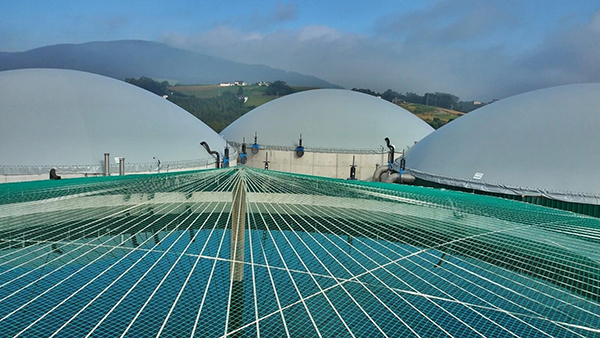
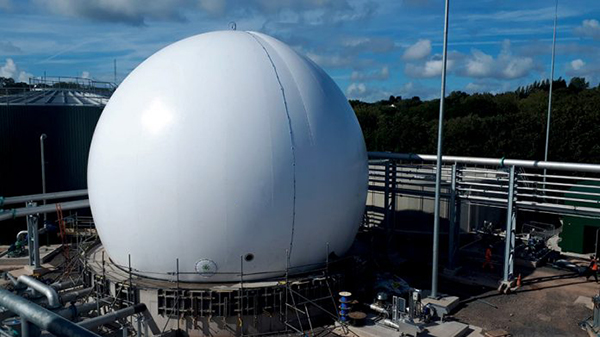
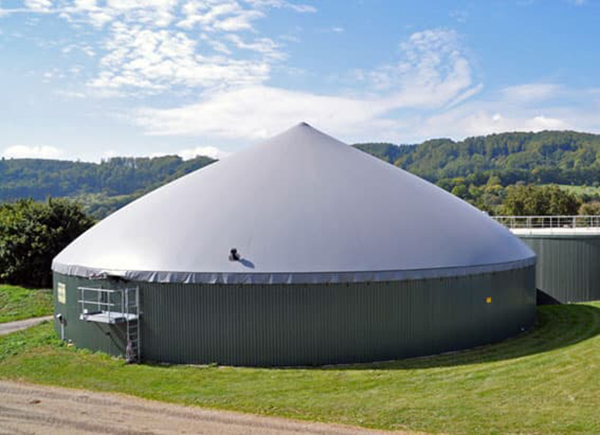
Biogas Holder Membrane Project Images
Real DERFLEX-hosted images for the product page. Hero is loaded eagerly; gallery images are lazy-loaded for page performance.
From TRAS 120 Requirement List to a Repeatable Membrane Specification
Requirement Review
Country, membrane layer, project standards, gas chemistry, loads and documentation list.
Material Direction
Base fabric, coating, gas-barrier direction, surface finish, color and weldability.
Sample & Testing
Confirm which tests are needed and whether the buyer requires a specified third-party laboratory.
Fabrication Approval
Trial weld, seam configuration, panel layout, reinforcement and interface details.
Production Control
Freeze the approved grade, inspection points, traceability, packaging and repeat-order identity.
For replacement membranes: send the existing holder drawing, current inner/outer membrane data sheet, photos of clamping/connection details, operating pressure, gas composition, failure history and the project’s updated TRAS 120 documentation requirement. Replacement should not be specified by copying only the old GSM and color.
Review DERFLEX double membrane biogas holder material directions →
Where TRAS 120-Oriented Biogas Membrane Specifications Are Used
German Agricultural Biogas Plants
Tank-mounted membrane roofs and flexible gas-storage systems for manure, crop residues and organic feedstock digestion.
Municipal Wastewater Digesters
Gas-holder and digester-cover membrane procurement where methane storage, maintenance access and plant safety documentation are important.
Food & Industrial AD Projects
Flexible membrane materials for organic-waste digestion plants with project-specific gas chemistry, H2S and condensate considerations.
Biomethane / RNG Projects
Buffer gas storage before upgrading, utilization or downstream renewable-gas handling, subject to complete system engineering.
Gas Holder OEM Programs
Repeatable inner/outer membrane grades for system builders that want stable documentation, color, width, welding behavior and batch control.
European EPC Specifications
Projects outside Germany where the client or engineering consultant asks for TRAS 120 as an additional membrane benchmark alongside local requirements.
Build a Complete Biogas Membrane Specification
TRAS 120 Biogas Membrane FAQ
Direct answers for project engineers, EPC procurement teams, gas-holder manufacturers and membrane fabricators.
What is a TRAS 120 biogas membrane?
Is TRAS 120 an EU-wide certification?
What methane permeability does TRAS 120 require for the inner gas membrane?
What strength is required for a TRAS 120 outer membrane?
Does the outer membrane need DIN 4102 B1 flame-retardant performance?
Why does TRAS 120 require conductive or dissipative membrane surfaces?
Can the same fabric be used for the inner and outer biogas holder membranes?
What information should I send DERFLEX for a German/EU biogas holder membrane quote?
Need a Biogas Membrane Specification for a German Project?
Send DERFLEX the membrane role, holder geometry, gas conditions, design loads, welding process and the exact TRAS 120 evidence requested by your client or EPC specification. We can review a suitable coated-fabric direction before sampling and bulk production.
- Inner / outer membrane role review
- PVC / PVDF coated fabric direction
- Project test and documentation checklist
- Custom width, color, finish and OEM supply discussion