



Which Is Better: Welded or Sewn Tarp Seams?
Neither method is automatically better in every tarp. Welded seams are usually preferred for the main panel joins of compatible PVC, vinyl and other thermoplastic-coated fabrics when water resistance, air retention or clean repeatable production is important. Sewing remains valuable for canvas, non-weldable textiles, intricate three-dimensional shapes, attachment details and projects where field repairability is a priority.
For many heavy-duty custom tarps, the strongest commercial answer is not an all-welded or all-sewn construction. It is a hybrid seam plan: welded overlaps in the water-shedding field, then engineered hems, webbing, pockets, straps, D-rings, wear patches and hardware zones using the joining method that best transfers the local load.
Specify the seam by function. Ask where water must be stopped, where load enters the tarp, which details need to flex or be repaired, and whether the selected coating can be qualified on the factory's welding equipment.
How Welded and Sewn Tarp Seams Are Made
Welded Tarp Seam
Two compatible coated-fabric panels are overlapped. Heat or high-frequency energy activates the thermoplastic surfaces, pressure brings the layers together, and cooling forms a bonded joint. Common production routes include hot-air welding, hot-wedge welding and HF/RF welding.
The joint does not depend on thread passing through the material. It depends on coating compatibility, surface condition, overlap geometry, temperature or energy input, pressure, speed, dwell time and cooling.
Sewn Tarp Seam
A needle forms a stitch line through overlapping material, usually with polyester or other industrial thread. Seam type, stitch density, needle size, thread specification and seam allowance influence the result.
Sewing is adaptable to a broad range of materials and complex assemblies. When rain protection is required, the stitch line may need seam tape, liquid sealant, a covering flap or another secondary sealing operation.
Buyers sourcing material for welded production can review DERFLEX weldable PVC tarpaulin options, which are intended for process qualification with the customer's actual equipment and seam design.
Welded vs Sewn Tarp Seams: Side-by-Side Comparison
| Decision Factor | Welded Seam | Sewn Seam | Procurement Interpretation |
|---|---|---|---|
| Joining principle | Compatible coating layers are fused under controlled energy and pressure. | Panels are mechanically joined with needle and thread. | Confirm whether the material chemistry suits the proposed joining method. |
| Water pathway | No sewing needle holes through the qualified overlap. | Every stitch creates a penetration unless the line is separately sealed or protected. | For rain-critical field seams, ask how penetrations, corners and hardware are sealed. |
| Seam consistency | Can be highly repeatable when machine settings and material lots are controlled. | Can be reliable, but stitch quality may depend more on operator technique and consumables. | Review sample approval, operator controls and batch inspection for both methods. |
| Strength behavior | Often strong in shear across a correctly designed overlap; poor process settings can cause peel or incomplete fusion. | Can distribute load through multiple stitch rows and added webbing; perforation and thread failure must be managed. | Ask for the seam test method and loading direction rather than a generic “strong seam” statement. |
| Material compatibility | Best suited to weldable thermoplastic coatings and films such as many PVC and TPU systems. | Works with a wider range of coated and uncoated textiles, including canvas and many mixed constructions. | Do not assume every PVC grade or surface treatment welds equally on every machine. |
| Complex geometry | Efficient for straight overlaps, long panels, hems, pockets and selected shaped work. | Highly flexible for tight curves, multilayer assemblies and detailed three-dimensional covers. | Complexity can shift the economical choice toward sewing or a hybrid plan. |
| Repairability | May require compatible patch material, heat equipment and a clean prepared surface. | Often easier to restitch in a workshop or in the field, subject to material condition. | Include the expected repair environment in the original construction decision. |
| Initial production setup | Requires welding equipment, tooling or settings development and qualified operators. | Typically uses widely available sewing equipment with lower setup barriers. | Short custom runs and prototypes may favor sewing; repeat programs may justify welding setup. |
| Repeat-volume economics | Can reduce thread consumption and secondary seam sealing while improving throughput on suitable designs. | Can remain economical for complex products, lower volume or operations already built around skilled sewing. | Compare total converted cost, not machine cycle alone. |
| Typical tarp use | Large waterproof PVC panels, truck covers, tank covers, liners, curtains, tents and shelters. | Canvas tarps, fitted covers, webbing assemblies, attachment zones, breathable covers and repairable details. | The finished tarp may use both methods in different zones. |
This comparison is a procurement guide. Final performance depends on the approved material, seam geometry, equipment, workmanship, test method, installation and service environment.
Waterproofing: Why the Seam Can Become the Weak Link
A waterproof coated fabric does not automatically create a waterproof finished tarp. Panel joins, corner folds, grommets, D-rings, sewn webbing and any later puncture can become a water path. The seam plan therefore has to be reviewed together with drainage angle, installation tension and the location of water pooling.
Welded seams and water resistance
A correctly qualified welded overlap avoids sewing holes across the primary panel joint. For PVC-coated polyester, the PVC surfaces can be activated and bonded so the seam behaves as a continuous sealed zone. This is one reason welded construction is widely selected for truck tarps, outdoor storage covers, containment products, industrial curtains and large shelters.
Welding is not a guarantee by itself. Underheating may leave incomplete fusion; overheating may damage coating or base fabric; contamination can reduce adhesion; and narrow overlaps can produce poor load transfer. Corners, transitions and hardware penetrations still need independent review.
Sewn seams and water resistance
Sewing penetrates the tarp with a needle. Even when thread fills much of the hole, water can move along the stitch path under rain, pressure or capillary action. A sewn seam can be made more water resistant through seam tape, compatible sealant, a lap orientation that sheds water, covered stitching or a welded cap strip.
These secondary steps add process time and must remain compatible with the coating, cleaning chemicals, flexing and temperature range. When waterproofing is the primary purchasing requirement, review the broader guidance on waterproof tarp construction rather than relying on the base fabric description alone.
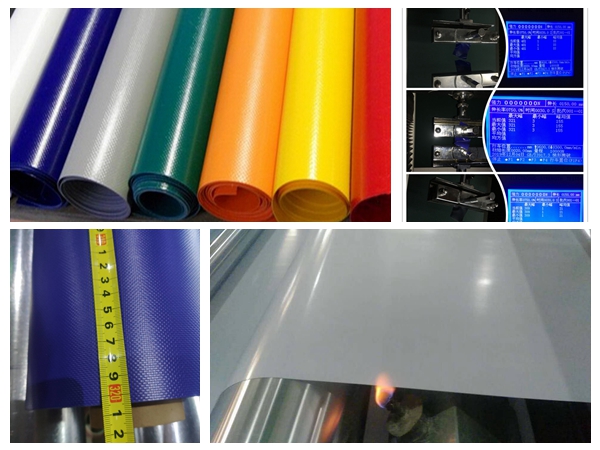
PVC Coated Polyester for Welded and Custom Tarp Fabrication
A woven polyester scrim carries much of the tensile and tear load, while the PVC coating provides the waterproof surface and weldable interface. The structure can be adjusted for finished weight, base yarn, coating, width, color, surface finish and environmental exposure.
Strength: The Strongest Seam Is the One Designed for the Load
Seam strength is not a single number. A joint can be strong in one loading direction and weak in another. Tarps experience shear across overlaps, peel at lifted edges, cyclic flexing, wind flutter, local puncture, abrasion, folding and concentrated forces at tie-down points.
Where welded seams perform well
- Long panel joins: controlled overlaps can spread load across a continuous bonded area.
- Consistent production: qualified temperature, pressure and speed settings can reduce variation across repeat runs.
- Clean load paths: the seam avoids a perforated stitch line in the primary weather field.
- Large waterproof assemblies: long seams can be produced efficiently on suitable hot-air, hot-wedge or RF equipment.
Where sewn seams remain useful
- Webbing and reinforcement: multiple stitch rows can secure thick multilayer assemblies where welding alone is not appropriate.
- Curves and fitted shapes: sewing can handle intricate contours and frequent direction changes.
- Mixed materials: thread can join layers that do not share a weldable chemistry.
- Repair-focused products: damaged stitching may be easier to access and renew with familiar equipment.
Common welded seam failure modes
Incomplete fusion, excessive heat damage, inconsistent pressure, misalignment, contamination, insufficient overlap, sharp transition geometry and poor cooling can all reduce service life. A visual inspection may not reveal every weak bond, so representative peel or seam-strength checks can be useful during qualification.
Common sewn seam failure modes
Thread abrasion, UV degradation, skipped stitches, incorrect tension, seam slippage, cut yarns, perforation tear-out and leakage through the stitch line are typical risks. Increasing stitch density is not always beneficial: too many closely spaced needle holes can create a perforation line that encourages tearing.
To evaluate whether the field fabric can support the seam and attachment system, compare tensile strength and tear strength in tarpaulins together with seam, edge and hardware performance.
Cost: Compare the Total Converted Tarp, Not Only the Seam Operation
Buyers often ask whether welded tarp seams cost more than sewn seams. The honest answer depends on production volume, seam length, geometry, material compatibility, labor, equipment, secondary sealing, scrap risk, quality control, repair expectations and freight-sensitive finished weight.
Sewing may have an advantage when quantities are low, shapes change often or the factory can use existing equipment without specialized tooling and welding trials.
Welding can become more economical when long compatible seams are repeated, settings are established and the process removes thread or separate seam-sealing steps.
Leakage claims, repair labor, downtime, rejected batches and early replacement can cost more than a small difference in initial seam fabrication.
Cost drivers for welded seams
- Equipment type, machine capacity and tooling requirements.
- Material trials, setup time and production qualification.
- Seam length, overlap width, travel speed and number of handling steps.
- Operator skill, energy use, maintenance and quality checks.
- Rework caused by contamination, poor fusion or distorted panels.
Cost drivers for sewn seams
- Thread, needles, bobbins, machine maintenance and operator time.
- Number of stitch rows, seam allowance and multilayer handling.
- Secondary seam tape, sealant or protective flap operations.
- Labor for curved geometry, corners and small detailed components.
- Potential repair or warranty cost from leakage and thread wear.
Ask suppliers to quote the approved finished construction, including seam type, overlap or seam allowance, reinforcement, sealing, hardware, inspection and packaging. Comparing only a material GSM or a per-square-meter price can hide the actual cost of the finished tarp.
Why Hybrid Seam Construction Is Common in Industrial Tarps
Heavy-duty tarps often contain several different engineering zones. The broad central panels mainly need weather protection and distributed load transfer. The perimeter has to accept tie-down tension. Corners see concentrated force. Hardware creates holes or local stiffness. Wear patches must protect against rubbing and sharp edges.
A practical hybrid construction may use welded field seams, welded hems where compatible, sewn webbing where multiple layers need secure mechanical attachment, reinforced corners, welded patches over high-wear zones and carefully positioned grommets or D-rings. The exact arrangement depends on the tarp size, orientation, anchor system and service conditions.
Hardware spacing should not be chosen independently from the hem. The DERFLEX tarp grommet spacing guide explains how 12, 18, 24 and 36-inch spacing changes edge load distribution and why closer spacing does not compensate for weak reinforcement.