Negative-pressure support
The helix helps the duct retain an open cross-section when an extractor creates suction. Required support rises with diameter, vacuum level and local deformation.



 Industrial airflow · project-configured finished duct
Flexible spiral-reinforced ducting for suction, exhaust, portable ventilation and routes where the airway must stay open through bends. DERFLEX can configure the coated textile body, steel-wire helix, wear protection, cuffs, section length and identification around your fan and installation—not around a one-size catalog hose.
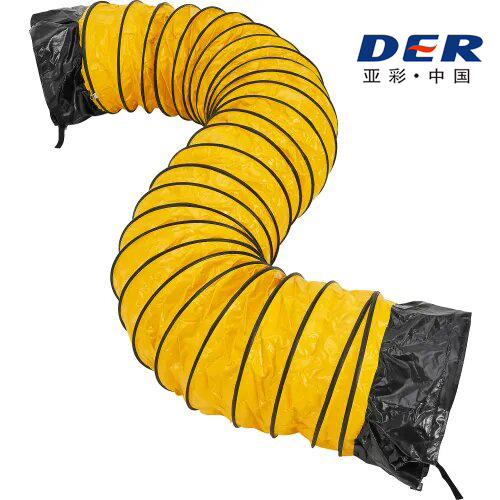
A wire reinforced ventilation hose is a flexible air-conveyance duct supported by a continuous helical wire or another repeated structural support. The reinforcement helps the circular passage resist collapse, controls how the hose bends, and allows the duct to be routed between a fan, extractor, hood, machine or work zone without using rigid sheet-metal ductwork.
In many industrial designs, the hose wall is a PVC-coated polyester technical textile. The coated fabric provides the air barrier and flexible body; the spiral steel wire provides shape support; a welded or sealed seam forms the tube; and cuffs or connectors create the interface with the rest of the ventilation system. An external wear strip can be added around the wire path where the hose is expected to drag over floors, tunnel surfaces, steel edges or access openings.
The buying intent is usually different from a standard layflat blower duct. A purchaser is often trying to solve one of four problems: the fan is pulling air rather than pushing it, the duct route has repeated bends, the hose must stay open when repositioned, or the equipment connection needs a more self-supporting flexible section. For those duties, the reinforcement becomes part of the airflow design rather than a cosmetic feature.
DERFLEX approaches the product as a finished ventilation assembly. The project discussion can cover diameter, length, wire gauge and pitch, coated textile construction, seam method, cuffs, suspension, wear protection, color, labels and specified flame-retardant or antistatic requirements where applicable.
A useful specification treats the wire, wall, diameter and route as one system. The same nominal hose diameter can behave very differently when wire pitch, wall stiffness or bend geometry changes.
The helix helps the duct retain an open cross-section when an extractor creates suction. Required support rises with diameter, vacuum level and local deformation.
Wire pitch, diameter and wall construction influence how the hose follows corners. A very tight route should be reviewed from actual geometry rather than a generic “flexible” label.
Spiral duct can compress accordion-style for transport, but tighter reinforcement generally increases the amount of wire and can change packed volume and handling weight.
Dragging and repeated contact often damage the outer helix path first. A wear strip can cover high-contact reinforcement zones and protect the coated textile underneath.
A corrugated flexible bore can create more friction than smooth rigid duct. Long runs, repeated bends and undersized hose can therefore consume fan pressure.
The reinforced body transfers handling force to the ends. Cuff depth, clamp area, ring strength and seam detail should match how crews connect and move the hose.
The table below is a purchasing guide, not a pressure rating. Final wire diameter and pitch should be verified against the complete construction and the required operating condition.
| Decision factor | Tighter wire pitch | Wider wire pitch | What the buyer should provide |
|---|---|---|---|
| Shape support | Generally increases local wall support and reduces unsupported span. | Provides fewer support turns along the same hose length. | Negative static pressure or extractor model, hose diameter and target length. |
| Flexibility | Can make the hose feel more structured depending on wire gauge and wall design. | Can improve freedom between support turns, but may reduce resistance to deformation. | Minimum practical bend radius, photos or route sketch. |
| Weight | More wire turns usually add material and weight. | Fewer turns can reduce reinforcement weight. | Whether crews carry, suspend, drag or repeatedly pack the hose. |
| Compression | May reduce how compactly the hose nests depending on construction. | Can favor more compact packing in some designs. | Storage limit, transport method and required extended length. |
| Cost direction | Higher reinforcement content can increase manufacturing input. | Lower wire content may reduce reinforcement input, subject to the required performance. | Target duty and quantity—not only a target price per meter. |
General engineering direction only. Exact behavior depends on wire gauge, wall stiffness, hose diameter, seam construction, temperature and test method.
The fields below help ventilation equipment brands, contractors, distributors and industrial procurement teams compare quotations on the same technical basis. They are planning references rather than universal guaranteed values.
Application names are not approval criteria. Pressure, temperature, contaminants, sparks, abrasion and required safety documentation still need to be reviewed before the final hose is confirmed.
Flexible connections for portable fans where crews repeatedly connect, reposition, compress and store the duct.
Routing between a capture point, machine enclosure, hood or temporary extraction point and the fan or filtration system.
Flexible air routes around tanks, vessels, manholes, utility works and maintenance zones where rigid ducting is difficult to deploy.
Shape-supported sections for localized suction, contaminated-air removal, bends or interfaces in underground ventilation systems.
Portable airflow for enclosed compartments, fabrication zones and temporary maintenance where hose routing changes with access.
Equipment-to-zone connections for temporary conditioned-air delivery or return when a flexible, compressible route is preferred.
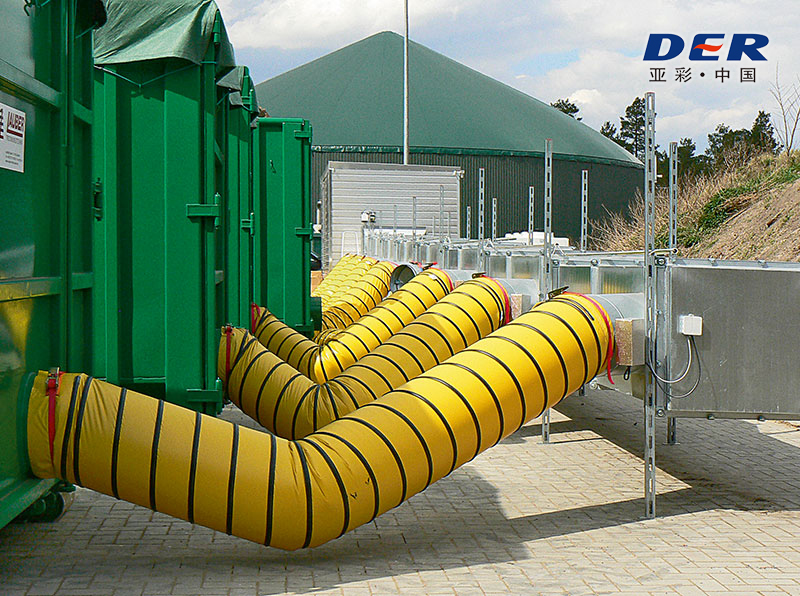
A long flexible route can lose useful fan pressure through undersized diameter, corrugation, bends, leaking joints or poor transitions. A stronger hose does not compensate for an incorrectly selected fan or air path.
For B2B ventilation programs, the practical advantage is control over the full flexible assembly—from the air-barrier fabric to the helix, seams, cuffs and repeat-order identification.
PVC-coated textile selection can be reviewed together with welding, reinforcement and the intended pressure direction instead of treating the fabric and hose as unrelated purchases.
Wire pitch, diameter and external wear protection can be discussed from the actual hose diameter, bend, extraction duty and handling method.
Cuffs, rings, clamp zones, zippers, belts and adapters can be developed around fan outlets, existing duct fleets or customer drawings.
Color, labels, airflow arrows, part numbers, storage bags and packing details can be controlled for distributors, fan brands and replacement programs.
Two hoses can use the same keyword and still be intended for very different pressure modes. Ask for construction evidence and an approved specification rather than comparing only diameter and price.
Use these related pages to compare pressure mode, material direction, fan interface and underground application requirements.
Short answers for industrial buyers, contractors, ventilation equipment companies, distributors and OEM procurement teams.
The helical wire provides mechanical support to the flexible wall. It helps the hose retain its airflow passage during suction, bending and handling, and it also influences compressibility and bend behavior. The required wire gauge and pitch depend on the hose diameter, wall construction and pressure condition.
It can be configured for negative-pressure extraction, but the presence of wire alone is not enough to establish a vacuum capability. The complete construction—including wire pitch, wire gauge, hose diameter, wall stiffness, seams and fan static pressure—should be reviewed and confirmed for the intended duty.
Layflat duct normally relies on positive internal pressure from a blower to inflate and hold its shape. A spiral wire reinforced hose has mechanical support along the body, so it is the usual starting point for suction, exhaust, tight bends or applications where the bore should stay open without depending entirely on internal pressure.
DERFLEX can discuss project-specific diameter, section length, wire pitch, end cuffs, rings, clamp areas, zippers, hook-and-loop connections, wear strips, suspension details, color and identification. Final options depend on the approved construction, quantity and application data.
Standard PVC-coated ventilation hose should not be assumed suitable for direct high-temperature exhaust, sparks or unusually hot process streams. The maximum service temperature must follow the confirmed material construction. Higher-temperature duties may require a different technical textile such as silicone-coated fiberglass or another application-specific material system.
Project-specific flame-retardant or antistatic configurations can be discussed when the buyer provides the required standard, test method and acceptance criteria. “Flame retardant” should not be interpreted as “fireproof,” and final compliance statements should correspond to the tested construction and order documentation.
Tell DERFLEX whether you are supplying air or extracting it, then send the fan outlet, static pressure or airflow if available, route length, bends, hose diameter, cuffs and environment. That information makes the first quotation more comparable and reduces avoidable sample revisions.