News
Company News

D-Rings vs Grommets for Tarps: Strength Guide | DERFLEX

Update:2026/8/16 16:59:23 Views:
Custom tarp hardware & reinforcement guide for industrial buyers DERFLEX · Request a project quote
Tarp Fastener Engineering Guide

D-Rings vs Grommets: Which Tarp Fastener Is Stronger?

The stronger tarp fastener is not determined by the metal fitting alone. Strength comes from the complete load path: tarp fabric, hem or webbing, hardware position, pull direction, stitching or setting method, and how many tie-down points actually share the load.

Quick answer: A properly set grommet in a reinforced perimeter is compact, low profile and avoids the sewn attachment used by many D-rings. A D-ring mounted on wide webbing can be better for straps, hooks, directional pull and tie-down points that must sit away from the edge. For truck tarps and other demanding covers, a mixed layout is often more practical than choosing only one fastener type.
Edge LoadsGrommets work well in reinforced hems.
Directional LoadsD-rings suit straps and webbing tabs.
Interior PointsD-rings can avoid a large punched opening.
Mixed LayoutUseful when one tarp has several load zones.
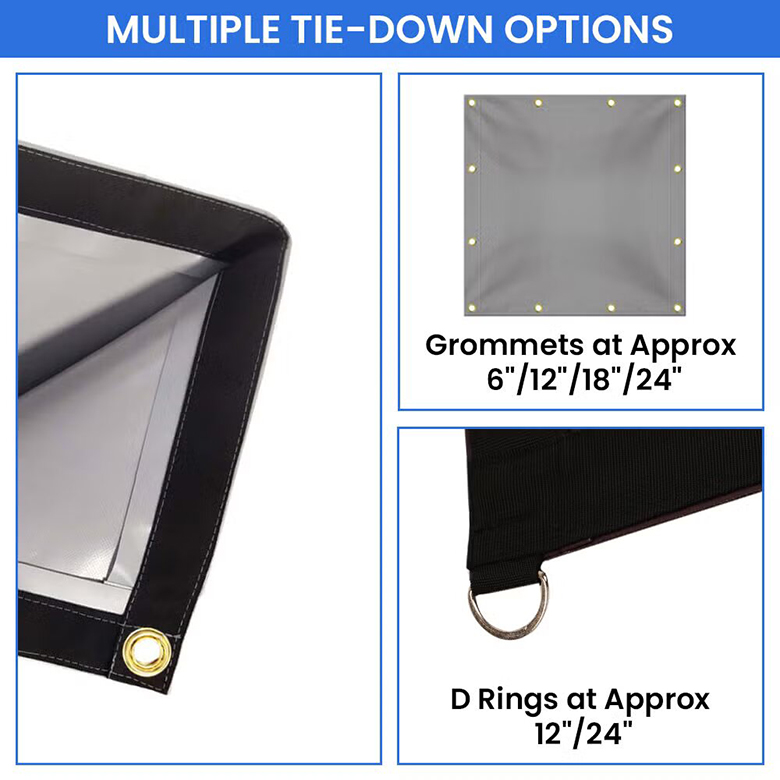
DERFLEX tarp tie-down options showing grommets and D-rings
DERFLEX product visual: grommet and D-ring tie-down options. Final spacing and reinforcement should be matched to the real anchor system.
Strength Depends on the Assembly

There Are Three Different Meanings of “Stronger”

Buyers often compare D-rings and grommets as individual pieces of hardware. In field use, however, the more useful question is how the attachment behaves after it is installed in a tarp and repeatedly tensioned.

1 · Load Strength

Can the tie point carry the expected pull?

A large metal ring does not automatically create a strong anchor. If the ring is attached to narrow webbing, weak stitching or an undersized patch, the surrounding textile can fail first. The same applies to a grommet pressed into an unreinforced hem.

2 · Fatigue Life

What happens after thousands of load cycles?

Transport tarps see vibration, flapping, folding and repeated retensioning. Stitching, coating, metal edges, webbing and the tarp body all age differently. A good specification considers cyclic use rather than a one-time pull.

3 · Tear Resistance

How far is force spread into the tarp?

Fastener performance improves when load is distributed through a wider reinforced zone. Perimeter webbing, double-layer hems, corner patches and correctly oriented D-ring tabs can reduce stress concentration around a single fixing point.

Metal Grommets / Eyelets

Low-Profile Perimeter Tie Points

A tarp grommet is a reinforced hole created by setting a metal eyelet and washer through the tarp edge or another reinforced zone. On industrial PVC tarps, the grommet should be supported by a hem, webbing, rope edge, added fabric layer or a combination of these structures.

  • Compact connection for rope, hooks, bungees and lacing.
  • Well suited to regular spacing along a perimeter.
  • No separate sewn webbing tab is required when the grommet is installed directly through a reinforced hem.
  • Low profile can reduce snagging during folding, rolling and storage.
  • Performance depends strongly on washer type, edge offset, reinforcement width and installation quality.
D-Rings

Defined Connection for Hooks & Straps

A D-ring is normally attached to a tarp with a webbing tab or a reinforced webbing row. The flat side provides a stable interface for the webbing while the curved side creates a convenient point for straps, rubber tarp ties, buckles or hooks.

  • Useful where the anchor needs to sit away from the perimeter.
  • Can be oriented around the expected direction of pull.
  • Works well with straps, hooks and truck-tarp tie-down hardware.
  • Can be installed in vertical or interior rows without punching a large eyelet opening in the center of the tarp.
  • Service life depends on webbing width, stitch pattern, thread durability, overlap and pull angle.
D-Rings vs Grommets Comparison

Which Fastener Has the Advantage?

The table below separates the hardware decision by real operating condition. “Advantage” means a practical starting direction, not a universal rating.

Decision Factor Grommets D-Rings Practical Specification Direction
Regular perimeter tie-down Advantage Works, but adds webbing tabs or stitched rows. Use reinforced grommets when rope, bungee or hooks repeat around the complete edge.
Long-term edge durability Often advantageous Check stitching & webbing A well-set grommet through a durable reinforced hem avoids a separate sewn D-ring tab. D-ring life depends on the textile attachment as much as the ring.
Interior or set-back anchor Possible, but creates a reinforced opening. Advantage Use D-rings on reinforced webbing when a hook or strap needs to connect away from the edge.
Directional strap load Works if pull is aligned with the hem. Advantage Orient the D-ring tab and its webbing/stitching with the expected pull direction.
Horizontal waterproof surface Usually easier to manage at the edge Check stitch perforation Avoid unnecessary sewn penetrations on upward-facing rain surfaces. Keep hardware in reinforced edge zones where practical.
Corner tie-down Good with large corner reinforcement. Useful for diagonal pull Choose by pull direction. A corner D-ring on cross-webbing can be effective; a spur grommet in a large reinforced corner can also work well.
Low-profile folding / rolling Advantage More protruding hardware. Grommets reduce protrusion where covers are frequently rolled or stacked.
Fast strap or hook connection Good with compatible hooks. Advantage D-rings provide a larger defined capture point for many hook and strap systems.
Repair and field replacement Often simpler Usually requires webbing and sewing capability. A damaged grommet can often be reset at a properly rebuilt reinforced location; do not simply press a new eyelet into a torn old hole.
Truck / flatbed tarp Perimeter control Side rows & straps Mixed system: grommets around selected edges plus D-ring rows where rubber straps and directional pull are required.
Important: Hardware size alone is not a reliable strength specification. A larger D-ring or thicker grommet can still fail early if the fabric, reinforcement width, stitch pattern, washer, edge offset or anchor geometry is wrong.
Load-Path Engineering

Four Factors Decide Whether a Tarp Fastener Pulls Out

This is the part that is often missed when buyers compare hardware only by appearance or metal thickness.

1

Reinforcement Width

A wider webbing or layered hem spreads force into more textile area. The reinforcement should extend well beyond the immediate hardware footprint.

2

Pull Angle

Sideways or diagonal pull can rotate a D-ring tab or pry a grommet toward the edge. Hardware should align with the real anchor position.

3

Load Sharing

One overtightened point may fail even when the hardware is strong. Closer spacing only helps when multiple points are actually connected and tensioned evenly.

4

Dynamic Movement

Wind flutter, highway vibration and repeated handling create fatigue loads. Elastic tie-downs, accurate fit and sufficient anchor density can reduce shock loading.

Interactive Selection Aid

Choose by How the Tarp Will Be Tied Down

Select the closest use condition for a practical starting direction. Final hardware should be confirmed against dimensions, load, exposure and reinforcement.

Fastener Fit Selector

What is the main tie-down situation?

Starting direction: Reinforced grommets For regular rope, bungee or hook points around an edge, grommets set through a reinforced hem provide a compact, repeatable fastening layout. Confirm spacing, washer construction, hem width and edge offset.
Application Guide

Recommended Direction by Tarp Use

Different applications create different failure modes. The fastening system should follow the load pattern rather than use the same hardware everywhere.

Flatbed & Lumber Tarps

Wind, repeated folding, cargo corners and rubber straps create changing loads.

Direction: reinforced perimeter grommets plus D-ring rows on webbing where strap access is needed.

Dump Truck & Roll-Off Covers

High cycle opening, vibration, frame contact and repeated tensioning matter more than static load alone.

Direction: low-profile grommets at defined frame points; D-rings or straps in high-use connection zones.

Machinery Covers

Irregular shapes and localized tie-down points can create diagonal stress.

Direction: drawing-controlled D-rings or webbing loops at machine anchors, with grommets where the edge is continuously secured.

Construction Weather Tarps

Temporary frames, changing anchor points and wind exposure favor flexible perimeter connection.

Direction: reinforced grommets or lacing points at suitable spacing, with corner patches and selected straps.

Agricultural Storage Covers

Large panel area and seasonal wind can concentrate force at corners and ground anchors.

Direction: reinforced perimeter grommets or loops, substantial corner reinforcement and controlled tension.

OEM Replacement Tarps

The critical requirement is repeatable fit with an existing frame or trailer system.

Direction: copy the verified anchor map, then improve known failure zones with revised webbing, patches or hardware position.
DERFLEX Custom Manufacturing

Specify the Fastener Together with the Tarp Structure

DERFLEX can coordinate PVC coated polyester material, finished dimensions, reinforced edges and hardware layout in one custom tarp specification for distributors, fabricators, fleet programs and industrial projects.

DERFLEX custom PVC tarps with reinforced grommet corners
Custom PVC tarp example with reinforced perimeter and metal grommets. Hardware type, spacing and reinforcement can be specified by project.
Tarp MaterialPVC coated polyester and other project-matched tarp structures; common industrial weight directions can be selected by duty level.
Edge ReinforcementFolded or welded hems, perimeter webbing, rope reinforcement, double layers and local wear patches.
Grommet OptionsSize, metal/finish, washer style, spacing, edge offset and row position can be defined on the drawing.
D-Ring OptionsRing size, webbing width, tab length, row height, orientation and attachment pattern can be specified.
Corner EngineeringLarger reinforcement patches, cross webbing, corner D-rings or additional grommets according to diagonal load.
FabricationHot-air welding, high-frequency welding, sewing and mixed fabrication routes according to material and hardware design.
OEM DetailsCustom size, color, logo printing, labels, packaging marks and repeat-order production references.
Approval DataFinished dimensions, hardware coordinates, approved sample, material code and inspection points can be recorded for repeat orders.

Buyer Specification Checklist

What to Put on a D-Ring or Grommet Tarp Drawing

Clear hardware data prevents “standard grommet” or “heavy-duty D-ring” from being interpreted differently during sampling and mass production.

ItemWhat to SpecifyWhy It Matters
Finished tarp dimensionsLength, width, drops, flaps, cut-outs and dimensional tolerance.Hardware coordinates are meaningful only when measured from a controlled finished edge.
Anchor mapActual rail, hook, frame or ground-anchor positions.Reduces diagonal pull and prevents one attachment from carrying disproportionate tension.
Grommet specificationInside diameter, material/finish, washer style, edge offset and center-to-center spacing.Controls connector fit and the size of the reinforced zone around the opening.
D-ring specificationRing size, finish, webbing type/width, tab length, orientation and row height.Defines how the ring transfers force into the tarp and whether the strap can connect cleanly.
ReinforcementHem width, webbing width, patch dimensions, rope edge or added fabric layers.The textile support often determines whether the hardware tears out.
Pull directionDownward, outward, lengthwise or diagonal; note high-cycle and wind-loaded zones.Critical for D-ring orientation, webbing layout and corner design.
Water exposureVertical side, sloped cover, horizontal top or fully exposed installation.Helps avoid unnecessary sewn penetrations in areas where standing rainwater is expected.
Inspection methodHardware seating, alignment, stitch pattern, weld quality, edge flatness and sample fit.Turns the approved fastener layout into a repeatable production requirement.
From Requirement to Production

A Practical Custom Tarp Approval Process

For B2B programs, the strongest fastener design is the one that can be clearly documented, sampled, checked on the real system and reproduced in later orders.

STEP 01

Map Anchors

Send frame dimensions, photos, an old tarp or a marked drawing showing usable tie points.

STEP 02

Define Loads

Identify wind exposure, strap direction, vibration, opening cycles and high-wear zones.

STEP 03

Select Hardware

Choose grommets, D-rings or a mixed system by connector type and load path.

STEP 04

Approve Sample

Check fit, alignment, corner reinforcement, stitching/welding and real tie-down operation.

STEP 05

Control Reorders

Reference the approved drawing, material code and inspection points for later production.

Frequently Asked Questions

D-Ring and Grommet FAQs

Concise answers for tarp buyers, fabricators, fleet managers and project engineers.

Are D-rings stronger than grommets on a tarp?

Not automatically. A D-ring may handle a strap or directional pull very well when it is mounted on wide reinforced webbing, but the webbing and stitching become part of the load path. A properly set grommet in a strong reinforced hem can provide excellent perimeter durability. The stronger option depends on installation, reinforcement and load direction.

Do grommets last longer than D-rings?

In some perimeter applications, grommets can have a service-life advantage because they do not require a separate sewn webbing tab. However, poor grommet setting, weak hems, wide spacing or uneven tension can still cause pull-out. D-rings can also provide long service when webbing, thread, stitch pattern and orientation are properly specified.

When should I use D-rings instead of grommets?

Consider D-rings when hooks, buckles or straps need a larger defined connection, when the tie point must sit away from the edge, when an interior row is required, or when the pull direction should be controlled by a webbing tab.

When are grommets the better tarp fastener?

Grommets are practical for regular perimeter spacing, rope or bungee lacing, low-profile folding and applications where a compact reinforced hole is easier to use than a protruding ring.

Can a tarp use D-rings and grommets together?

Yes. Mixed systems are common on transport and custom industrial covers. A tarp can use grommets around selected edges, D-rings in vertical or horizontal rows, reinforced loops at corners and straps on flaps. Each zone can be designed for its own connector and load.

What grommet spacing should I choose for a heavy duty tarp?

Common starting points include approximately 12, 18, 24 and 36 inches, but spacing should follow wind exposure, cover size, anchor positions, hem strength and handling frequency. Closer spacing does not help unless the anchors are used and load is shared evenly.

Can DERFLEX make custom D-ring rows and grommet positions?

DERFLEX can develop custom tarp layouts from dimensions, photos, drawings or an existing cover. Hardware positions, row heights, edge reinforcement, webbing, corner patches, fabrication method, color, printing and packaging can be coordinated for sampling and repeat production.

Need a Tarp Fastening Layout Built Around Your Real Anchors?

Send DERFLEX the finished size, application photos, anchor positions, preferred tie-down method and order quantity. The material, reinforced edge, grommet spacing and D-ring layout can then be reviewed as one manufacturing specification.

Technical selection guidance is application-dependent. Final fastener material, reinforcement, spacing and fabrication should be confirmed against the actual cover geometry and use conditions.
Consulting Services
+86-021-54361792 / 54361798
Email
sales@derflex.com