What will the hardware touch?
Rainwater, road salt, sea spray, fertilizer residue, cleaning chemicals, dust and trapped moisture create very different corrosion risks. “Outdoor use” is too broad for a repeatable hardware specification.



For truck tarps, industrial covers, construction tarps and repeat OEM programs, hardware should be selected by corrosion exposure, connector type, load direction, reinforcement and maintenance—not by the words “heavy duty” alone. This guide explains how stainless steel and galvanized / zinc-coated grommets and D-rings fit different service environments, and what buyers should put on the drawing before approving a sample.
Choose stainless steel when corrosion resistance is a dominant requirement, especially where hardware may see salt spray, deicing salts, frequent wetting, repeated wash-down or a long inspection interval. Where stainless grade can be specified, 316-type stainless generally offers better resistance to chloride attack than 304-type stainless. Choose galvanized or otherwise zinc-coated steel when general outdoor durability, broad availability and cost control matter and the service environment is not aggressively chloride-rich or chemically demanding.
The metal choice does not determine finished tarp strength by itself. Grommet pull-out and D-ring retention also depend on the fabric, hem, webbing or patch, hardware dimensions, setting quality, stitch / weld pattern, edge distance and the direction of pull. For high-load or repeat-use projects, qualify the actual finished attachment zone rather than comparing metal names alone.
Rainwater, road salt, sea spray, fertilizer residue, cleaning chemicals, dust and trapped moisture create very different corrosion risks. “Outdoor use” is too broad for a repeatable hardware specification.
Rope or bungee through a grommet produces a different contact pattern from a hook or strap through a D-ring. The hardware should match the real connector, pull direction and expected retensioning cycle.
A premium eyelet in a weak single-layer edge can still pull out. A D-ring on a short, poorly oriented tab can still rotate or tear away. Review the complete load path from metal to webbing / patch to tarp.
In procurement language, “stainless” and “galvanized” should be treated as starting descriptions—not complete specifications. Stainless performance depends on alloy grade, forming and surface condition. Zinc-coated steel performance depends on the coating process, coating amount / thickness, damage during forming and the actual environment.
| Decision factor | Stainless steel grommets / D-rings | Galvanized or zinc-coated steel hardware | What to write into the RFQ |
|---|---|---|---|
| Corrosion strategy | Relies on the stainless alloy’s passive surface film; grade matters when chlorides are present. | Zinc coating protects the underlying steel as a barrier and can provide sacrificial protection while zinc remains. | State environment, metal grade or coating method, and any corrosion-test requirement. |
| Salt / chloride exposure | Often preferred for coastal, marine-adjacent and road-salt exposure; 316-type stainless is commonly selected where chloride resistance is important. | Can be suitable for many outdoor uses, but zinc is gradually consumed and service life depends heavily on coating system and exposure. | Describe salt source, wetting frequency, cleaning and maintenance interval. |
| Scratch / coating damage | No separate zinc coating to wear through, although the stainless surface can still stain, pit or corrode in aggressive conditions. | Small coating damage may still benefit from surrounding zinc, but protection reduces as zinc is consumed or severely damaged. | Do not accept “rustproof” as a specification. Define finish and environment. |
| Appearance | Useful where buyers want a consistent metallic finish and lower risk of red-rust staining from exposed carbon steel. | Fresh zinc-coated hardware can look bright or matte depending on process; weathering changes appearance over time. | State whether cosmetic staining matters or only functional corrosion resistance matters. |
| Cost direction | Usually higher initial hardware cost, especially for specified stainless grades. | Often selected where initial hardware cost and broad sourcing availability are important. | Compare total service needs, not only piece price. |
| Strength | Do not infer finished tarp pull-out strength from “stainless” vs “galvanized” alone. Geometry, material thickness, ring wire size, grommet profile, reinforcement and attachment method can dominate. | Define finished-assembly acceptance or approved sample when retention strength matters. | |
“Galvanized” is frequently used loosely in trade language. If corrosion performance is important, ask whether the hardware is hot-dip galvanized, electro-zinc plated, zinc-alloy coated or another finish, and specify the project’s required evidence rather than assuming equivalent performance.
For demanding service, the stainless grade should be part of the hardware approval. 304-type stainless is widely used for general corrosion resistance. 316-type stainless contains molybdenum and is commonly selected where chloride pitting resistance is more important, such as coastal air, salt spray, deicing salt contamination and some repeated wash-down environments.
That does not make 316 immune to corrosion. Deposits, crevices, chemical exposure, poor drainage and contaminated surfaces can still create localized attack. If a tarp program is going into a chemically aggressive site, specify the actual chemical and concentration rather than assuming “stainless” solves every environment.
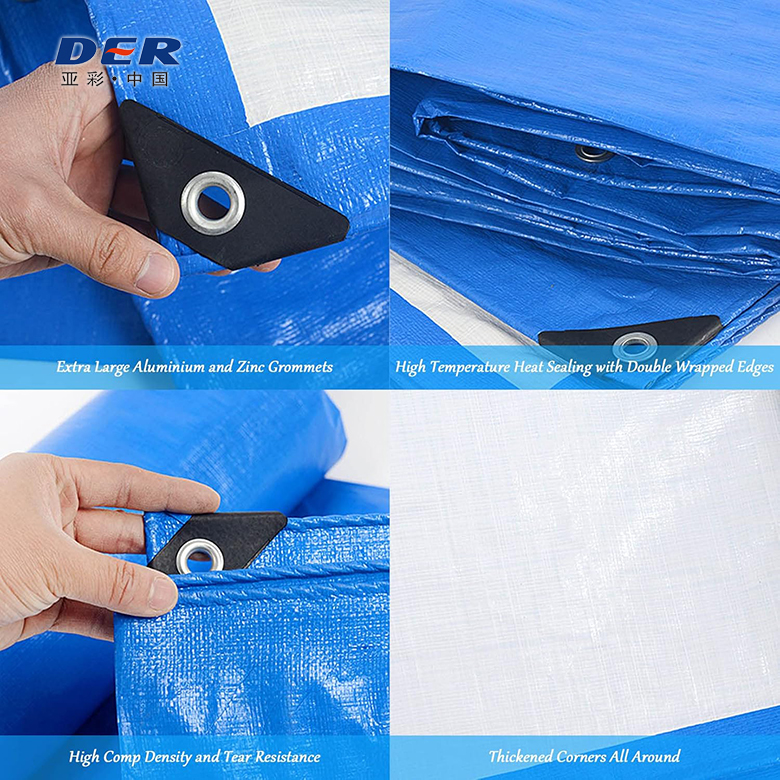
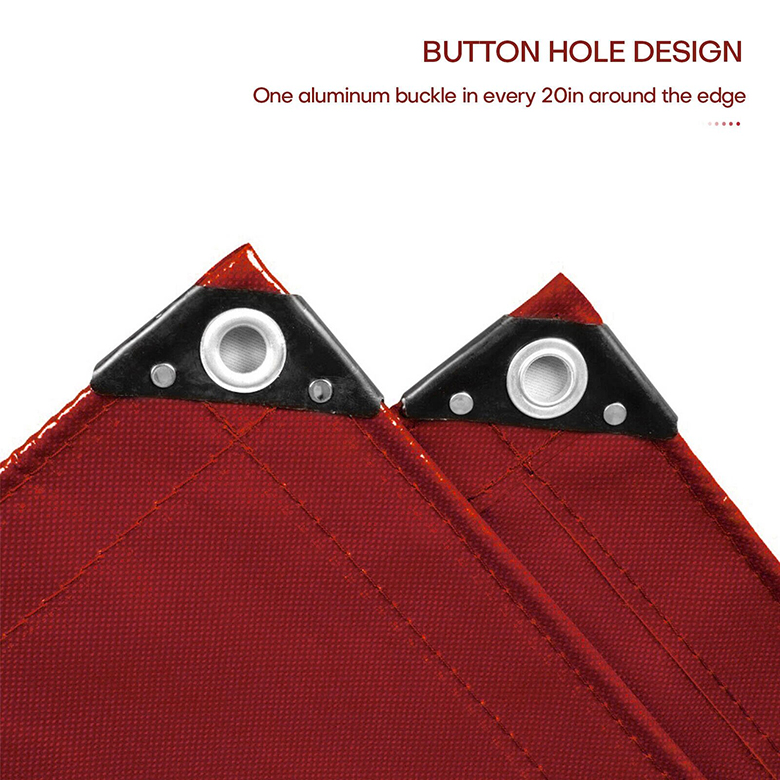
Specify the inside opening, outer flange, barrel length and washer / backing construction. A grommet that is too short for the folded hem and webbing stack can set poorly; an oversized hole can remove more fabric than necessary.
Metal grade does not compensate for an incomplete roll, cracked eyelet, uneven washer engagement or damage around the punched opening. Production inspection should check seating consistency and surrounding reinforcement.
Folded hems, welded reinforcement, continuous webbing, rope-in-hem and local corner patches can spread force away from the opening. For a deeper test framework, review DERFLEX’s grommet pull-out strength guide.
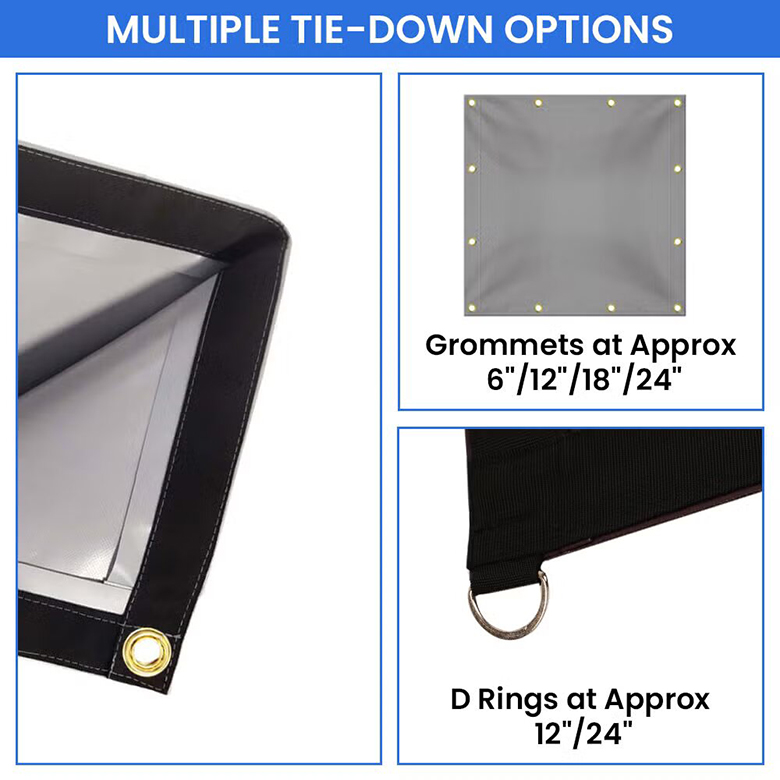
A tarp D-ring is useful when hooks, straps or buckles need a defined connection point. Material selection matters for corrosion, but D-ring performance is also controlled by ring opening, wire / section size, joint construction, orientation, webbing width, webbing overlap, stitch or weld pattern, backing patch and how that reinforcement enters the perimeter.
Consider stainless where the ring will remain wet, where salt contamination is expected, where appearance is important or where corrosion-related maintenance access is difficult. For chloride-rich service, ask which stainless grade is actually supplied.
Do not specify “stainless D-ring” without ring dimensions and attachment detail. A smaller section or poor webbing design can still be the limiting part of the assembly.
Zinc-coated steel D-rings are common on truck and industrial tarps because they combine practical outdoor corrosion protection with broad commercial availability. The coating method and durability should be matched to road exposure, moisture, handling abrasion and expected service interval.
If hooks rub the ring repeatedly, inspect coating wear in addition to webbing wear. A strong ring with a damaged coating can become a maintenance issue long before the tarp fabric fails.
For a product-level explanation of layouts, spacing and webbing tabs, see DERFLEX custom tarps with D-rings.
| Service environment | Hardware direction to evaluate | Why | Additional design check |
|---|---|---|---|
| Indoor warehouse / mostly dry storage | Galvanized / zinc-coated or stainless, based on market and maintenance needs | Corrosion demand is usually lower than exposed outdoor service. | Focus on connector compatibility, spacing and edge reinforcement. |
| General inland outdoor use | Quality zinc-coated hardware or stainless | Both can be practical; selection depends on wetting cycle, expected life, inspection and budget. | Check coating damage, drainage and retained moisture. |
| Highway truck tarp with winter road salt | Stainless hardware is worth evaluating; robust zinc-coated systems may also be specified with defined maintenance | Salt contamination and repeated wet / dry cycling increase corrosion risk. | Also review webbing abrasion, D-ring orientation, flapping and repeated folding. |
| Coastal / marine-adjacent outdoor cover | Stainless, with grade explicitly defined; 316-type direction may be appropriate for chloride exposure | Chloride attack is a primary hardware-selection concern. | Prevent crevice water traps and review any dissimilar-metal contacts. |
| Frequent wash-down | Stainless often merits evaluation | Repeated wetting can shorten the maintenance interval for zinc-coated hardware depending on water chemistry and cleaning agents. | State cleaning chemistry; chemical compatibility must be project-specific. |
| Agriculture / fertilizer contamination | Project-specific stainless or coated hardware selection | Residues and persistent moisture can be more aggressive than ordinary rain exposure. | Identify fertilizer / chemical contact rather than writing only “farm use.” |
| OEM retail / distributor program | Freeze one approved hardware code per product tier | Repeatability matters as much as one-time material choice. | Control grade / coating, dimensions, spacing, setting and approved sample by revision. |
These are procurement directions, not universal service-life guarantees. Final hardware depends on actual environment, design, test requirements and maintenance.
| Hardware type | Common connection | Design advantage | Main failure risk to control |
|---|---|---|---|
| Grommet / eyelet | Rope, bungee, hook, lacing | Compact perimeter fastening; practical for regular spacing around edges. | Local bearing / tear around the hole, poor setting, side pull or weak hem. |
| D-ring on webbing tab | Hook, webbing strap, buckle, ratchet-style connector where appropriate | Can transfer directional pull through a wider reinforced webbing path. | Tab peel, stitching / weld fatigue, webbing abrasion, ring rotation or off-axis loading. |
| Mixed system | D-rings at higher-demand points + grommets along regular edges | Lets different zones use different connection methods without over-specifying every point. | Poor coordination of spacing, anchors and reinforcement between zones. |
A D-ring tarp is not automatically stronger than a grommet tarp. A properly reinforced grommet can outperform a poorly attached D-ring. Compare the finished attachment zones and actual pull direction. DERFLEX also provides separate guides for custom tarps with grommets and reinforced tarp edges.
PVC coated polyester weight, base fabric, fold depth, additional layers and weld / seam placement determine how much material surrounds the hardware.
Continuous webbing or local patches can move force away from one small opening or tab. Corners often require a different reinforcement geometry from straight edges.
Side-loading can deform a grommet or twist a D-ring tab. The production drawing should show real anchor positions instead of copying a generic spacing pattern.
If hardware tears out in service, diagnose the failure mode before simply changing metal. DERFLEX’s guide to tarp damage around grommets explains how wind, edge reinforcement, pull angle, abrasion and installation can change the failure path.
| Specification field | What to define | Why buyers need it |
|---|---|---|
| Application | Truck, trailer, equipment, construction, storage, agriculture, curtain or project-specific cover | Sets the service environment and handling cycle. |
| Tarp material | Material family, approved construction code, target GSM / thickness if required | Hardware must fit the actual material stack. |
| Hardware type | Grommet, D-ring, strap, loop or mixed system | Defines the connector architecture. |
| Metal | Stainless grade or zinc / galvanized finish description; supplier hardware code | Prevents vague “rust-resistant” substitutions. |
| Dimensions | Grommet inside diameter / flange; D-ring opening / section size | Controls connector fit and local bearing geometry. |
| Spacing / coordinates | Center-to-center spacing or drawing coordinates from fixed datum points | Supports repeat installation and replacement-cover fit. |
| Orientation | Ring direction and expected pull direction | Reduces off-axis loading and tab rotation. |
| Edge reinforcement | Hem build-up, webbing, rope-in-hem, patch dimensions, corner detail | Controls how load spreads into the tarp. |
| Attachment method | Grommet setting; D-ring webbing overlap and stitch / weld architecture | Finished retention depends on attachment quality. |
| Environment | Rain, salt, wash-down, chemicals, temperature, outdoor duration, maintenance interval | Drives corrosion and inspection requirements. |
| Inspection / test | Visual standard, finished pull test or buyer-defined acceptance method where required | Converts “heavy duty” into a repeatable acceptance criterion. |
| Change control | Approved sample, drawing revision and hardware supplier code | Helps keep repeat orders equivalent. |
Confirm the approved hardware code, stated metal / coating, dimensions and visible finish before bulk assembly.
Check concentric seating, washer engagement, cracked or distorted metal, punched-hole damage and spacing against the drawing.
Check ring orientation, webbing overlap, stitch / weld placement, backing patch position and clearance from fold or abrasion zones.
Verify hem depth, reinforcement continuity, corner build-up and any local patch dimensions that support the hardware.
If retention is critical, qualify the actual finished assembly with an agreed pull direction, fixture, endpoint and failure-mode record.
Retain approved drawing revision, golden sample / photo reference, material code, hardware code and packaging identification.
For broader material, seam and finished-product QC planning, use the DERFLEX tarpaulin testing standards and buyer inspection guide. Mechanical properties should also be interpreted correctly; tensile, tear and hardware pull-out describe different failure modes. See tarp tensile strength vs tear strength.
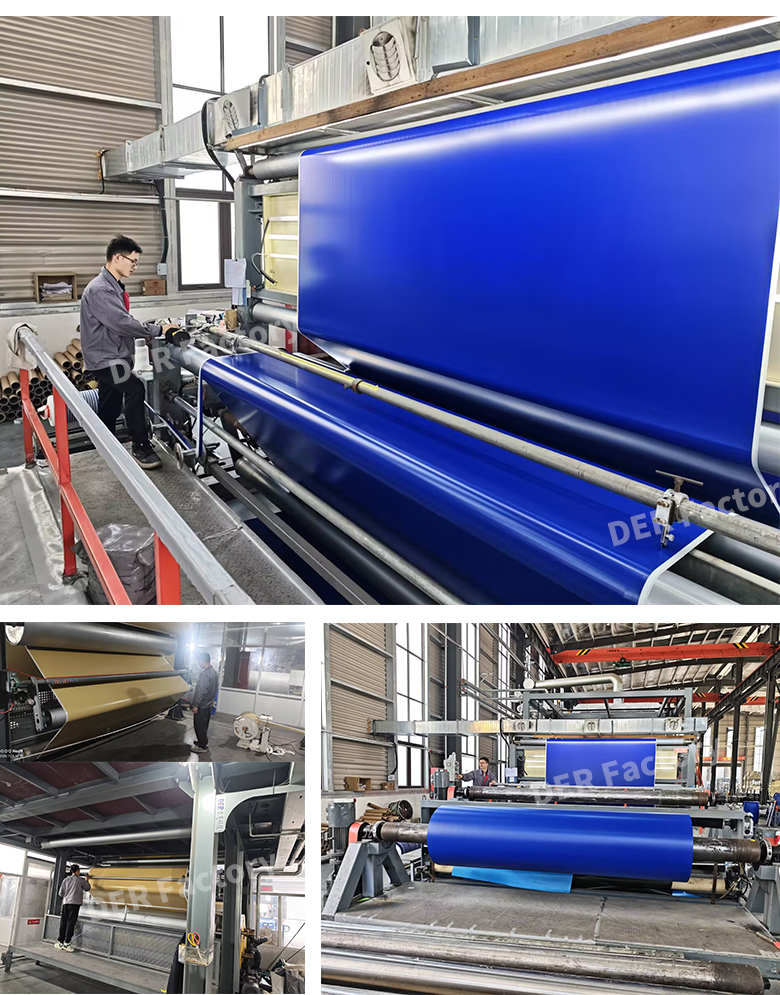
These images use existing DERFLEX site assets so the page can support image search while keeping the visual subject aligned with the actual topic. The hero image is loaded immediately; supporting images below are lazy-loaded.
Highway wind, folding, vibration, road spray and repeated tie-down create a hardware environment different from static storage. Hardware choice should be made together with webbing rows, corner patches and wear zones. See custom truck tarp manufacturing.
Fixed anchor points make drawing-based hardware coordinates practical. Stainless can be useful where washing, condensation or contamination increases corrosion exposure; coated steel can remain suitable for many general installations.
Wind cycling and changing anchor geometry often make reinforcement and spacing more important than hardware metal alone. The hardware plan should be reviewed with the complete perimeter.
Chloride exposure raises the importance of stainless grade selection, drainage, cleaning and crevice control. “Stainless” without a grade is incomplete procurement language.
Persistent moisture, fertilizer residue, mud and seasonal outdoor exposure should be described in the RFQ so hardware is not selected as if the cover were only exposed to clean rainwater.
The critical requirement is repeatability: hardware code, finish, grommet setting, D-ring tab construction, spacing and packaging should stay tied to an approved drawing and sample.
Not in every application. Stainless is often preferred when corrosion exposure is demanding, especially around salt, repeated wetting or wash-down. Galvanized or zinc-coated steel can be a practical choice for many general outdoor applications. Finished pull-out strength still depends on grommet geometry, hem / webbing reinforcement, setting quality and pull direction.
304-type stainless is widely used for general corrosion resistance. 316-type stainless is commonly chosen where chloride resistance is more important because its molybdenum addition improves resistance to localized chloride attack. For coastal, road-salt or marine-adjacent service, state the expected exposure and require the actual grade to be identified.
,Yes, zinc-coated steel D-rings are commonly used outdoors. Suitability depends on coating process, coating condition, wetting, salt exposure, abrasion and maintenance. If the cover will see aggressive chloride contamination or difficult maintenance access, stainless may be worth evaluating.
The metal name alone does not answer that question. Ring section size, material grade, forming / joint design, webbing, stitch or weld pattern, backing patch and load direction all affect the finished assembly. Compare hardware dimensions and qualify the complete D-ring attachment zone when strength matters.
D-rings are useful for hooks, straps, buckles and repeated directional tie-downs where webbing can spread load into a wider zone. Grommets are compact and efficient for rope, bungee or regular perimeter lacing. Many heavy-duty tarps combine both.
Mixed hardware is possible, but the design should account for exposure, appearance, maintenance and any prolonged wet contact between dissimilar metals. For demanding environments, it is better to define each hardware material by zone and approve the finished construction rather than mix metals casually.
Send the application, finished dimensions, quantity, tarp material or duty level, service environment, connector type, hardware preference, grommet / D-ring spacing or drawing coordinates, pull direction, reinforcement details, photos of the installation, branding / packing and any required test or acceptance method.
Send DERFLEX your tarp drawing, anchor positions, exposure conditions and required hardware layout. The discussion can cover PVC coated fabric, finished dimensions, hems, webbing, grommets, D-rings, corner reinforcement, sample approval, labels and packing as one repeatable B2B specification.
Technical note: the comparison above is intended for B2B specification development. Actual corrosion life, pull-out capacity and service performance vary with material grade, coating process, geometry, environment, installation and maintenance. Final requirements should be confirmed in the approved specification and sample.