


How to Stop a Tarp from Flapping
Stop the movement at its source: remove loose fabric, block wind entry, balance tension, shorten unsupported spans and spread pull across reinforced attachment points.
Flapping is usually a fit-and-tension problem before it is a fabric-weight problem. A tarp can still snap, flutter or billow even when it is heavy if the windward edge is loose, the cover is oversized, tie-down points are too far apart or one side is tensioned harder than the other.
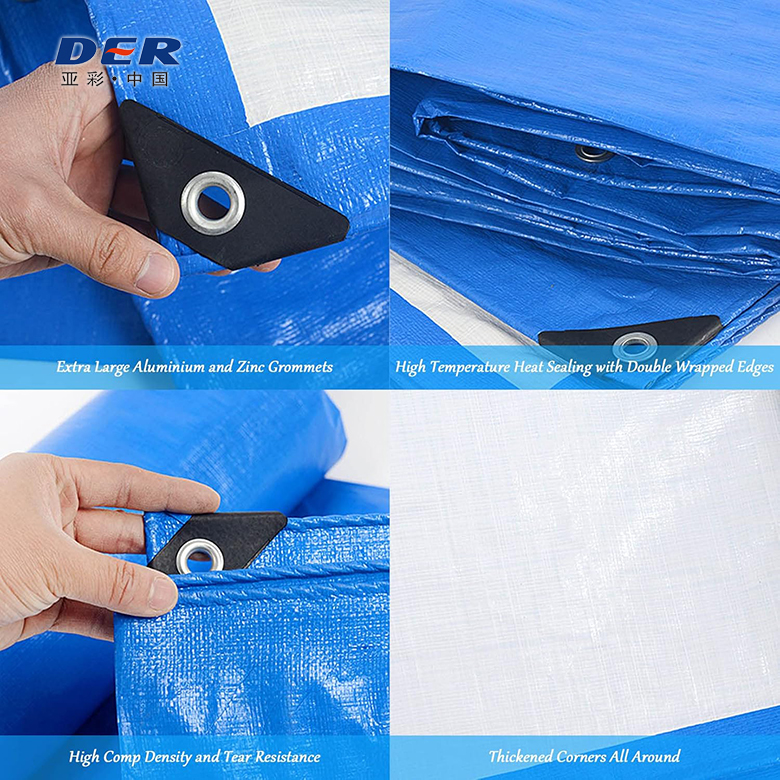
What Is the Fastest Way to Stop a Tarp from Flapping?
Remove slack first. Center the tarp, fold or roll excess material, secure the windward edge, tension opposite corners gradually, then add intermediate ties wherever an edge or center span still moves. The tarp should be smooth and controlled, not stretched so hard that grommets or seams distort. If the center still billows, shorten the unsupported span with a suitable cross-strap, support or additional reinforced fixing point.
Why Does a Tarp Flap in the Wind?
Tarp flapping begins when moving air finds a loose edge, pocket or unsupported panel and makes the fabric repeatedly change shape. The more the cover moves, the more it can rub, snap at hardware and cycle load through hems, seams and corners.
Too Much Loose Material
An oversized tarp leaves folds, hanging skirts and broad unsupported areas. Wind can lift those sections even if the four corners are tied.
Wind Gets Under the Edge
A high or open windward edge behaves like an air scoop. Once air gets underneath, the pressure can travel through the whole cover and create billowing.
Uneven Tension
One tight corner and one loose side twist the tarp into diagonal wrinkles. Those wrinkles become flexible zones that can flutter or snap.
Tie Points Are Too Sparse
Long unsupported edge spans can flap between anchors. More attachment points only help when the surrounding hem or reinforcement is strong enough to transfer the load.
How to Stop Tarp Flapping in 6 Practical Steps
Make adjustments before severe weather or high-speed movement begins, and only while access is safe. The goal is to remove uncontrolled motion without overloading one eyelet, strap or anchor.
Find Where the Motion Starts
Watch the tarp from a safe position. Is the first movement at the windward edge, a corner, between two grommets or in the middle of a large panel?
Remove Excess Fabric
Re-center the cover and fold or roll unnecessary overhang. Do not leave a loose tail or hanging flap where airflow can catch it.
Control the Windward Edge
Keep the leading edge low and close to the covered object where the installation allows. Close obvious air-entry gaps before tightening the rest.
Tension Opposite Points
Work in diagonal or opposite pairs. Increase tension gradually around the perimeter rather than fully tightening one side first.
Shorten Moving Spans
Add practical intermediate ties, a suitable over-the-top strap, support, or extra reinforced fixing point where a long edge or center panel still billows.
Inspect the Load Path
Check whether grommets are elongating, D-rings are twisting, hems are curling or anchors are moving. Stop increasing tension if the hardware zone is deforming.
Tarp Flapping Diagnosis Matrix: Fix the Symptom You Actually See
Repeatedly tightening every rope can make the wrong problem worse. Use the motion pattern to identify whether the real issue is air entry, poor fit, a long unsupported span, hardware spacing or abrasion.
| What You See or Hear | Likely Cause | Best Correction Direction | What to Inspect Next |
|---|---|---|---|
| Rapid snapping at one edge | Loose windward edge or too much overhang | Reduce the loose skirt and add balanced edge control | Hem condition, nearby tie points, anchor alignment |
| Large center panel balloons upward | Wide unsupported span or air entering below the tarp | Close air entry and reduce the span with a suitable strap/support/fixing layout | Center contact, sharp objects, panel size, edge fit |
| One corner jerks while other sides look calm | Uneven load or diagonal pull through one corner | Loosen and retension the full perimeter in opposite pairs | Corner patch, grommet distortion, D-ring orientation |
| Flapping only between two tie-down points | Attachment spacing too wide for that edge span | Add a planned intermediate fixing point or redesign the edge layout | Whether the hem is reinforced enough for the extra load point |
| Tarp becomes noisy only on a moving truck or trailer | Dynamic airflow, loose front edge, excess drop, poor strap map | Improve vehicle-specific fit and front/side restraint | Road vibration, cargo profile, D-ring/webbing positions |
| Flapping returns after rain | Water pooling, stretched elastic ties or shifted anchors | Restore drainage geometry and re-balance tension | Low spots, water load, bungee condition, anchor movement |
| Noise disappears when pushed against the load | Center or side panel lacks support/contact | Use a safe compression strap, support or better fitted custom cover | Abrasion points and whether compression can damage the covered item |
If rainwater is creating the loose pocket, solve the drainage geometry rather than just increasing local tension. See DERFLEX’s tarp water pooling guide.
Bungees, Rope, Ratchet Straps or D-Rings: Which Stops Flapping Best?
No connector is best in every tarp installation. The useful question is: how does the connector transfer load into the tarp edge and into the anchor without allowing too much movement or creating a concentrated tear point?
| Method | Best Use | Flap-Control Strength | Main Caution |
|---|---|---|---|
| Elastic bungee / rubber strap | Temporary covers and situations needing controlled shock absorption | Can reduce shock loading while maintaining moderate tension | Too much stretch can allow continued movement; aged elastic can fail suddenly |
| Rope / lacing | Irregular anchor layouts and continuous perimeter tying | Good when tension can be adjusted and distributed through multiple points | Do not saw rope across sharp metal or pull sideways through weak grommets |
| Cam or ratchet strap | Strong, adjustable restraint on suitable attachment points | Excellent for controlling a moving panel or cross-compressing a cover | Easy to over-tighten; better connected to reinforced webbing or D-rings than unsupported eyelets |
| D-rings + webbing | Repeat-use commercial, truck, equipment and custom covers | Provides defined high-control pull points with planned reinforcement | Ring orientation and backing patch/webbing route must match the pull direction |
| Tarp clips / grippers | Adding temporary attachment points to sound fabric | Useful for reducing long unsupported spans when no factory eyelet exists nearby | Grip depends on clip design and fabric condition; not a substitute for engineered reinforcement in demanding service |
How Tight Should a Tarp Be?
A tarp should be tight enough that edges and broad panels stay controlled, but not so tight that grommets stretch the surrounding fabric, D-rings twist out of line, seams distort or the tarp compresses the covered load.
For repeat-use heavy-duty covers, the fixing system should be designed as part of the tarp rather than added after the finished size is chosen. DERFLEX’s reinforced-edge tarp guide explains how hems, webbing, corner patches and wear zones help spread pull.
When D-Rings Make More Sense
D-rings are useful where hooks or straps need a defined connection point and the load is higher than a small perimeter eyelet should carry. Their performance comes from the webbing route, backing reinforcement and pull direction.
See DERFLEX’s custom tarp with D-rings page for repeat-use attachment layouts and custom fabrication directions.
How to Keep a Tarp from Flapping by Application
Static outdoor covers, moving vehicle covers and temporary shelters do not experience the same airflow. Match the correction to the real use rather than applying one generic tie-down rule everywhere.
| Application | Primary Flapping Risk | Better Control Direction | Important Caution |
|---|---|---|---|
| Outdoor equipment cover | Loose side skirts and wide top span | Closer fit, padded contact points, balanced perimeter ties, optional cross restraint | Avoid sharp corners that abrade the tarp during repeated motion |
| Pallet / material stack | Wind gets under bottom edge | Keep windward drop controlled, reduce excess side material, use stable perimeter anchors | Do not rely on loose blocks or unstable objects as improvised anchors |
| Truck / trailer cover | Road-speed airflow, vibration and cargo profile changes | Vehicle-specific fit, reinforced front edge, repeatable side tension, webbing/D-ring map | The tarp is a cover; cargo securement remains a separate requirement |
| Temporary shelter / canopy | Large unsupported roof or side panels | Positive pitch, controlled edges, suitable guy lines and shorter panel spans | Do not adjust exposed structures during unsafe wind or lightning |
| Construction / industrial enclosure | Large solid area creating wind pressure | Project-specific fixing layout, reinforced perimeter and mesh zones where airflow is acceptable | Large enclosures can alter structural wind loads and may require engineering review |
| Privacy / debris screen | Solid sheet acting like a sail | Consider mesh when waterproofing is not required, while still reinforcing the perimeter | Mesh reduces pressure but does not eliminate the need for safe anchors |
Signs You Need a Better-Fitting or Better-Reinforced Tarp
The Same Edge Always Flaps
If one side remains loose after repeated retensioning, the finished dimensions, side drop or hardware positions may not match the real anchor geometry.
Grommets Start Pulling Out
More tension is not the answer if the fixing zone is already deforming. The edge may need wider reinforcement, webbing, corner patches or a different attachment type.
Center Billowing Needs Permanent Cross-Straps
For repeat-use equipment or transport covers, it may be cleaner to design strap paths, D-ring rows, sleeves or additional attachment zones into the finished tarp.
Excess Fabric Must Always Be Folded Away
That is a strong sign the tarp is oversized for the coverage path. A custom size can reduce loose material and make the tie-down sequence more repeatable.
Road-Speed Noise Keeps Returning
Moving vehicles need a tarp designed around the cargo profile, front edge, drop, strap map and vibration—not simply a heavier rectangular sheet.
Repairs Keep Failing at the Same Stress Point
Repeated failure often indicates a load-path problem. The replacement cover should change the reinforcement or hardware layout, not just patch the old location again.
What to Tell DERFLEX for an Anti-Flap Custom Tarp
- Application: truck, equipment, storage, shelter, curtain or enclosure
- Finished dimensions and side drops
- Photos or drawing of the covered object
- Actual anchor locations and pull directions
- Where flapping currently starts
- Waterproof or mesh/airflow requirement
- Preferred material / GSM direction if already specified
- Grommets, D-rings, webbing, straps, pockets or sleeves
- Reinforced corners and known wear zones
- Color, printing or branding requirement
- Quantity and packaging requirement
- Destination and any required compliance documentation
Custom Manufacturing Direction
DERFLEX can discuss custom finished size, heavy-duty PVC coated polyester tarp materials, reinforced hems, webbing, grommets, D-rings, patches, welded seams and OEM finishing for applications where repeatable fit and tie-down control matter.
The useful design question is not simply “How heavy should the tarp be?” It is “How will wind and strap force travel through the finished cover into the real anchor points?”
For made-to-order finished covers, review DERFLEX custom heavy duty tarps.
Real Tarp Reinforcement, Tie-Down and Manufacturing Images
These existing DERFLEX website assets support the page topic for Google Images and visual explanation. Hero is loaded immediately; below-fold images use lazy loading.
Reinforced Corner & Grommet
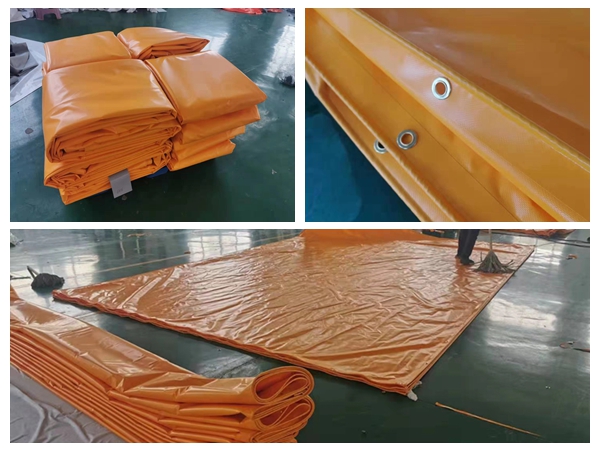
Finished PVC Tarp Edges
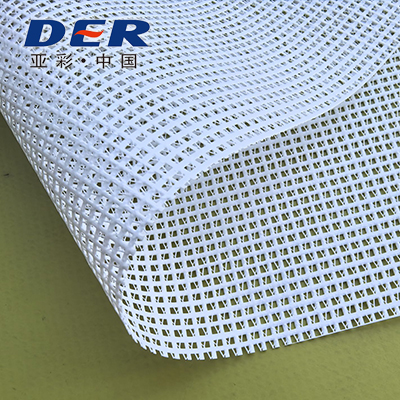
Wind-Relief Mesh Material
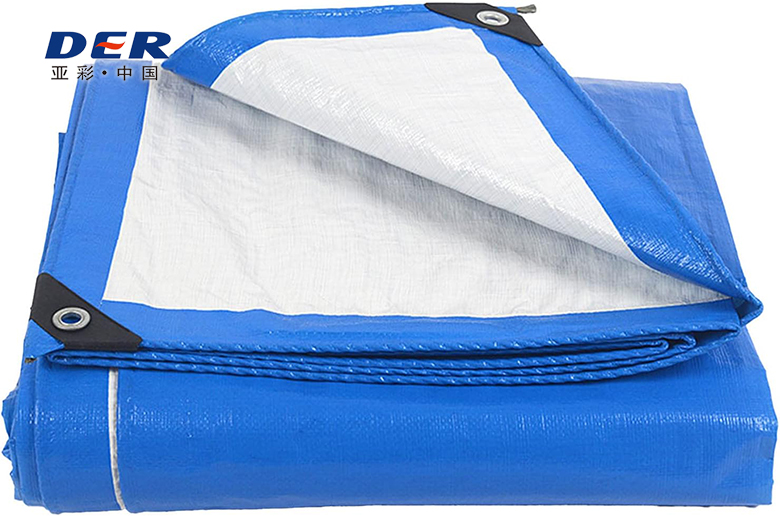
Reinforced Perimeter Construction
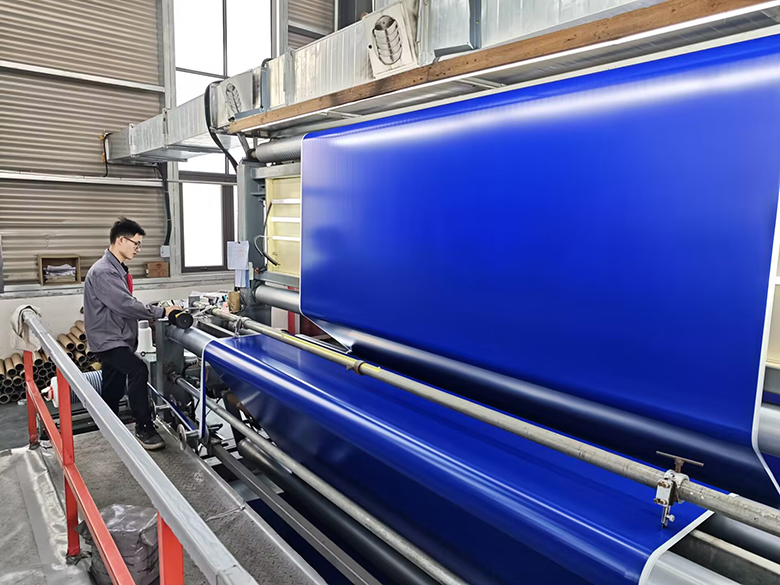
PVC Coated Fabric Manufacturing
Attachment-Zone Detail
7 Mistakes That Make Tarp Flapping Worse
Only Tying the Corners
Long side spans remain free to flutter and transfer cyclic load back into the corners.
Over-Tightening One Side
The tarp shifts off center and creates diagonal slack elsewhere instead of eliminating movement.
Leaving the Windward Edge Open
Wind can enter under the cover and lift a much larger area than the loose edge itself.
Using a Much Oversized Tarp
Extra drop and folds create loose “sails” that are hard to tension evenly.
Ratchet-Strapping Weak Eyelets
High strap force can pull out unsupported grommets even when the center fabric remains intact.
Ignoring Water Pooling
Standing water changes the surface shape and can reintroduce slack or overload fixing points.
Fixing a Moving Cover During Dangerous Weather
Do not climb onto roofs, trailers, scaffolds or exposed structures while severe wind, lightning or unsafe access conditions are present.
Continue the Tarp Wind-Control & Specification Process
These six DERFLEX resources cover adjacent decisions without duplicating the core “flapping diagnosis and fix” intent of this page.
Questions About Tarp Flapping, Noise and Wind
Short answer-first responses help users and search systems quickly understand the most common related problems.
How do you stop a tarp from flapping in the wind?
Remove loose overhang, secure the windward edge, re-center the tarp, tension opposite points gradually and add intermediate ties where an edge or panel still moves. If the center billows, reduce the unsupported span with a suitable cross-strap, support or extra reinforced attachment point.
How tight should a tarp be to stop flapping?
It should be smooth and firmly controlled, not drum-tight. Stop tightening if grommets stretch the surrounding fabric, seams distort, D-rings twist or the tarp compresses the load. Even tension across several reinforced points is more important than extreme force at one point.
Do bungee cords stop a tarp from flapping?
They can help because controlled elasticity absorbs short movements, but too much stretch can still allow the cover to oscillate. Use sound bungees, keep extension reasonable and add enough fixing points that the tarp does not develop long unsupported spans.
How do I stop a tarp from flapping on a truck or trailer?
Control the front edge first, reduce excess side drop, map tie-downs to the vehicle’s real rails or hooks, and use reinforced webbing, D-rings, grommets or straps in a repeatable pattern. Road-speed airflow creates dynamic loading, so a close custom fit is usually more effective than simply choosing a heavier loose tarp.
Can I run a strap over the top of a tarp to stop center billowing?
Yes, when the covered object and strap path allow it safely. An over-the-top strap can shorten a large unsupported span and keep the panel closer to the load. Protect the tarp from abrasive contact and avoid excessive compression or sharp strap edges.
Does a heavier tarp flap less?
Sometimes, but not reliably. A heavier tarp can be more resistant to wear, yet it can still flap if it is oversized, poorly tensioned or open to wind underneath. Fit, edge control, reinforcement and anchor layout usually matter more than GSM alone.
How can I stop tarp flapping noise?
Find the exact moving edge or panel rather than trying to silence the whole cover. Remove loose material, keep the windward edge controlled, add tension across opposite points and shorten the vibrating span. Noise is usually a symptom of repeated fabric movement.
How do you stop a tarp from flapping without grommets?
Use purpose-designed tarp clips, webbing loops, sleeves, pockets, straps or another attachment method compatible with the material. Avoid punching improvised holes into an unreinforced edge because the cut can become a tear starter under repeated wind load.
Can flapping damage a tarp?
Yes. Repeated movement can increase abrasion at rails and corners, cycle load through grommets and hems, and accelerate fatigue around seams or hardware. If the same area repeatedly snaps or rubs, correct the fit or restraint before the damage grows.
Need a Tarp That Stays Better Controlled in Wind?
Send DERFLEX the application, finished size, current flapping location, wind exposure, anchor map, material preference, waterproof or mesh requirement, grommet / D-ring / webbing details, quantity, branding and destination. Photos or a marked drawing are especially helpful for repeat-use covers.