



PVC Fabric Samples for Your Production Line
DERFLEX supplies PVC-coated polyester rolls to industrial converters and OEM factories. Select samples around your sewing, hot-air welding, HF/RF joining and cutting conditions—not GSM alone. Validate seam integrity, web flatness, usable width and coating behavior on your own line, then agree on grade-specific tolerances and batch acceptance before scaling to repeat roll orders.
What Should a Production-Line PVC Fabric Sample Prove?
PVC-coated polyester fabric is a reinforced textile in which a woven polyester base carries mechanical loads while the PVC coating provides a protective, joinable surface. Fabricators use it for truck curtains, industrial covers, tents and partitions. The right sample is not merely a color swatch: it must represent the intended fabric grade, coating finish, usable width and conversion process. Select candidates against the application environment, then trial the actual sewing, hot-air or high-frequency welding and cutting operations. Approve the material only after agreed inspection and seam tests demonstrate suitability for the proposed product.
Commercial boundary: This page concerns fabric rolls and material selection. Finished covers, equipment, fittings and system certification must be quoted or assessed separately.

Sample Specification Matrix
Use this matrix as a request and approval record. Published DERFLEX ranges describe material families, not guaranteed values for a particular sample. The final grade, numeric tolerances and reports belong in a signed specification.
| Parameter | Direction for initial review | Required confirmation before bulk approval |
|---|---|---|
| Material / construction | PVC-coated polyester textile; compare coated and laminated options where relevant | Named grade, polyester scrim, coating build and declared construction |
| Mass (GSM) | Choose a target based on bending, strength and handling—not mass alone | Grade-specific nominal g/m², permissible variation and test method |
| Base fabric | Polyester yarn structure, weave and reinforcement direction | Construction details plus warp/weft tensile and tear evidence where specified |
| Coating / finish | Gloss, matte, lacquer, surface friction and selected process | Coating adhesion, seam compatibility, color master and approved face orientation |
| Width / length | Nominal width, required cuttable width, target running meters | Minimum usable width, edge exclusion, length tolerance and splice policy |
| Color / graphics | Factory swatch or supplied color reference; printing only if required | Color evaluation conditions and ink/finish compatibility trial if applicable |
| Environment | Indoor or outdoor; folding, cold, UV, moisture and cleaning exposure | Relevant grade-specific test evidence and end-use limitations |
| Documentation | Request available TDS or test records for the proposed grade | Actual report, method/version, specimen, date and lot relationship |
| Roll handling | Core, winding direction, maximum mass, packaging and labeling | Handling limits, roll identification and batch traceability records |
Any weight, width, finish, FR or UV option is subject to product-grade feasibility and supporting documentation. There is no universal tolerance or performance value for every PVC fabric construction.
Match the Trial to Your Fabrication Process
One material can behave differently across machines and joint geometries. Request samples large enough for the most demanding stack-up, not only a single flat test strip.
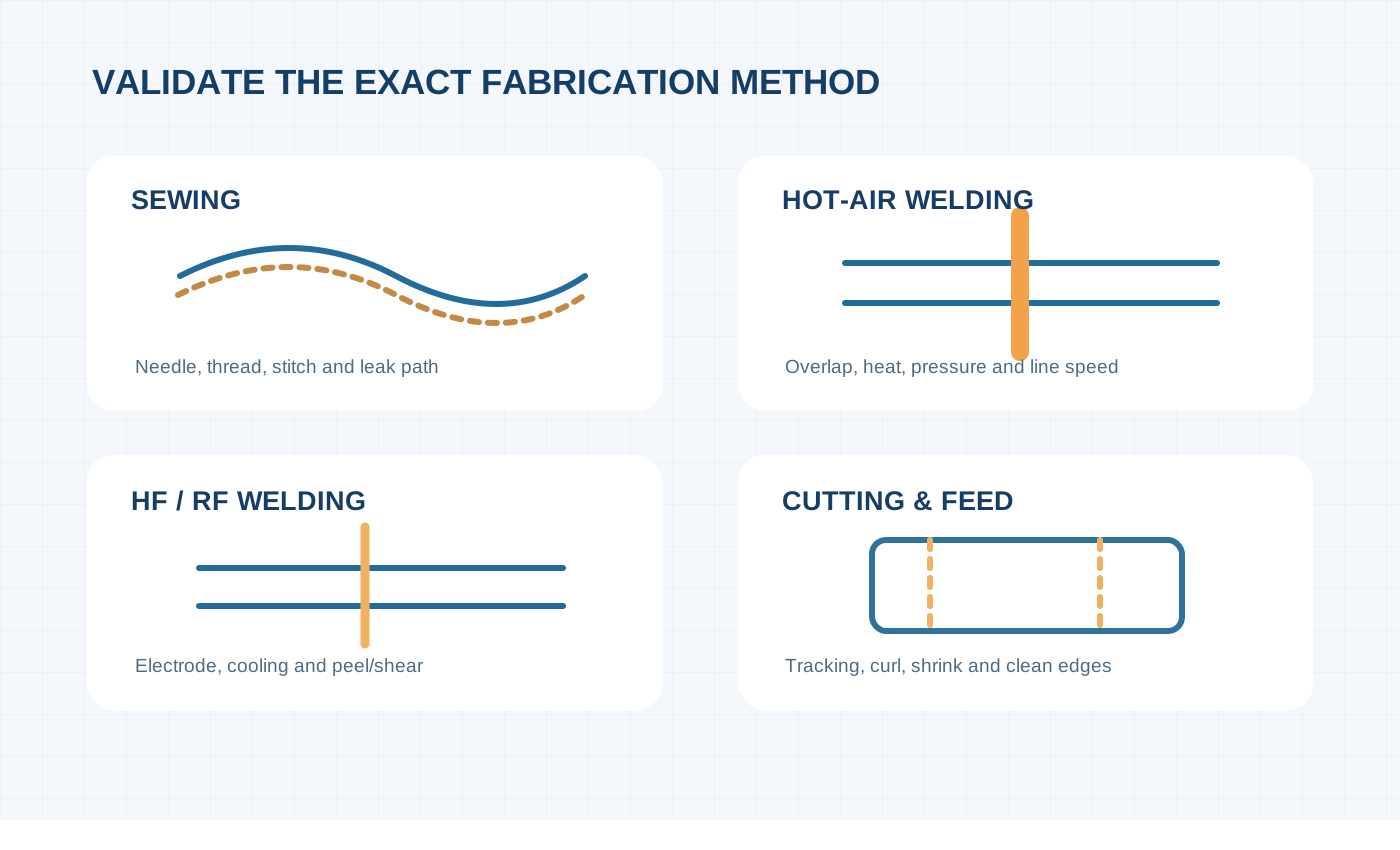
Sewing
Inspect needle penetration, feeding drag, stitch formation and coated-surface damage. Include multi-layer hems and reinforcement. Check: seam pull, tear initiation, repeated folding and water paths through needle holes where relevant.
Hot-air welding
Record nozzle, overlap, air temperature, pressure, travel speed, face orientation and cooling conditions. Check: bond continuity at starts and stops, peel or shear behavior and changes after conditioning.
HF / RF welding
Validate the selected PVC finish with your electrode, tooling, dwell and cooling cycle. Check: cosmetic marking, uniform fusion, coating separation and full-stack patches—not only an easy straight seam.
Cutting / feeding
Assess unwind tracking, curl, blade behavior, wrinkles, edge trim and dimensional recovery. Check: usable width and cutting yield under the intended lay-up, tension and production speed.
Important: No generic temperature, electrode energy, stitch length or machine-speed setting can qualify every grade. Keep the machine recipe, sample conditioning and acceptance method with your trial record.
Which Fabricator Is the Sample Intended For?
Start with the end-product failure risk and the highest-stress fabricated detail. Application photographs and the buyer’s own drawings should be reviewed against the actual sample grade.
Truck curtain converters
Long welds, repeated opening, buckle-zone reinforcement, print compatibility and even tracking on automated lines.
Equipment-cover makers
Hem strength, stitchability, corner reinforcement, folding life and abrasion against equipment edges.
Tent and shelter fabricators
Weather exposure, panel welding, dimensional changes, flame requirements and connection details.
Industrial curtain shops
Panel flatness, cut accuracy, cleaning behavior, attachment zones and fit with the installed system.
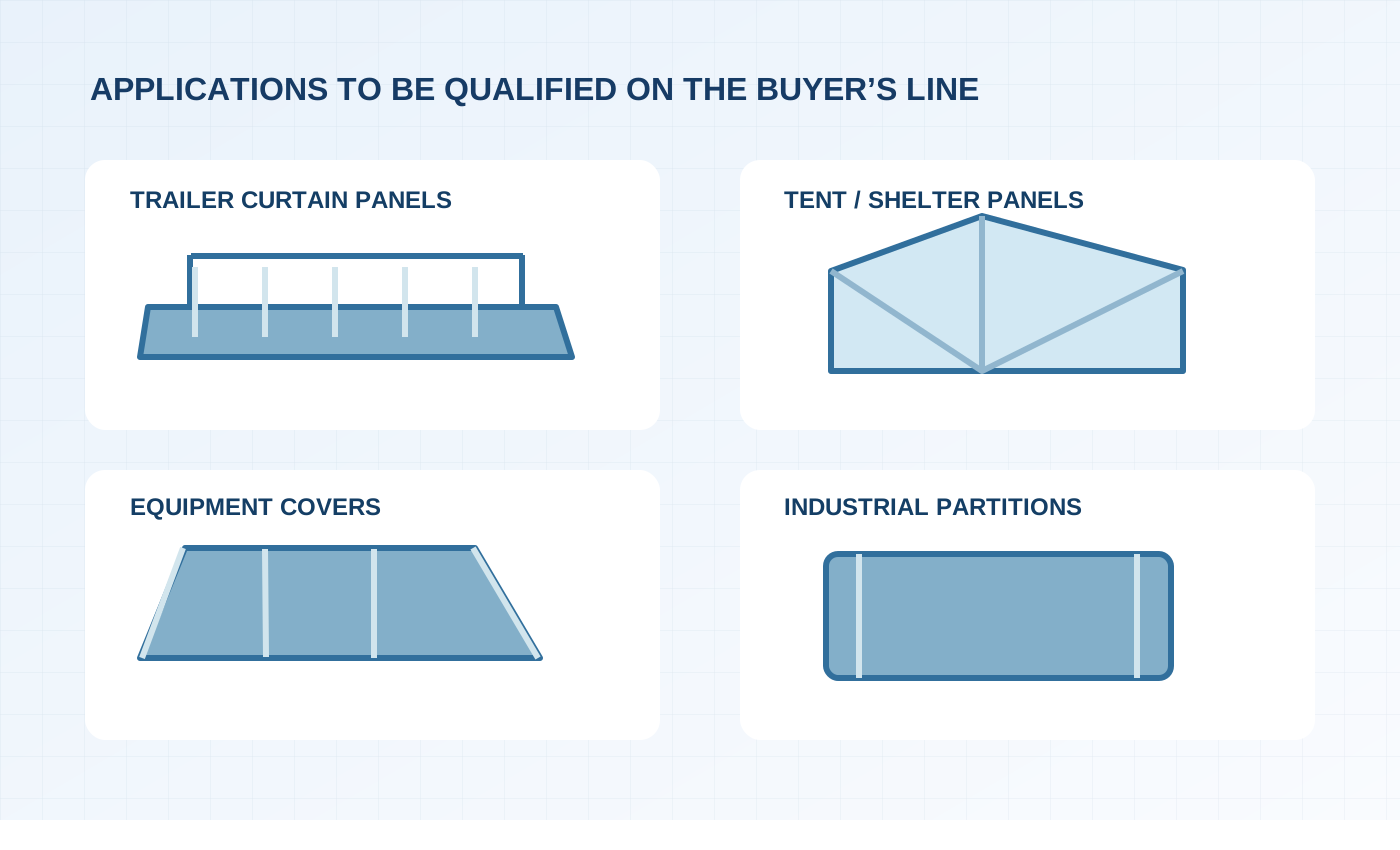
For specific production needs, review PVC fabric for automated truck curtains, sewable coated fabrics for covers, and industrial cover fabricator roll supply. Each application still requires its own test plan.
Compare Nominal Width With Usable Width
A roll labeled with a certain width may offer less dependable cutting area after excluding curled, damaged or uneven edges. Define the acceptable web area before estimating yield.
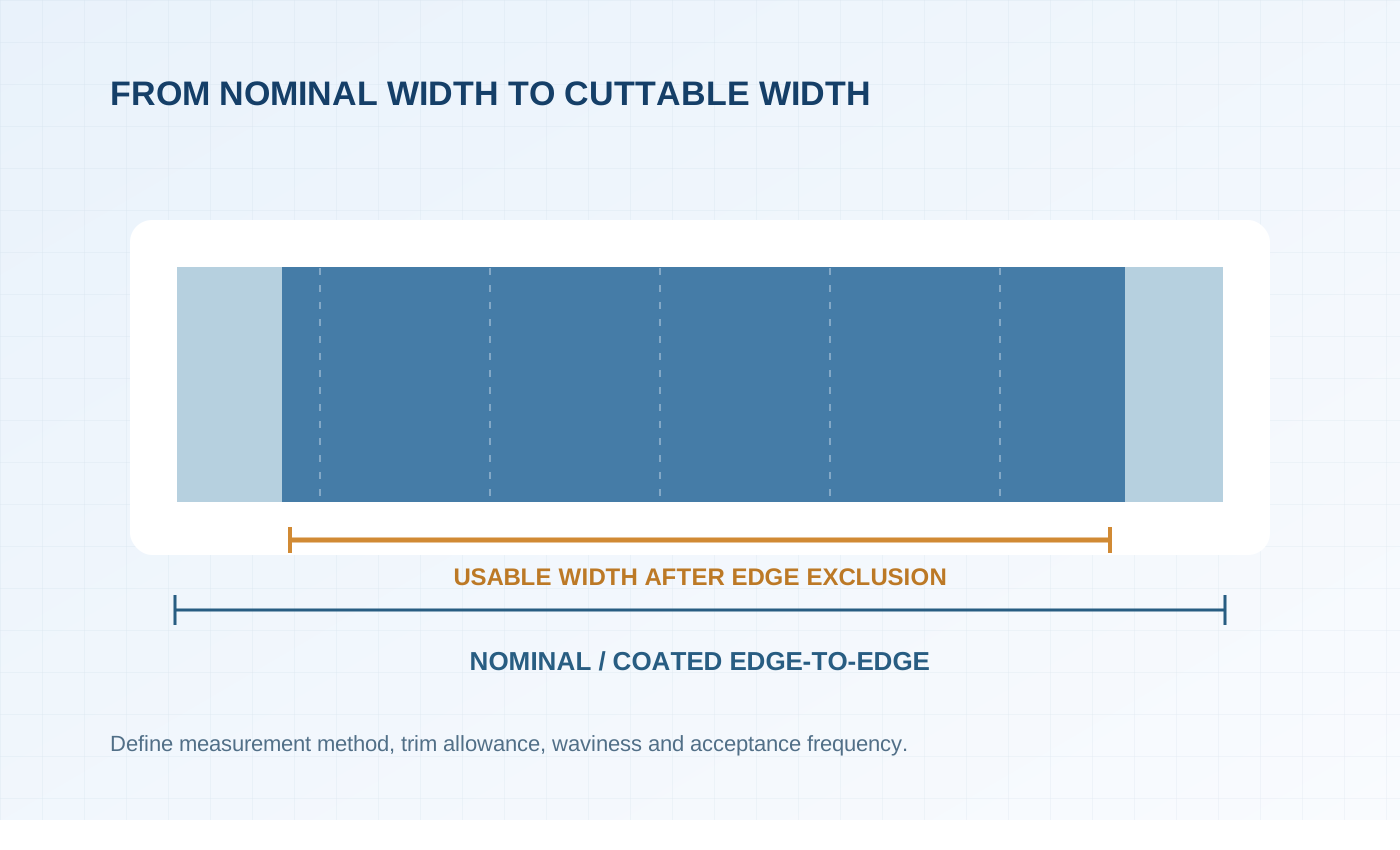
Make roll acceptance measurable
- Set the reference state. Define unwind length, conditioning time and measurement locations across the roll.
- Inspect the web. Record flatness, telescoping, blocking, scratches, coating defects, color and edge condition.
- Agree on joins. Specify whether splices are permitted, how they are marked and the minimum uninterrupted length.
- Connect roll to lot. Record grade, batch/lot identifier, roll number, label format and approved sample reference.
- Release against criteria. Confirm who signs off appearance, dimensions, joining tests and documentation before repeat orders.
For a deeper explanation of production yield, see DERFLEX’s PVC roll flatness and cutting-efficiency guide. The wider PVC-coated polyester material overview helps compare structure and finished-use needs.
Six Steps From Fabric Sample to Approved Roll Order
A trial should produce a controlled purchase specification, not an unrecorded opinion that a swatch “looks good.”
Define the end product
Supply a drawing, sample of the current fabric or clear photographs. Explain size, assembly detail, environment and expected production volume.
Shortlist material grades
Compare structure, mass, coating finish and width against process and product constraints. Confirm which sample variants are feasible.
Set pass / fail rules
Write the inspection method and minimum acceptable result for joining, cutting, appearance and any necessary environmental conditioning.
Run the real operation
Use your normal tooling and representative seam, reinforcement, folds and line speed. Keep all settings and observations with the specimen.
Retest weak points
Review peeling, coating separation, stitch-hole tearing, width loss or visual defects. Adjust the design or material choice, then repeat the check.
Freeze the purchase spec
Identify the approved sample, permitted tolerances, report needs, roll labels, packing and changes that trigger a new qualification.
Sample-size planning: Ask for enough length and width to assess the real seam, nesting layout and machine feed. A hand swatch may screen color but cannot stand in for a production-representative roll trial.
What Should You Compare Before Approving a Supplier?
Identify equivalent trial conditions before comparing prices or certificates. A test is useful only when its method, specimen and grade correspond to the material you intend to purchase.
| Buying approach | Usually tells you | Still needs confirmation |
|---|---|---|
| Color swatch only | Approximate shade, face texture and surface appearance | Joining quality, roll-flatness, strength and repeat supply |
| Catalogue GSM comparison | Nominal mass per area for a proposed construction | Scrim strength, coating properties, flexibility and grade-specific variation |
| Single seam coupon | Initial bond on one geometry under one recipe | Full-stack corners, reinforcement, aged seams and production speed |
| Representative line trial | Feeding, joining, cutting and inspection on the buyer's equipment | Batch limits, controlled records, packaging and repeat-lot acceptance |
Relevant evidence to request
- Fabric mass and width measurement method, including tolerance and sample conditioning.
- Tensile / tear results with warp and weft orientation and an identified test method.
- Coating adhesion, seam peel or shear results from representative fabrication samples.
- UV, cold-flex or flame data only when required and supported for the exact grade.
- Roll labels, batch traceability and change-control records for recurring orders.
Limits of material test reports
A material's declared water resistance does not certify the stitched holes or welded corners of a finished product. Likewise, a flame-test report for a coated textile does not establish approval of an installed curtain or complete tent system.
Request original reports or applicable specifications, check the method and date, and verify the report covers the proposed construction. DERFLEX can discuss available evidence for the identified grade; no report or certification is promised without confirmation.
Request PVC Fabric Samples for Your Production Line
Send only what you know today. Drawings and the current material sample are often more useful than an unverified list of specifications.
| Please share | Helpful detail |
|---|---|
| Fabricated product | Truck side curtain / machine cover / tent panel / industrial partition, with drawing or photographs |
| Joining and cutting | Sewing, hot-air, HF/RF, cutter model, seam and reinforcement detail |
| Desired material | Existing sample or proposed GSM, scrim, coating finish and color |
| Roll requirements | Nominal and minimum usable width, length, core, winding and allowed splices |
| Quantity | Sample / trial length, initial order and expected monthly or annual roll demand |
| Tests and documents | Seam, tear, UV, FR or other criteria; applicable standard and any report deadline |
| Delivery details | Country, desired shipment period, packing method and delivery term preference |
Quote comparison: Confirm whether your supplier quotes per running meter, square meter or roll; compare on the same fabric grade and delivery term. Customized color, width, inspection requirements, splice restrictions and trial quantity can change cost and lead time. MOQ, sample availability and timelines depend on the grade and order scope.
Frequently Asked Questions
Can I request a PVC fabric sample before placing a bulk roll order?
Yes, you can submit a material sample or trial request through DERFLEX’s enquiry channel. State your required application, construction, joining process and desired trial length. The available grade, quantity, sampling terms and delivery schedule must be confirmed for your specific project.
Is a small swatch enough to qualify fabric for industrial welding?
No. A swatch helps screen surface, color and perhaps initial welding response, but cannot reproduce long seams, roll feed, edge curl or reinforced corners. Use a production-representative sample size and your actual tooling for qualification.
Can the same PVC-coated fabric be sewn and hot-air or HF welded?
Some constructions support more than one process, but sewing and each welding technology need separate verification. Test the actual coating face, tooling, seam geometry, operating recipe and finished application before assuming compatibility.
Which GSM should I choose for a trial?
Select mass based on the end product’s mechanical loads, folding needs, application environment and available equipment. Compare trial grades using tensile, tear, seam, handling and surface criteria; a higher GSM alone does not guarantee a stronger finished cover.
How do I specify usable roll width?
Record nominal coated width and the minimum cuttable width after acceptable edge trimming. Agree how and where it is measured, what edge curl or defects are allowed, and the width tolerance that applies to each roll or lot.
Will DERFLEX provide flame-retardant or weathering test reports?
Ask for available documentation for the exact proposed material grade. The applicable method, specimen, issue date and declared result must be checked. Optional FR or weathering performance should not be treated as certified until suitable evidence is confirmed.
What information speeds up a sample quotation?
Send the application, existing fabric reference or target construction, joining method, usable width, color or finish, sample quantity, estimated repeat volume, destination and required tests. A drawing and photos of difficult seams or failures help clarify the trial.
Continue the Material and Process Review
Use these existing product and technical pages to compare the material family, application and purchasing constraints. The sample-qualification workflow on this page remains separate from the application-specific guides.
Technical context
For industry context on coated textile construction and truck conversion, see Sioen Industries: Coated Textiles and Sioline: Transport & Railways. These are external references, not DERFLEX test reports or endorsements. A sample specification should be checked against actual grade-specific evidence.
Test the Roll on Your Line Before You Standardize It.
Tell DERFLEX what you manufacture, how you cut or join the fabric, the roll width you need and the testing you must pass. Ask for a suitable PVC coated fabric sample direction and a quote aligned to your purchasing program.