



B2B MATERIAL SOURCING · TRACEABLE CLAIMS
Recycled Content Heavy Duty Tarp Fabric
Explore recycled-input PVC tarpaulin and reinforced tarp fabric options with the right evidence: identify the recovered component, define the percentage basis, approve performance and plan an actual end-of-life route.
For converters, importers, distributors and OEM programs reviewing recycled-content specifications. Grade availability, declared recycled percentage and certifications are subject to written verification.
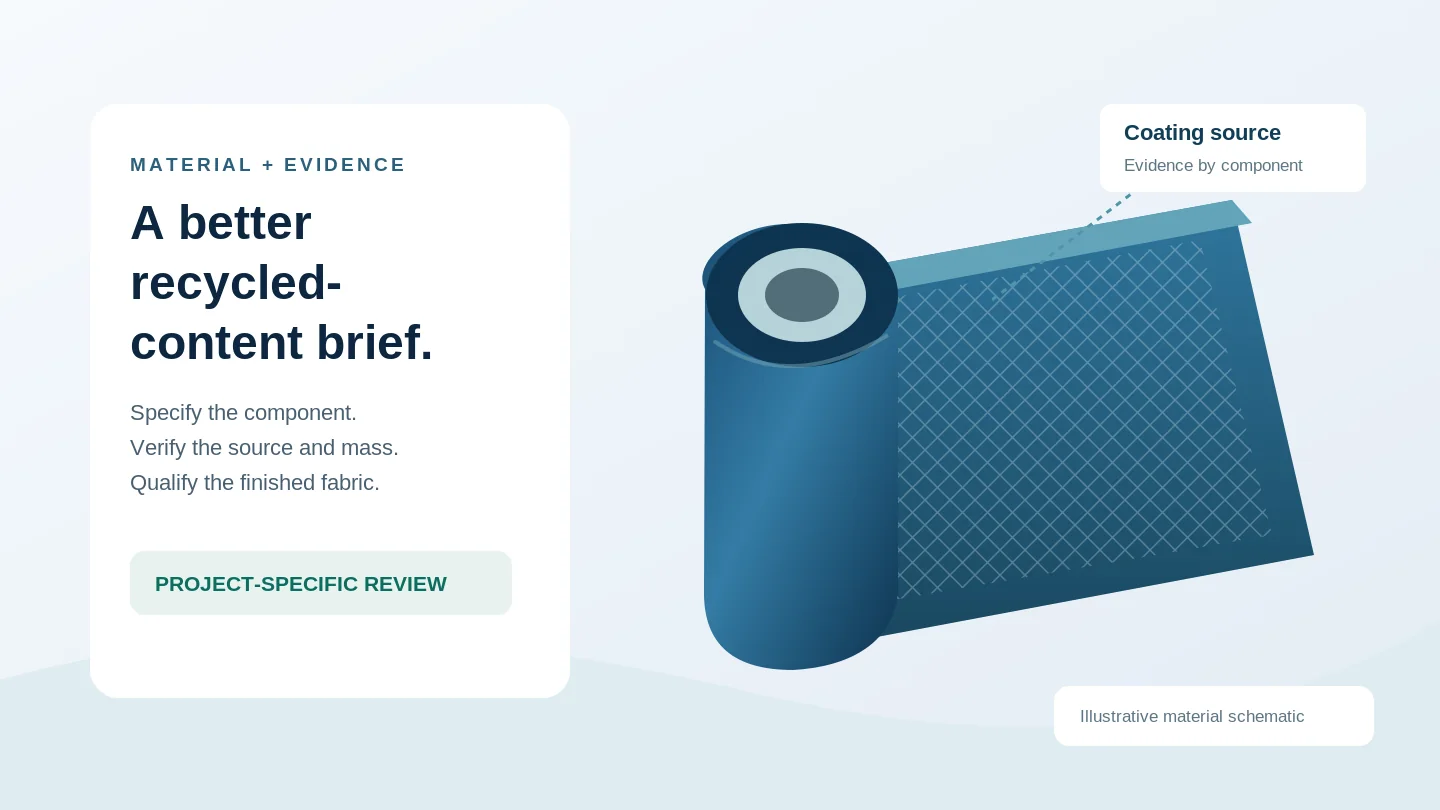
What is recycled-content heavy duty tarp fabric?
Recycled-content heavy duty tarp fabric is a reinforced flexible covering material made with a documented quantity of qualifying recovered input in one or more components, such as PVC coating compound or polyester reinforcement. Its recycled content does not, by itself, establish strength, waterproofing, durability, recyclability or environmental superiority.
Industrial PVC tarpaulin is commonly constructed with a polyester textile core and a PVC coating or laminated surface. The polyester provides the reinforcing structure; the coating provides a flexible protective barrier and a surface that may support welding. Heavy-duty performance depends on the complete design, not on one material label.
DERFLEX currently discusses recycled-input directions for selected tarp applications on its sustainable tarpaulin overview. However, no specific recycled-content grade, percentage, certification, stock level or lead time is established by this page. Recycled feedstock must be checked against the proposed manufacturing route and end use.
Three different purchasing descriptions
- Recycled PVC tarpaulin: asks whether eligible recovered PVC is used in the PVC-related coating input.
- Recycled-polyester reinforced tarp: asks whether the woven textile contains verified recycled polyester yarn.
- Reused or repurposed tarp: describes a second use for an existing sheet, not newly made fabric with recycled input.
For a side-by-side resin-origin analysis, read the DERFLEX guide to virgin vs recycled PVC tarps. This page concentrates on the evidence and procurement controls needed to develop a repeatable recycled-content material specification.
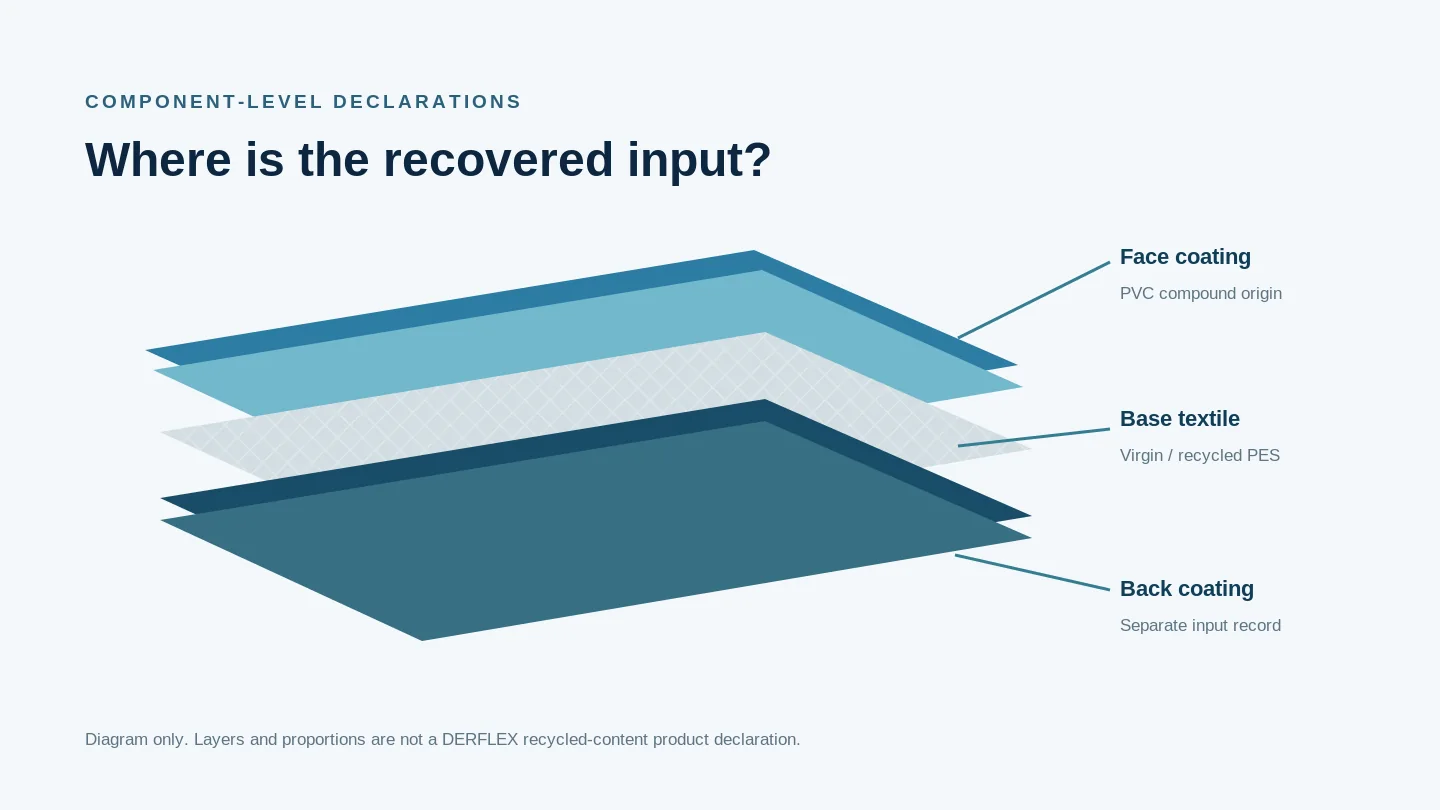
A recycled percentage needs a boundary, a source and a record
A headline such as “30% recycled PVC” is incomplete until its mass denominator and qualifying input are named. The whole tarp can include PVC coating, reinforcement, sewn reinforcements, hardware and packaging; not all of these belong to the same claim boundary.
| Claim wording | What it can refer to | Evidence to ask for | What it does not prove |
|---|---|---|---|
| Recycled PVC input | Eligible recovered PVC used within a defined resin or coating formulation | Source category, polymer identity, lot input and qualifying mass basis | Recycled percentage of the full coated fabric |
| Recycled coating compound | Recovered input as a share of the complete coating compound mass | Compound bill of materials, qualifying input statement and mass reconciliation | Recycled content in the polyester reinforcement |
| Recycled polyester reinforcement | Recovered material used in the woven polyester yarn or fabric | Yarn supplier claim, chain-of-custody scope, fabric mass in construction | Recycled PVC in coating |
| Whole-fabric recycled content | Qualifying recycled input divided by total coated-fabric mass within a declared boundary | Component masses, calculation method, evidence and batch records | End-of-life collection and actual recycling |
Illustrative mass logic: recycled-content % = qualifying recycled input mass ÷ total mass inside the stated product boundary × 100. This is a definition, not a measured DERFLEX value. Internal rework, offcuts and post-consumer inputs may be treated differently by the selected claim rules. Obtain the scheme’s current definition before counting a reclaimed stream.
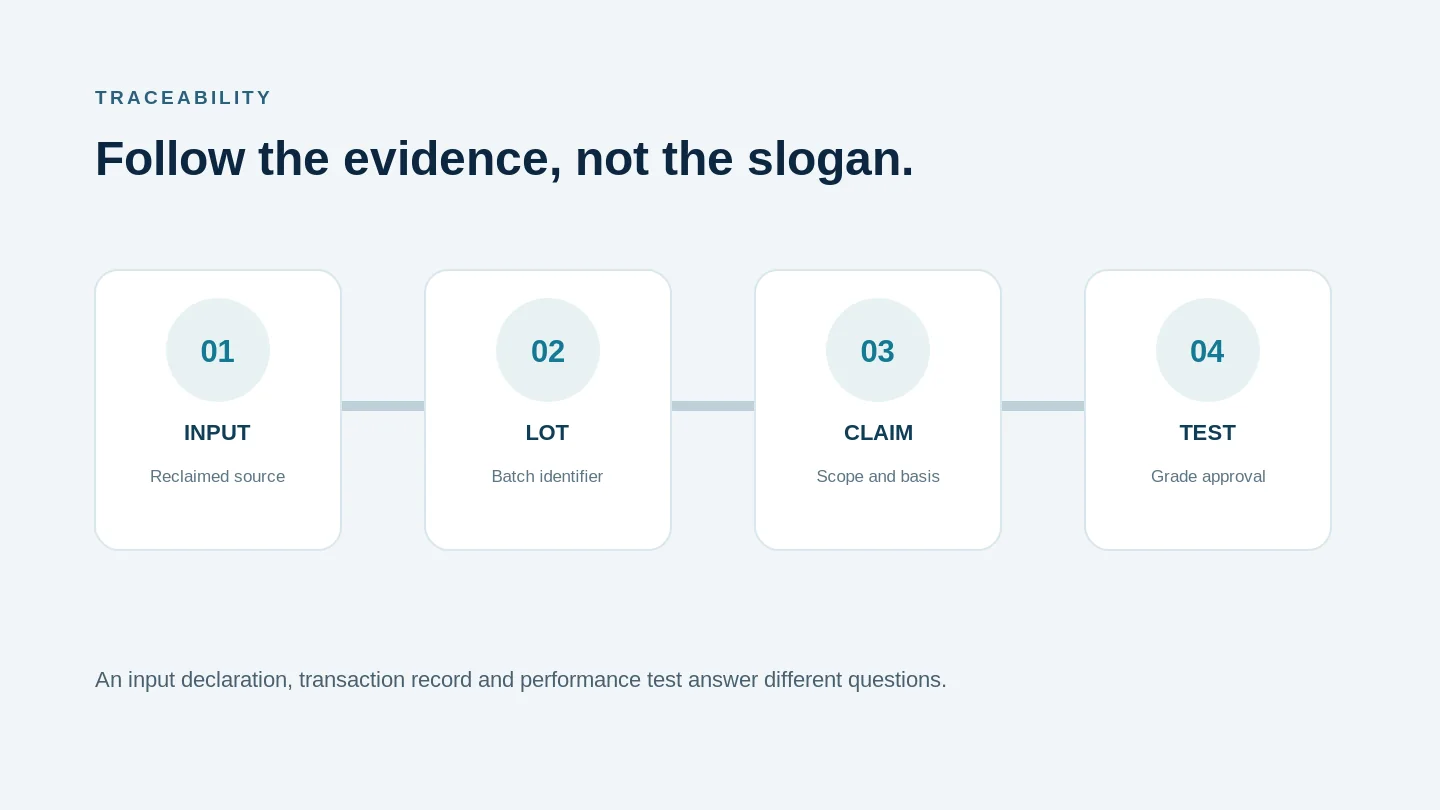
What makes a claim auditable?
- Source identity: material type, origin category and approved incoming streams.
- Product boundary: a resin, coating, yarn, fabric or finished-product percentage—named explicitly.
- Lot continuity: material receipts, batch records, conversion losses and outgoing product references.
- Applicable certification: current validity, covered sites/products and relevant shipment documentation where requested.
- Approval of change: no unreviewed switch in recycled source, blend, color or coating formulation after a golden sample.
Textile Exchange describes chain-of-custody and transaction certificates for its programs. A supplier's general certificate does not automatically certify every downstream finished tarp. Verify the product scope and current rules rather than printing a GRS or RCS logo by assumption.
Specify the actual fabric before choosing a recycled input route
For B2B conversion, begin with a target fabric specification and acceptance limits. The values below are RFQ fields—not advertised recycled-content inventory or verified SKU data.
| Specification field | Buyer should define | DERFLEX review point |
|---|---|---|
| Supply format | Coated fabric roll, cut panel or fully fabricated cover | Confirm whether the reviewed formulation and documentation apply to that format |
| Material construction | PVC coated or laminated polyester; face/back coating; substrate yarn/weave | Record exact input location and formulation identity |
| GSM and dimensions | Target g/m², usable width, roll length and permitted tolerances | Test representative lots; avoid treating GSM as strength evidence |
| Claim requirement | Target eligible recycled percentage and whether it applies to PVC, coating, textile or full fabric | Request source, calculation, certificate scope and lot support |
| Appearance and finish | Color tolerance, gloss/matte, surface treatment and intended printing/cleaning | Assess feedstock influence on color, finish and stability |
| Service exposure | Temperature, UV, abrasion, repeated folding, moisture and chemical contact | Agree testing method, conditioning and minimum pass limits |
| Downstream assembly | Hot-air/RF welding, sewing, hem, reinforcement, eyelets and accessories | Trial exact fabric on intended equipment and finished construction |
| Repeat-order controls | Sample reference, formulation change notification, lot labels and inspection criteria | Lock approved grade and evidence package before scale-up |
Explore heavy duty tarp fabric roll purchasing for width, roll-mass and converter handling decisions, or custom PVC coated fabric development when coating chemistry and surface performance must be tuned to an OEM application.
Recycled-input candidates still need heavy-duty performance proof
A material can have documented recycled input and still fail a user's seam, handling or exposure requirements. Evaluate the specific construction using the same test method and acceptance limits as the alternative material.
Comparative testing matrix
| Test area | Required decision |
|---|---|
| Tensile / tear | Warp/weft strength, relevant test method, units and failure mode |
| Coating adhesion | Adhesion to reinforcement after specified conditioning |
| Water resistance | Fabric barrier and representative finished-seam leakage |
| Low-temperature flexibility | Cracking, stiffening and repeated folding at chosen temperature |
| Accelerated weathering | Exposure cycle and retained properties, not “years” inferred from hours |
| Seam & hardware | Weld parameters, peel/strength, corner reinforcement and pull-out checks |
| Substance / compliance | Destination-specific restrictions, test report applicability and recycled-source screening |
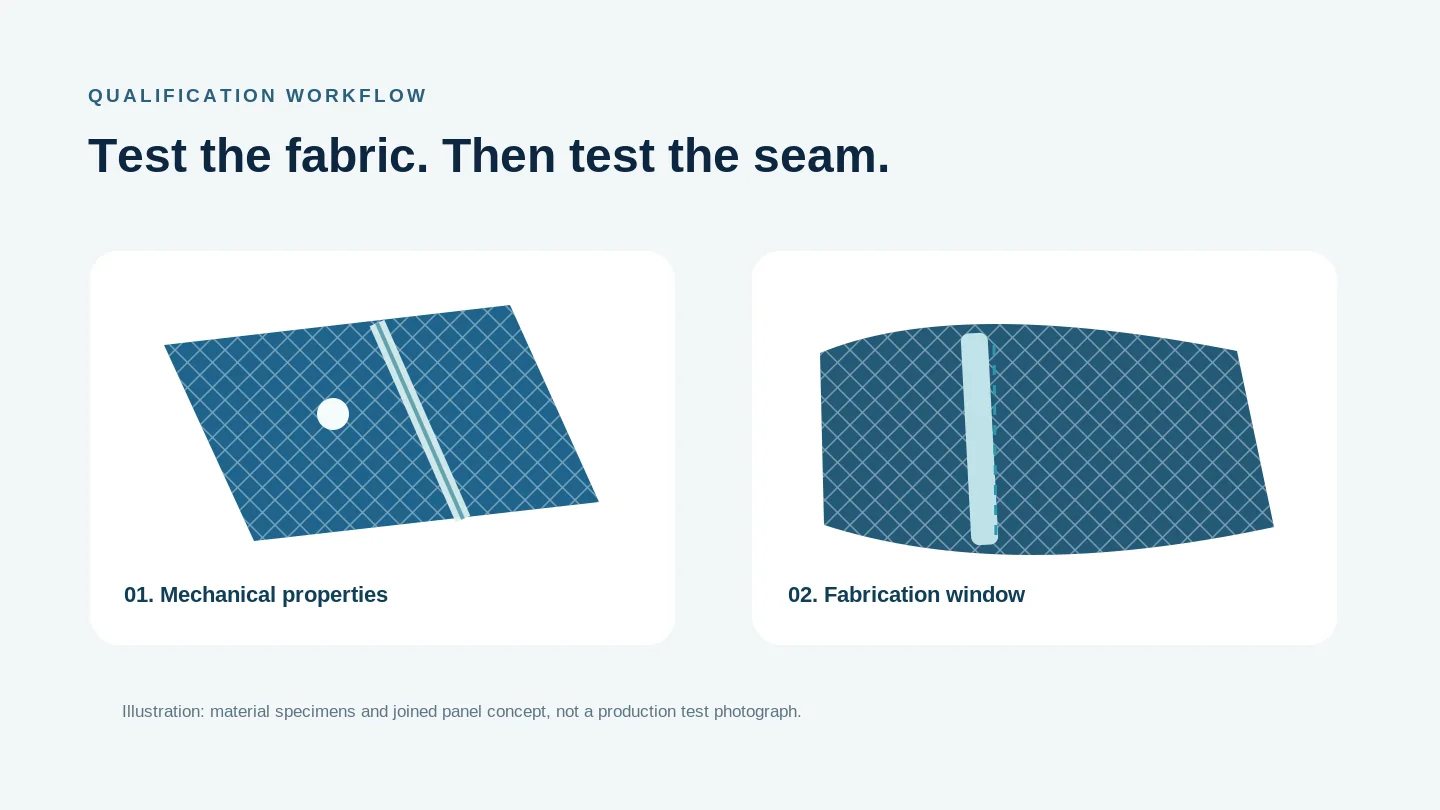
For hot-air or high-frequency welding, a change in surface finish or coating formulation may alter the usable joining window. Approve trial settings and inspect the seam on the converter's actual equipment.
- STEP 01
Screen inputs
Request source type, process compatibility and claim records before producing a comparison sample.
- STEP 02
Approve a swatch
Check appearance, measured construction and performance reports tied to the offered grade.
- STEP 03
Validate conversion
Run cutting, welding, reinforcement and handling trials on the proposed construction.
- STEP 04
Lock the repeat lot
Agree traceability, document retention, incoming acceptance and change-control triggers.
DERFLEX provides a broader heavy duty tarp application and construction overview; use it to set mechanical and fabrication expectations without assuming that a recycled-content route passes them automatically.
Where is recycled-content tarp fabric worth evaluating?
The following are candidate evaluation scenarios, not confirmed DERFLEX recycled-content customer projects or warranted applications. Review consequence of failure, recycling claims and environmental exposure before selecting a candidate.
Industrial equipment covers
Recurring equipment protection programs may prioritize cut yield, abrasion resistance, repairability and a controlled color range. Agree working temperature, exposure cycles and seam design.
Truck and trailer fabric
Cover converters should prioritize tear growth, repeated folding, edge loading, welding and lot-to-lot consistency. A documented recycled source is only one part of truck-cover approval.
Warehouse divider materials
Flexible curtains and barriers need suitability checks for cleaning, flexibility, visual finish and any project-specific flame, static or indoor-environment requirement.
Outdoor storage and agricultural protection
Match UV exposure, moisture management, temperature and repeated installation to the grade. Do not infer outdoor lifespan from generic recycled-content language.
OEM protective products
Private-label buyers may need component-level claim language, batch numbers, labels and approved change-control rules before placing a repeat branded order.
Converter trial rolls
Selected facilities can run sample welding and cutting tests before approving production volumes. Keep coating source and finishing consistency in the material spec.
Recycled content does not establish a recycling route
A tarp can contain eligible recovered material yet have no practical recycling outlet at its destination. PVC-coated polyester is a composite; metals, sewing, adhesives, dirt and mixed streams may affect acceptance. Check real local capabilities before using “recyclable tarp material” in a purchasing claim.
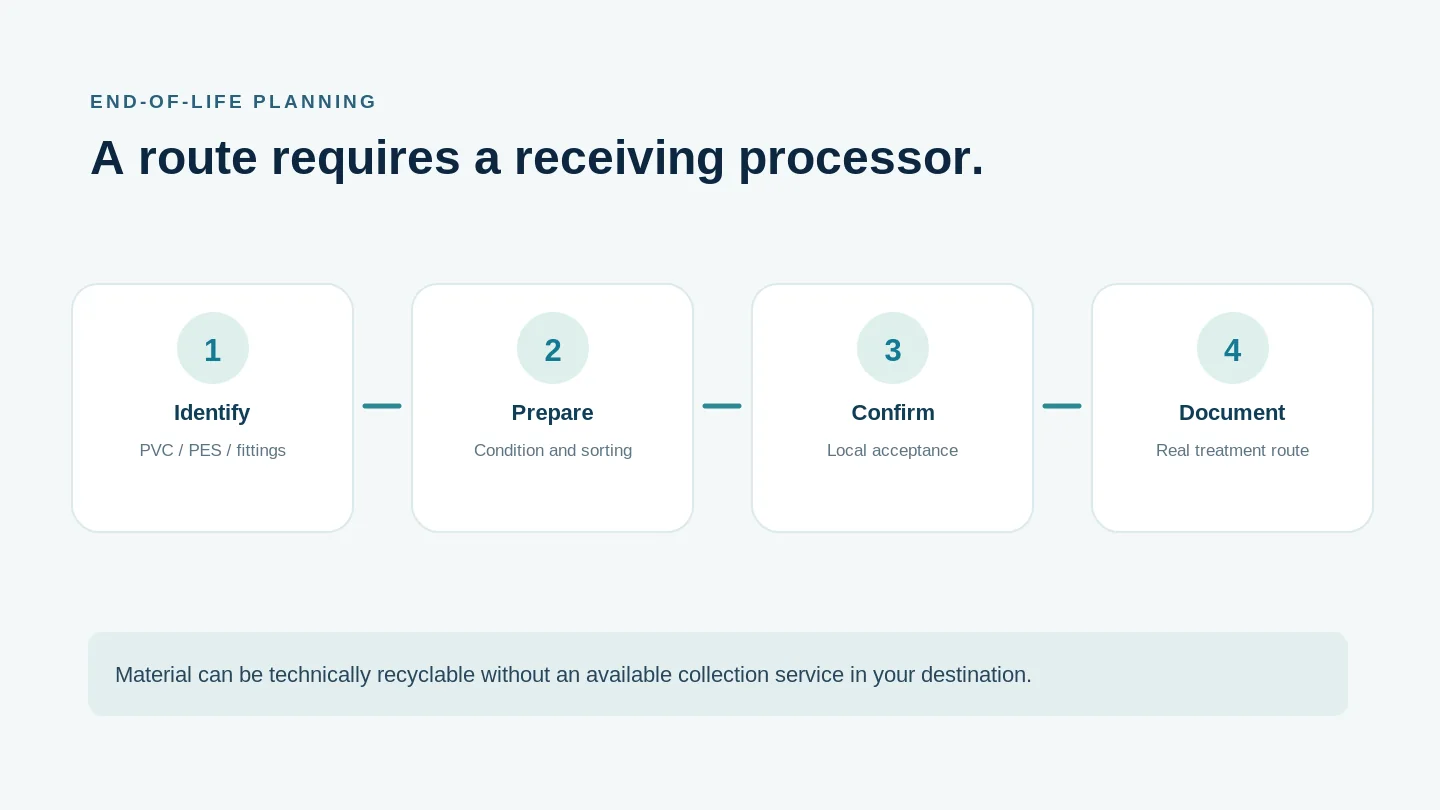
Four questions for the receiving processor
- Will you accept this exact PVC-coated polyester construction, additives and condition?
- Which contamination limits and removal steps apply to straps, eyelets, adhesives and reinforcements?
- Which destination regions, quantities, logistics arrangements and documentation do you actually support?
- Is the output a recovered secondary material, repair/reuse route or disposal? Do not call energy recovery material recycling.
Review DERFLEX's PVC tarp recycling guide for sorting and end-of-life buyer questions. Industry work such as the VinylPlus RETAIN project highlights why composite tarpaulin recycling remains an active technical and logistics challenge.
Compare proposals on evidence, performance and total value
Illustrative procurement choice
Two tarp samples can display the same nominal GSM but use different coating inputs, reinforcement and welding parameters. A recycled-content percentage is not a substitute for comparable grade-level testing.
Choose the candidate that satisfies both your documented material-origin requirement and approved service specification. Include conversion yield, reject risk, repairs and realistic end-of-life costs when comparing overall value; cheaper input resin does not guarantee a cheaper compliant finished cover.
For finished covers, see custom heavy-duty tarp fabrication options and define finished dimensions, reinforcement and fittings separately from the raw fabric claim.
Five release gates for bulk purchasing
- Define scope: recycled coating, textile or whole fabric.
- Check eligible source and batch documents.
- Approve material and seam performance.
- Confirm claim wording and applicable shipment certification.
- Lock packaging, roll identification and change control.
No validated source or test package? Keep the project in feasibility review rather than advertising a certified material.
Send a recycled-content tarp fabric specification that suppliers can review
You can paste the brief below into DERFLEX's existing Request A Quote form. There is no automatic submission here; the fields and evidence request help the sales team assess feasibility without promising a stocked recycled grade.
Required buyer decisions
- End use and site conditions, including temperature, UV, water and handling cycles.
- Roll, panel or finished cover; width, GSM, color, quantity and repeat demand.
- Recycled PVC, recycled polyester or both; target percentage and calculation basis.
- Claim scheme, certificate scope, transaction documentation and destination restrictions if applicable.
- Performance methods/limits, welding process, approved sample and change-control criteria.
- Country or region for both delivery and potential material collection at end of life.
The initial RFQ can start from an application photo or simple drawing. Tests, MOQ, lead time and recycling partners need order-specific confirmation; they are not assumed.
Copy-ready request
Copy the text above and include it in the Description field of the quotation page.
Recycled heavy duty tarp fabric FAQ
Does DERFLEX supply recycled-content heavy duty tarp fabric?
DERFLEX discusses recycled-input options for selected tarpaulin applications, but this page does not confirm a stocked grade or a fixed recycled percentage. Submit your construction, volume and documentation needs to check feasibility and availability.
Is recycled PVC tarpaulin the same as a tarp with recycled polyester?
No. Recycled PVC refers to eligible recovered input in the coating or PVC compound. Recycled polyester refers to the textile reinforcement. The two can be used independently, and every claim must identify the component and mass basis.
What documents should support a recycled-content claim?
Request the source category, declared component, qualifying recycled mass, percentage denominator, supplier and lot traceability, and the applicable claim standard. If certification is requested, check valid scope and transaction documents for the actual shipment.
Can recycled-content PVC tarp fabric still be waterproof and weldable?
It can be a candidate for those uses, but neither property follows from recycled content alone. Qualify the offered grade for fabric water resistance, coating adhesion, weld strength, seam leakage and the intended operating conditions.
Can a recycled-content PVC tarp always be recycled after use?
No. Recycled content and end-of-life recyclability are different claims. Actual recycling depends on the coated construction, contamination, removable accessories and a processor that accepts the material at the destination.
Does a GRS or RCS supplier certificate prove my finished tarp is certified?
Not by itself. Certification and claims depend on the relevant standard, certified supply-chain scope and appropriate transaction or product documentation. Confirm the current rules with the certification body before using certification wording or logos.
What should importers include in a trial-order RFQ?
Provide the application, roll or finished-cover format, base-fabric and coating requirements, target recycled component and percentage basis, dimensions, performance limits, volume, destination, required records and sample approval method.