


 REQUEST A QUOTE
Canvas Drop Cloth Weight Guide for Painting and Bulk Purchasing
Choose a canvas drop cloth by its areal weight, weave and intended job—not a “heavy-duty” label alone. This guide compares 6 oz, 8 oz, 10 oz and 12 oz canvas drop cloth weight classes, converts them to GSM and shows how a buyer can test hand feel, foldability, paint penetration and finished-sheet requirements before placing a bulk order. These classes are common market references; no grade is presented as confirmed DERFLEX inventory.
What Is the Best Canvas Drop Cloth Weight?
A painter buying one drop cloth for furniture protection may value a soft, portable fabric. A contractor repeatedly dragging folded protection from room to room may prefer a heavier, well-finished sheet. A distributor building a product range may need several weights, each defined by an approved physical sample and consistent purchasing specification.
Uncoated woven canvas is absorbent, not inherently leakproof. Even a 12 oz label cannot establish waterproofness or slip resistance. For a broader material and finished-sheet overview, see the canvas drop cloth bulk sourcing guide.
6 oz vs 8 oz vs 10 oz vs 12 oz Canvas Drop Cloths
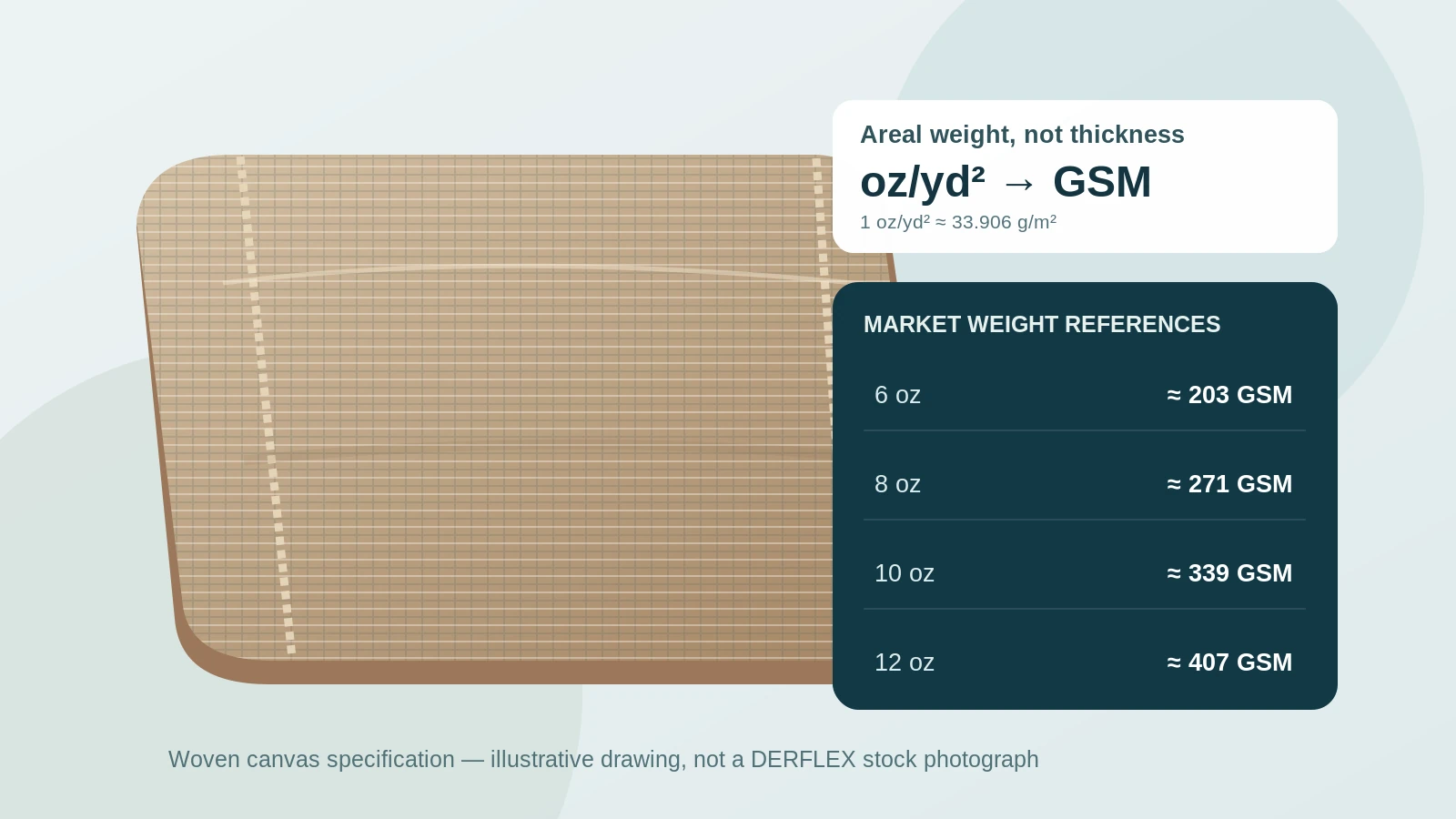
The table uses the North American convention oz/yd² (ounces per square yard). It does not mean the total ounces in a finished cloth. Approximate conversions show equal units of area mass only, not measured or stocked DERFLEX products.
| Nominal class | Equivalent area mass | Reason to sample it | Potential trade-off | Buyer's verification |
|---|---|---|---|---|
| 6 oz/yd² | 203 GSM | Occasional furniture draping, dust containment and lightweight folding. | Construction may be too open or light for some wet paint exposure. | Weave openness, lint, drip behavior and underside contact. |
| 8 oz/yd² | 271 GSM | General-purpose painter's cloth and easy-to-handle room sheets. | Not every 8 oz fabric has the same density or surface hand. | Fiber, actual weight tolerance, seam quality and drape. |
| 10 oz/yd² | 339 GSM | Frequent contractor handling or more substantial-feeling sheet programs. | Bulkier folding and greater material mass. | Repeat-fold response, seam bulk and absorbed-paint behavior. |
| 12 oz/yd² | 407 GSM | Very heavy market class for buyers prioritizing substantial textile mass. | Greater handling, drying, packing and shipping weight. | Manageability, finish compatibility and any barrier requirement. |
Trade-weight descriptions vary by seller and manufacturing convention. Confirm whether quoted mass refers to base fabric or finished/backed material, the conditioning or sampling procedure, and the agreed tolerance. These four values are reference calculations, not a DERFLEX SKU list.
Convert Canvas Ounces to GSM—and Estimate Sheet Mass
Two equivalent area-weight units
GSM = oz/yd² × 33.906. Conversely, oz/yd² = GSM ÷ 33.906. Example: a 10 oz/yd² woven canvas is approximately 339 g/m² on a nominal basis. The values do not specify weave tightness, caliper or the actual total mass of a hemmed sheet.
To estimate unprocessed fabric weight, calculate area in square meters and multiply by grams per square meter: fabric mass (kg) = width (m) × length (m) × GSM ÷ 1000. For a nominal 9 × 12 ft sheet at 8 oz/yd², the fabric-only estimate is about 2.72 kg (6.0 lb).
Keep estimates separate from delivered weight
- Joined panels, hems and additional backing can increase mass.
- Moisture and absorbed paint change the in-use handling weight.
- Cut size and finished size can differ after hems and seams.
- Actual measured weight and tolerances belong on the approved sample record.
Canvas Weight Estimator
Enter nominal fabric weight and finished coverage to calculate an approximate fabric-only mass. This is a planning aid, not an inventory or freight quotation.
GSM Is Not Weave Density, Thickness or a Quality Score
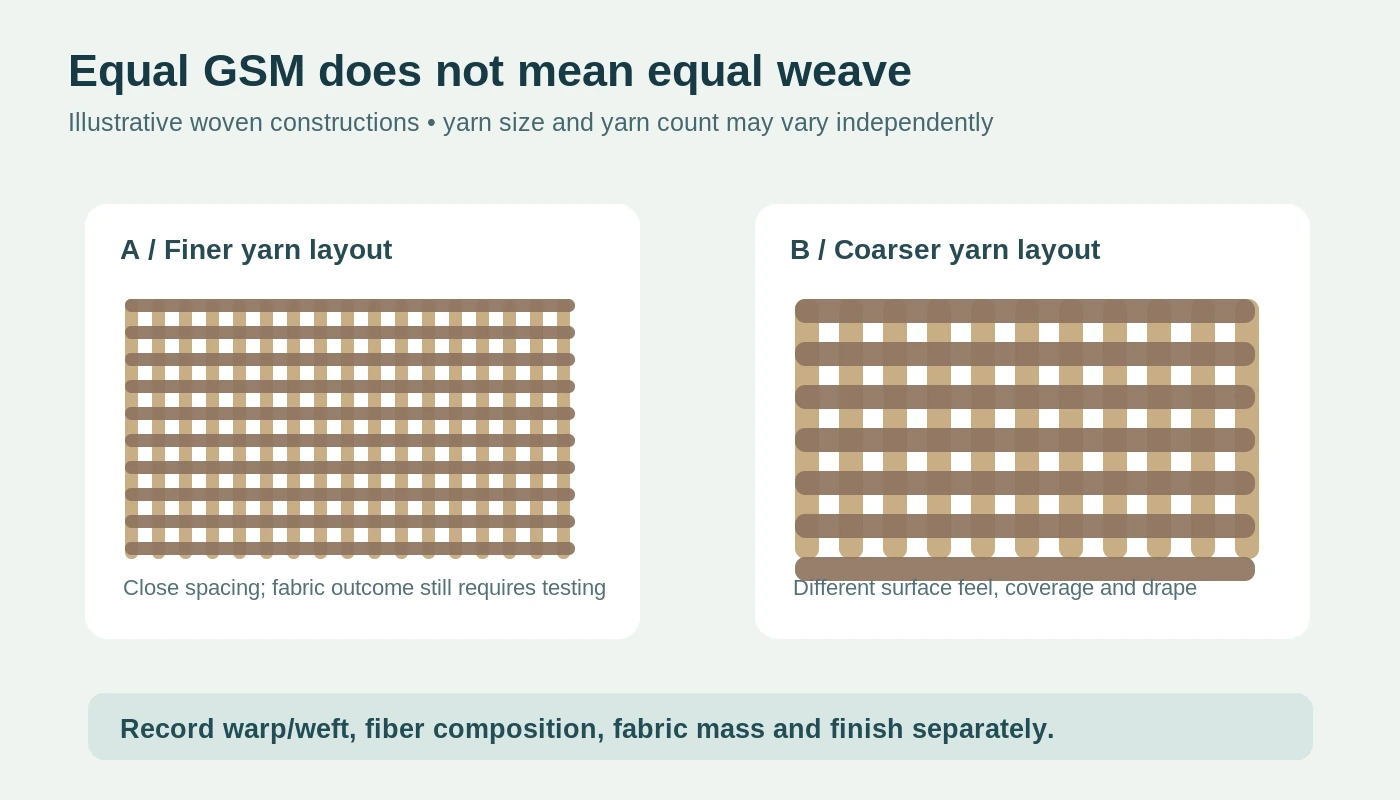
Two 8 oz canvas drop cloths can feel very different. One may use thicker yarns in a more open arrangement; another may use finer yarns packed more closely. Both can have the same nominal mass per unit area but different drape, surface texture, pore coverage and response to a paint drip. Fiber composition, moisture conditioning, yarn twist, weave, finishing and laundering all influence what a painter feels in hand.
What each measurement tells you
- oz/yd² or GSM: weight of material over a defined area.
- Weave density: yarns per direction and fabric openness; specify yarn and construction with the count.
- Caliper / thickness: distance across a material measured with an agreed method and pressure.
- Hand feel: perceived softness, stiffness, flex and texture, assessed against samples.
- Paint resistance: application-specific liquid absorption and potential penetration, requiring a real trial.
Do not convert GSM directly to mil thickness. Mil is 0.001 inch and describes thickness, whereas GSM describes areal mass. For thickness-based selection of coated tarpaulins, use the GSM, mil and tarp-thickness guide; plastic-sheet thickness is a different material decision.
Match Canvas Weight to the Painting Task
Start with the surface to be protected and the worksite's actual exposure. A nominally heavier sheet is not automatically safer or more protective if it creeps underfoot, traps grit or permits liquid to soak through.
| Job condition | Useful starting comparison | What to observe | When a different system is needed |
|---|---|---|---|
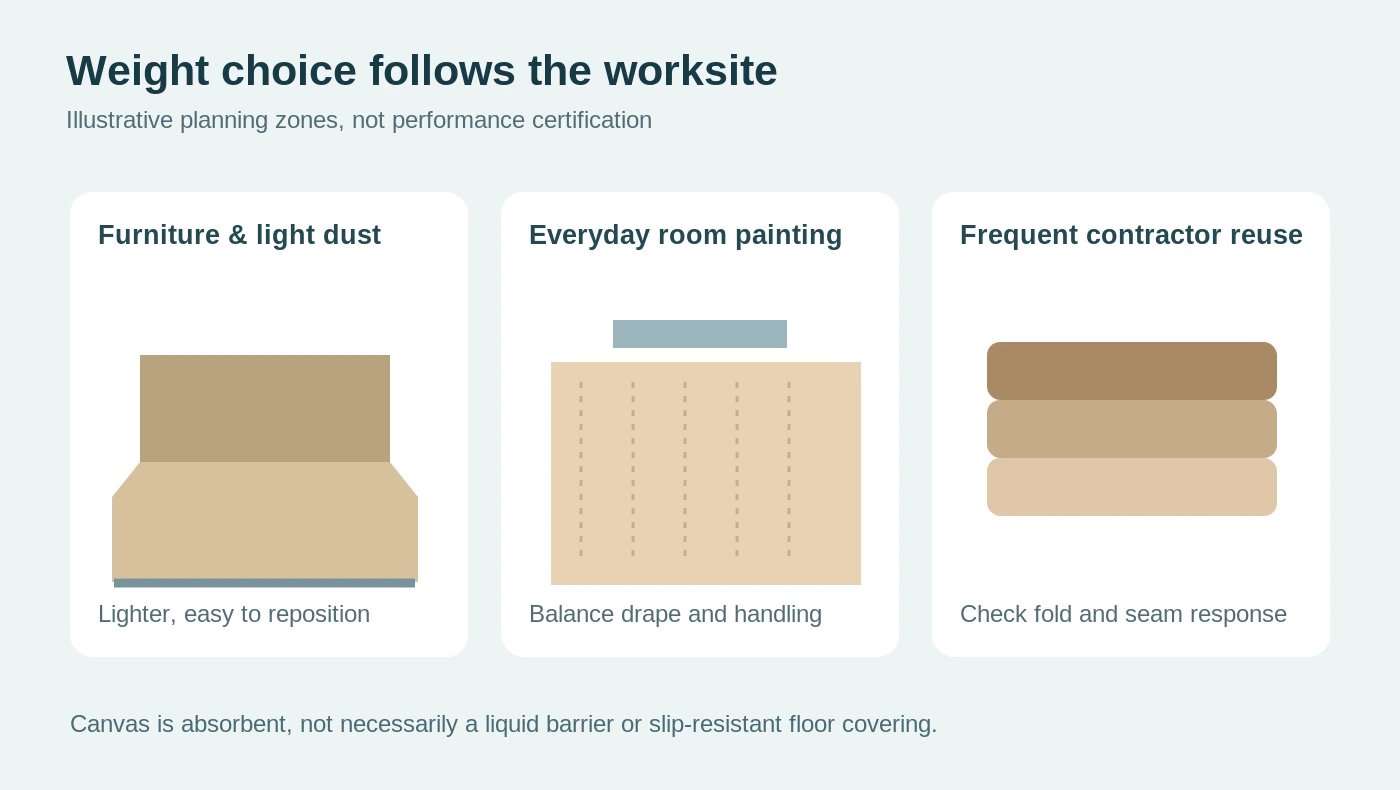
| Dust and furniture draping | 6–8 oz classes for manageable folds | Lint, abrasion, shade transfer and soft contact | Sensitive lacquer or high-polish surfaces require compatibility checks |
| Routine wall and ceiling painting | 8 oz first, then 10 oz if handling calls for it | Small paint drips, weave openness, floor grip and portability | Large liquid spills require separate barrier evaluation |
| Daily contractor reuse | 10–12 oz classes alongside lighter comparison swatches | Repeated folding, seam integrity, carrying weight and drying | A heavy cloth with poor seams is not necessarily the better product |
| Hallway or narrow-room floor protection | Any approved weight with proper runner geometry | Wrinkling, flat hems, position on the actual substrate | Wet/slippery zones need separately verified floor controls |
| High-volume paint or solvent exposure | Specify a tested material system, not nominal canvas weight | Penetration, compatibility, cleanup and disposal rules | Review a coated industrial paint-protection fabric where appropriate |
Compare Weight Samples by Hand, Not by Label Alone
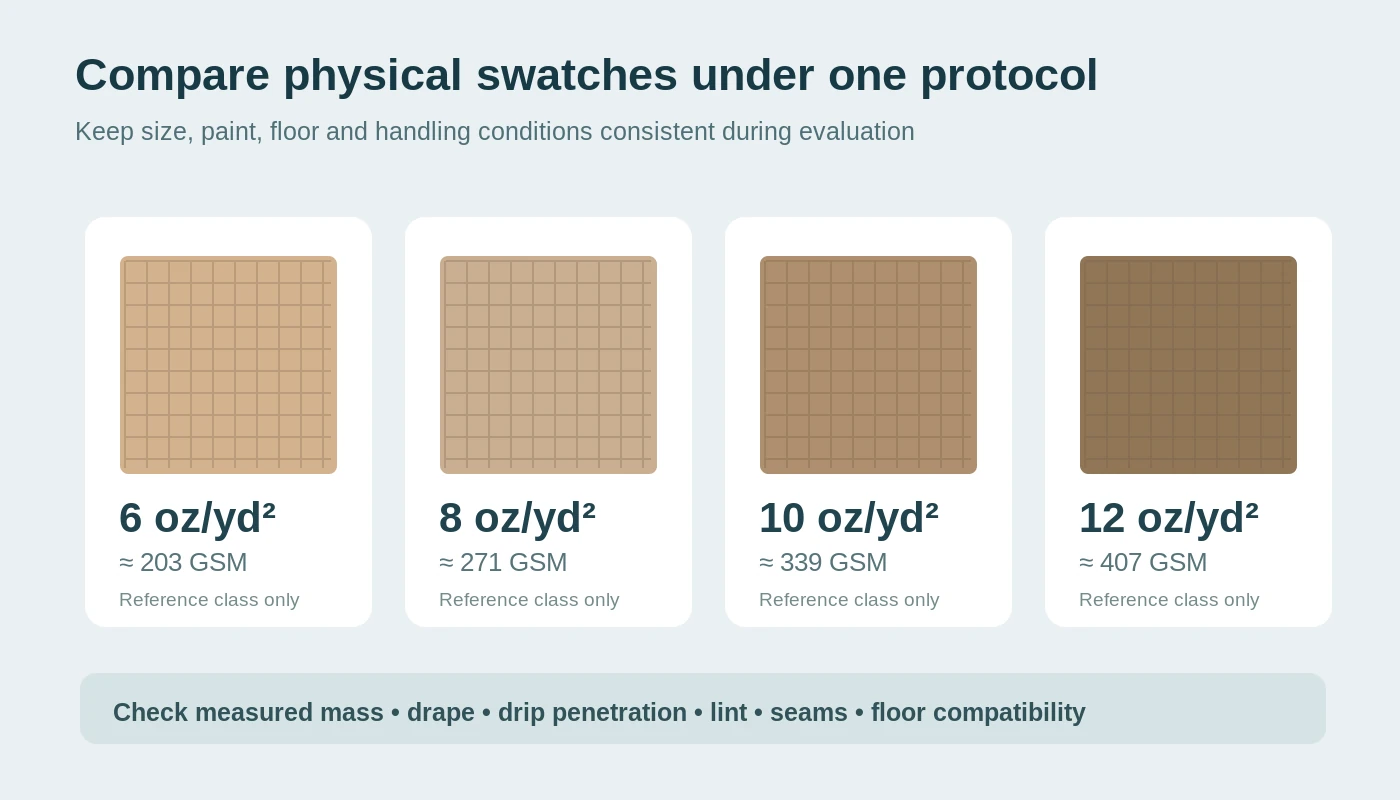
To compare a 6 oz canvas drop cloth with 8, 10 and 12 oz options fairly, request actual swatches of the proposed fiber blend, weave and finish. Label every swatch with its supplier reference and nominal weight. A smooth, soft 10 oz fabric may be easier to drape than a stiff 8 oz fabric finished differently. Avoid assumptions about quality from the number printed on a packet.
Identify the material
Confirm actual fiber composition, nominal oz/yd² or GSM, backing or treatment, and lot traceability. Record a swatch identifier.
Check drape and texture
Fold equal-sized pieces, compare flex and lint, and inspect the back against a representative surface.
Run a controlled drip trial
Use the intended paint and contact time over a compatible test substrate. Document absorption, seep-through and cleaning.
Check repeat use
Repeat an agreed number of folds and moves; inspect fraying, seams, shape and changed surface contact.
Verify finished size
Measure after hemming or any agreed washing/conditioning; log joined panels and seam positions.
Approve the specification
Keep an approved sample, measured values and tolerances with the final purchase-order version.
For higher duty finished goods, see professional heavy duty canvas drop cloth construction. For textile input rolls, use the canvas drop cloth roll specification guide, where usable width and splice limits matter independently of fabric weight.
What Bulk Purchasers Should Specify Beyond Weight
A “10 oz, 9 × 12 ft” description is not enough to compare two tenders. Keep a consistent acceptance record for each shortlisted weight, and state whether dimensions refer to cut material or finished, hemmed coverage. If orders involve branded retail packs, quote the packing and label separately from the fabric itself.
| RFQ field | Buyer should state | Evidence to approve |
|---|---|---|
| Material identity | Cotton / declared blend, weave, treated or untreated, backed or unbacked | Composition statement and labeled fabric sample |
| Nominal weight | e.g. 8 or 10 oz/yd²; equivalent GSM, target tolerance and sampling basis | Actual lot or sample measurement under agreed conditions |
| Finished geometry | Width × length, finished vs cut, panel joins, hem width and seam layout | Measured sample and drawing |
| Performance checks | Paint type, floor surface, lint, shrinkage, seep-through and reuse trial | Recorded agreed application test and acceptance rule |
| Buying format | Roll, cut piece, sewn sheet, or private-label pack as requested | Confirmed supply route, scope and pack sample |
| Commercial range | Quantity per weight/size, packaging mix, destination and delivery basis | Written quotation and approved order specification |
Example classes and inquiry formats are planning references. DERFLEX's actual supply role, cotton weaving/converting route, weight tolerance, minimum quantity and sample availability must be confirmed separately for the proposed product.
For labels, size mixes and repeat-order change control, read custom canvas drop cloth and private-label planning. Related outdoor canvas tarp materials are not interchangeable with uncoated painter's floor cloth without verifying treatments and intended contact.
Application Notes That Prevent a Weight-Based Mistake
Protect the actual floor
Test the underside on finished wood, polished stone, resin-coated floors or other sensitive substrates before long use. Sweep away grit; place and secure cloth to avoid catching a foot or moving under a ladder. Canvas weight is not a certified non-slip rating.
Do not rely on absorbency as a sealed barrier
Paint can soak through ordinary woven canvas. For liquid-tight requirements, specify a suitable independent protective layer or documented backed system and test it with the actual paint.
Control care and repeat orders
Check material-specific washing instructions, drying, lint release and change in dimensions after use. Do not assume coated, treated and uncoated textiles share the same care method. Retain the approved swatch and reference lot.
Separate canvas from plastic film thickness
A conversion between oz/yd² and GSM is valid for area mass; GSM-to-mil is not. Thin plastic film gauges require their own material/thickness specification and should not be inferred from this canvas guide.
Canvas Drop Cloth Weight FAQ
What is the best canvas drop cloth weight for painting?
There is no universal best weight. A 6 oz/yd² cloth is a lighter reference for occasional dry protection, while 8 oz is a practical comparison point for everyday painting. Many buyers evaluate 10 or 12 oz for repeated handling, but construction, paint exposure and actual floor compatibility must be checked on samples.
What is the GSM of a 10 oz canvas drop cloth?
A nominal 10 oz/yd² fabric equals approximately 339 GSM, using 1 oz/yd² = 33.906 g/m². The conversion describes areal mass, not a measured DERFLEX canvas item or a guarantee of actual fabric tolerance.
Does 12 oz canvas mean a drop cloth is waterproof?
No. Heavier uncoated woven canvas may absorb liquid but can still allow wet paint or water to penetrate when saturated. For floors that cannot tolerate seep-through, test a verified backing or a separate suitable barrier.
Can GSM be converted into canvas thickness in mil?
No direct conversion is reliable. GSM and oz/yd² measure mass per area; mil and millimeters measure thickness. Yarn size, weave, fiber density, coatings and finishing change caliper at a given GSM. Measure thickness separately under a stated method if it matters.
How should I compare the feel of 6 oz, 8 oz, 10 oz and 12 oz samples?
Ask for fabric swatches of the actual proposed constructions and compare drape, stiffness, surface texture, lint, wet behavior and repeated folding under the same conditions. Keep fiber content and treatment visible on each sample label; do not judge only from a trade weight name.
What should a bulk buyer provide to request canvas weight samples?
Provide the painting or dust-protection task, target weight or GSM range, cotton or blend preference, finished sizes, expected usage frequency, any seam or backing requirements, quantities by size, packing needs and destination. DERFLEX can review the sourcing brief; actual availability and samples require confirmation.
Related DERFLEX Buying Guides
Select the next resource by the actual question your team needs to answer—material identity, heavier construction, roll supply or branded finished goods.
Compare Weight Samples for Your Actual Painting Program
Send DERFLEX the weight class and usage conditions you want to compare. A sourcing conversation can identify the sample and specification review needed; cotton-canvas stock, converting scope and commercial terms are subject to written confirmation.
Helpful details for your request
- Target grade: 6, 8, 10 or 12 oz/yd², or target GSM
- Job: furniture protection, room painting or repeat contractor use
- Fiber, weave, absorbency and any backing needs
- Finished sheet sizes or usable roll width and quantity
- Seams, labels, packaging, destination and reference swatch