



Canvas Drop Cloth Runners for Stairs and Hallways
A canvas drop cloth runner is a narrow, elongated painter's cloth intended to protect a defined walking or work route. In a hallway, the decisive dimensions are finished width, finished length and side clearance. On stairs, the cloth must also follow tread and riser geometry. DERFLEX can review a proposed runner sourcing brief within its wider canvas and protective-textile programs; cotton construction, finished-sheet supply and order availability require project-specific confirmation.
- Hallway and trim-length layouts
- Stair, landing and turn measuring
- Hem, seam and fold decisions
- Bulk and private-label RFQ planning
Why a Narrow Canvas Drop Cloth Works Differently from a Room Sheet
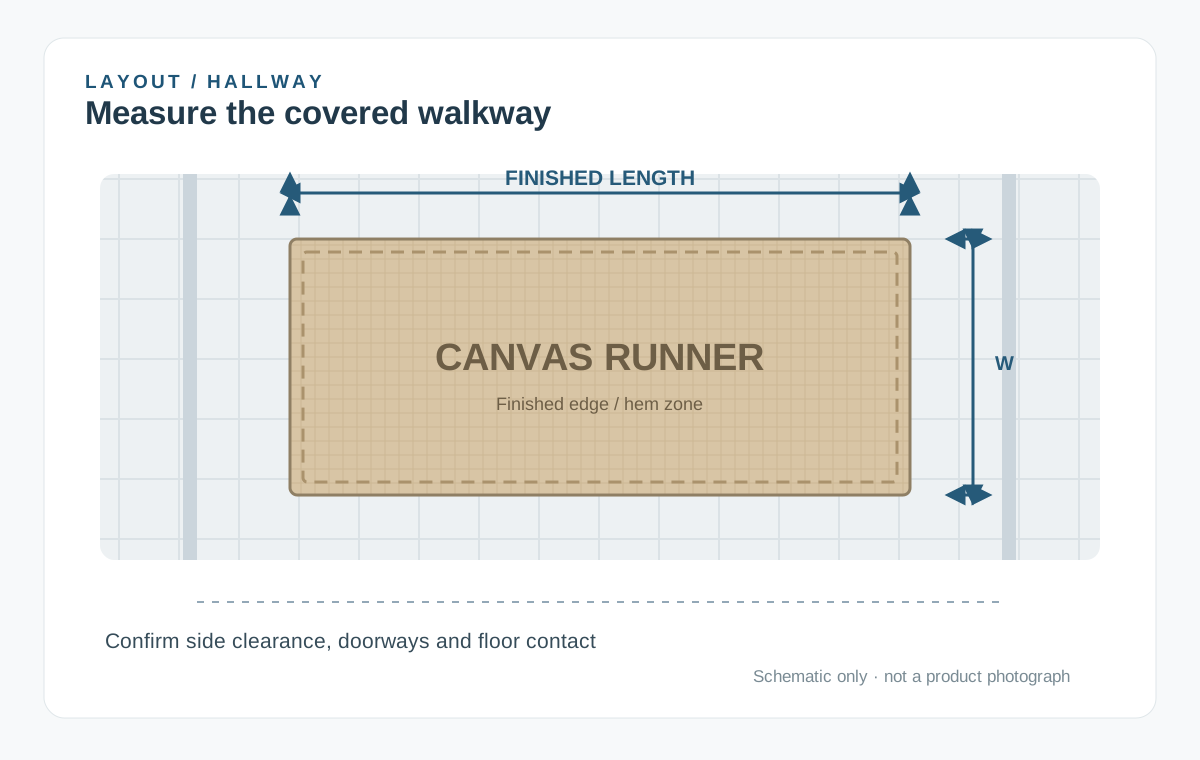
A painter's runner drop cloth focuses fabric where painters and equipment pass repeatedly: between doorways, along walls, beside baseboards and through stair approaches. It can be simpler to carry and position than a large rectangular sheet, provided its contact with the floor and movement during the job are controlled.
Hallway drop cloth
Match the required protected strip to the usable corridor width, including baseboard work zones and traffic clearance. Avoid loose side folds that become raised edges.
Stair drop cloth
Follow the actual stair profile, not merely the floor plan. Landing returns, nosings, intermediate doors and handrails may require a different panel arrangement.
Trim and renovation route
Plan the number of moves, the folded bundle and any panel joins. Check that the fabric is clean and dry before repositioning on a finished floor.
For all-size cotton cloth sourcing, start with the canvas drop cloth specification hub. This runner page addresses long, narrow geometry rather than fabric-weight grade selection or backing claims.
Canvas Drop Cloth Runner Sizes: 4 × 12 ft, 4 × 15 ft and Custom Lengths
The dimensions below represent recognizable trade-size requests, not a DERFLEX inventory list. Confirm whether a label states the fabric's cut size or the usable size measured after hems and any joined seams. The same nominal 4 ft width can cover very different lengths.
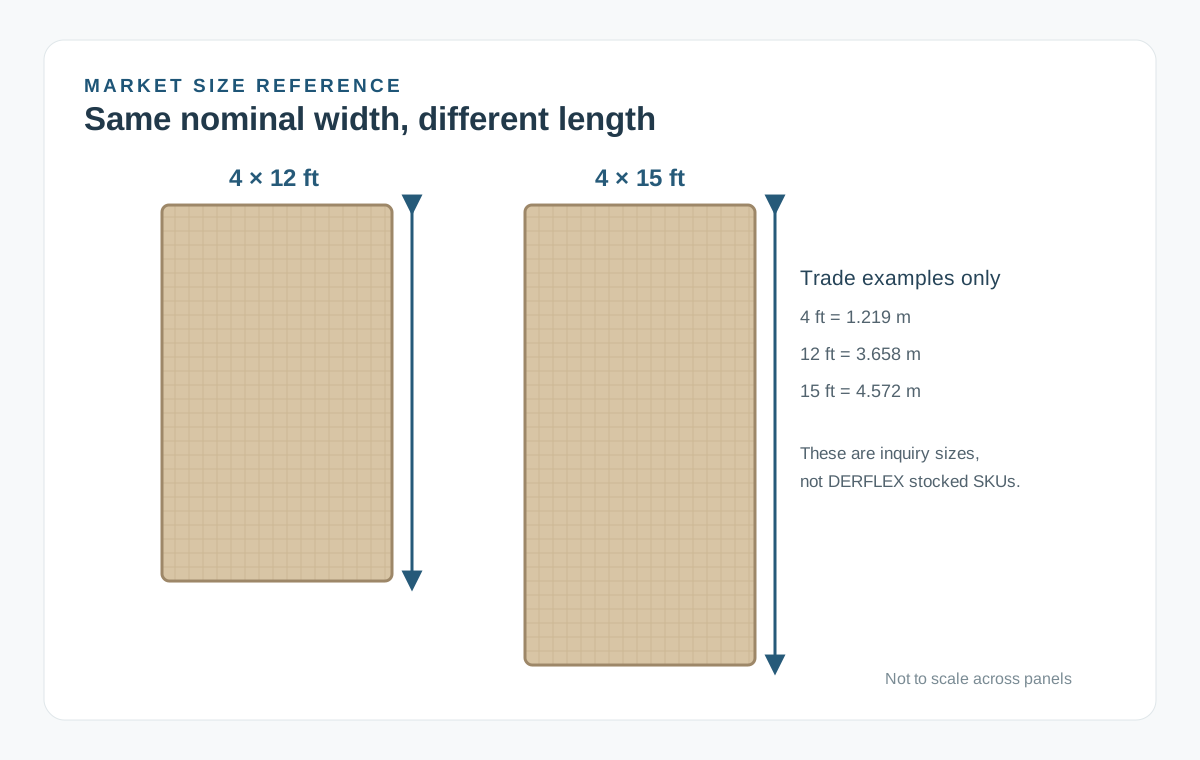
Choose by finished coverage, not label alone
| Buyer inquiry | Approx. metric size | What to check |
|---|---|---|
| 4 × 12 ft runner | 1.22 × 3.66 m | Straight corridor segment, door approach and usable end coverage. |
| 4 × 15 ft runner | 1.22 × 4.57 m | Longer route with fewer panel changes; verify lifting and fold weight. |
| Custom narrow runner | Buyer-defined | Exact finished width, route length, joint position, tolerance and labeling. |
Rounded conversions: 1 ft = 0.3048 m. A trade size describes geometry, not fabric mass, traction, thickness, construction or availability.
Distributors building several sizes can review custom canvas drop cloths and OEM packing; converters sourcing material before cutting can instead use the canvas fabric roll specification guide.
Three dimensions that belong on the drawing
Protected strip
Measure the surface to be covered, then account for safe clearance beside walls, doors and railings. A runner is not a substitute for a wider work platform.
Route travel
Measure along the actual cloth route, including any changes in level. Clarify whether multiple panels or a single finished piece are intended.
Usable coverage
Specify hems, allowed joins, seam bulk and dimensional tolerance. Joined widths or shrinkage can reduce finished coverage.
How to Lay Out a Canvas Runner on Stairs, Landings and Corners
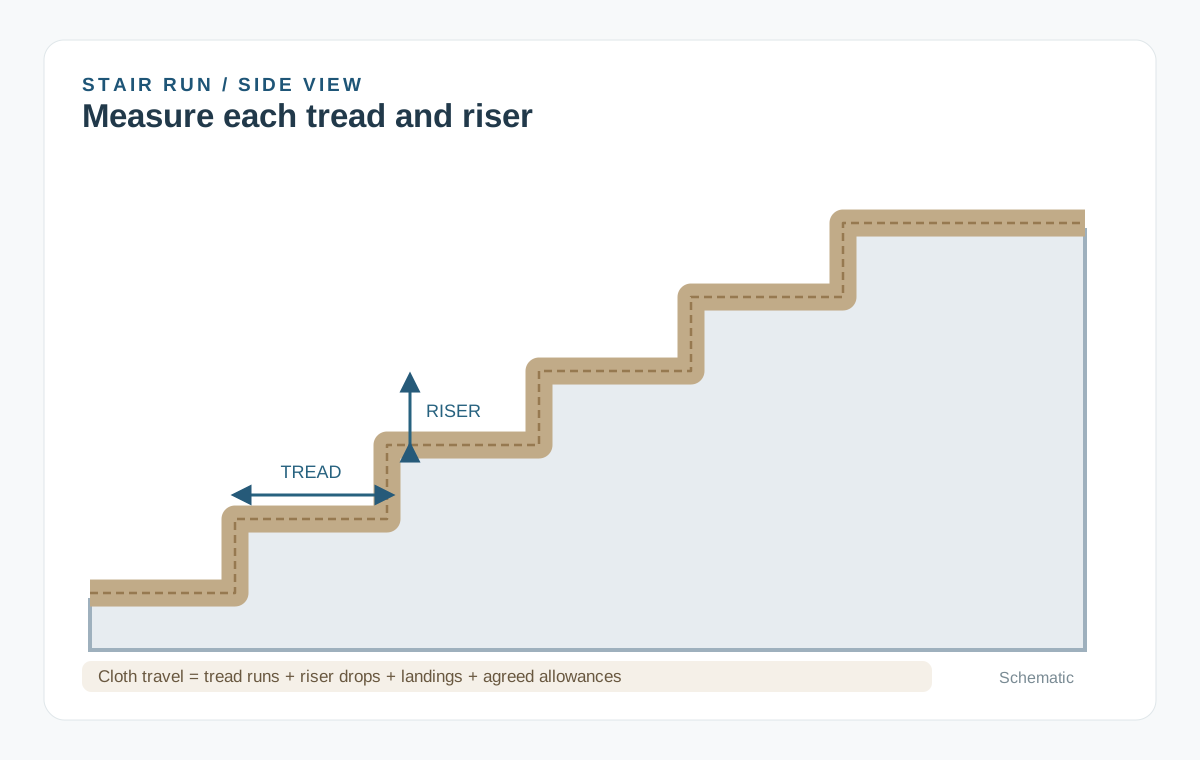
Stairs: count the rise and the run
For a preliminary stair-route estimate, add the horizontal tread travel and vertical riser travel for each step covered, then add measured landings and any specified end coverage. For example, 12 identical steps with an illustrative tread depth of 10 in and a riser height of 7 in produce 12 × (10 + 7) = 204 in, or 17 ft, before landing and end allowances.
That example makes clear why a nominal 4 × 15 ft stair drop cloth cannot be selected from step count alone. Actual stair geometry, nosings, fold points, accessibility and the securing method govern the decision. Measure on site.
Turns and overlaps: design the junction
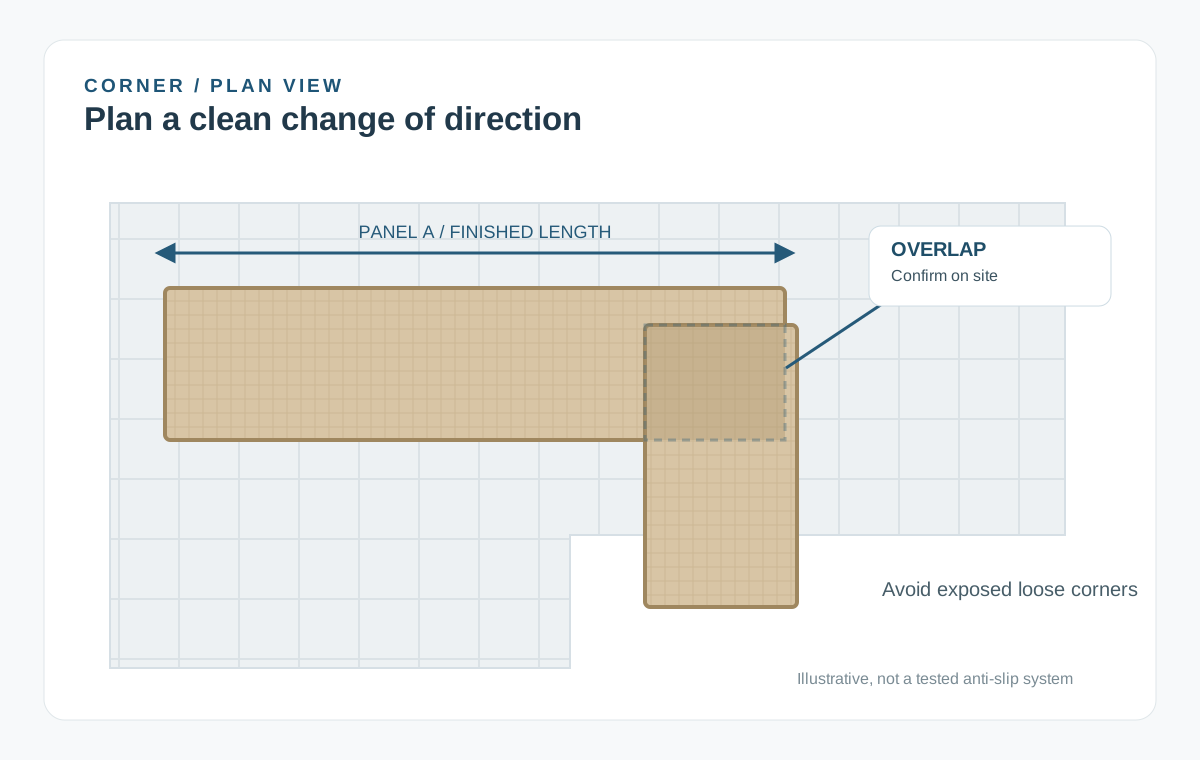
At an L-shaped hallway, two shorter panels may be easier to size and pack than one fabric piece with loose folds. Draw the corner, choose the panel direction, mark door swing clearance and decide where the junction should occur. A planned overlap can maintain surface coverage but should not create an exposed raised lip.
- Measure both legs from their actual start and end points.
- Mark doors, stair transitions, thresholds, work carts and footpaths.
- Specify panel orientation, overlap length and acceptable finished-edge location.
- Trial the selected material with a floor-compatible securing method; inspect for movement, bunching and residue.
When choosing between absorbent textile and a coated sheet for liquid spills, compare the separate industrial paint drop cloth fabric options. Liquid barriers and slip control require their own verification.
Estimate a Runner's Finished Coverage from Your Job-Site Measurements
This simple helper estimates straight-route coverage, not slip resistance, cutting yield, installation safety or a DERFLEX quoted SKU. It subtracts your planned clearances from the measured corridor width and adds your stated end allowances to route length.
Approx. 4.27 × 14.11 ft · 5.59 m² covered area.
Planning math only; finished size, seams and site conditions require confirmation.
Calculations stay in your browser. No form data is sent.
How to use the result
Use this checker only for one straight, level span. For stairs, calculate the cloth travel over treads and risers instead.
State whether the order is for a single finished runner or several pieces with an overlap. Do not assume joining allowances are included.
Check finished length and width after edge processing, fold lines and packaging. Surface compatibility and location-specific securing remain separate.
Specify Low-Profile Hems, Seam Position and Practical Folding
Finished edges
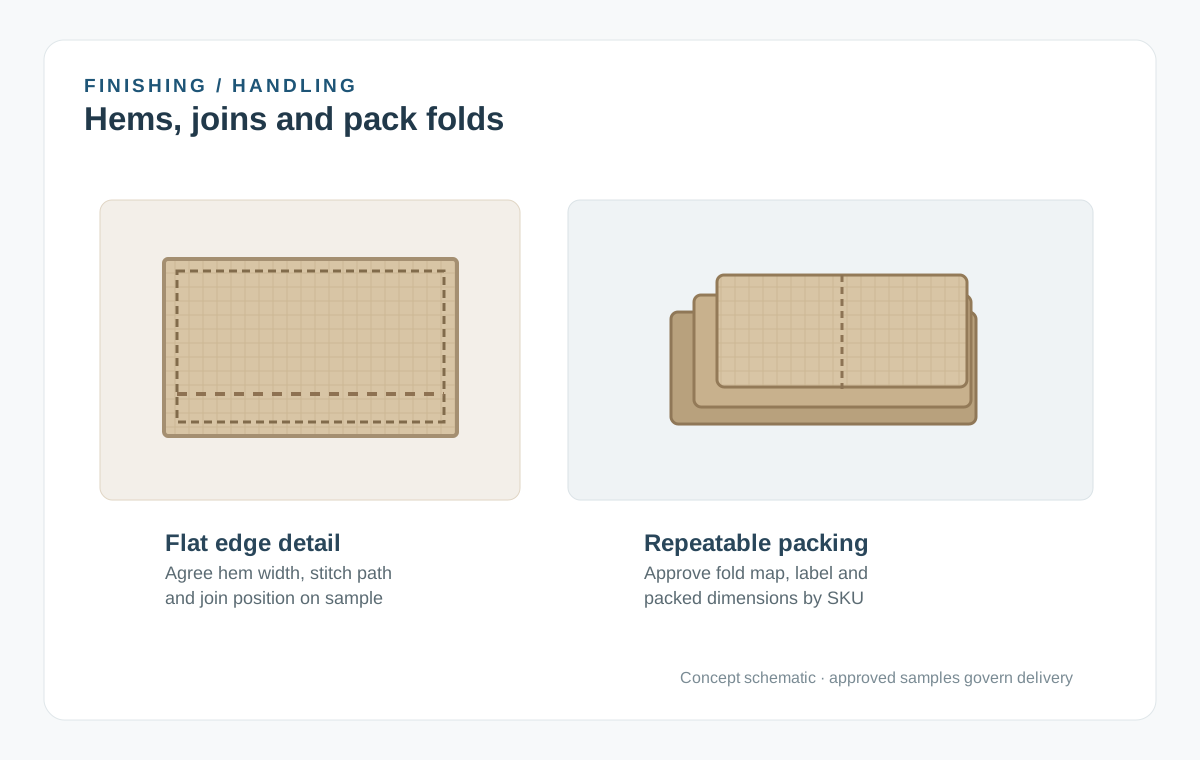
The narrow format makes the two long edges especially visible. Define whether they are turned and stitched, otherwise finished, or cut for a converter. Record hem width, thread or seam construction and dimensional tolerance on the sample. A heavy fold along a busy footpath can create a raised edge; avoid assuming added reinforcement is always advantageous.
Panel joins and cloth integrity
Ask where fabric widths are joined and whether the stitch position crosses an active route. Examine thickness transitions, loose thread, fraying and how the cloth lays after unfolding. Confirm exact fiber composition and any treatment separately: an outdoor canvas tarp finish is not automatically suitable for interior painting.
Pack for repeat deployment
Specify folding direction, finished pack size, size label, unit pack and carton quantity. Keep a sample of the approved fold plan so reorders can be compared without relying on an ambiguous printed 4×15 description.
For more demanding repeated-use weight categories, refer to the heavy duty canvas drop cloth construction guide; do not infer material performance from runner geometry alone.
Dimension and construction schedule for purchasing
| Field | Buyer-specified value | Acceptance discussion |
|---|---|---|
| Runner geometry | Finished width × finished length, unit of measure, pieces per route | Measure after hemming; distinguish finished size from initial cut. |
| Material | Cotton duck or blend preference; target weight and untreated / treated condition | Approve fiber declaration and actual sample; no assumed 100% cotton claim. |
| Edge and seam | Long-edge finish, end hem, join location, stitch detail, tolerance | Inspect flatness, fraying and any raised join along the route. |
| Floor & application | Hardwood / tile / vinyl / stairs; type of paint and job traffic | Trial the full floor-contact and securing arrangement; evaluate staining and seep-through. |
| Handling | Folding direction, unit weight target where supported, pack method | Approve folding sample and clean/dry handling instructions. |
| Commercial | Quantity per finished size, labels, cartons, destination, planned date | Supplier role, MOQ, production route and lead time agreed in writing. |
This is a buyer RFQ template, not a published inventory specification or test report.
Floor Conditions and Handling Rules to Confirm Before Approving a Runner
Test the real finish
Remove grit first. On polished wood, stone, tile and resilient flooring, review finish cure, color transfer, moisture and any marking or residue from the proposed securing system.
Control traffic and edges
Check movement, folds, door clearance, footwear and route changes each time the runner is repositioned. Neither heavy canvas nor a narrow profile provides an inherent non-slip rating.
Dry before folding
Remove paint responsibly, follow approved care instructions, allow damp cloth to dry, and inspect for stains, holes, worn seams or hardened paint before the next use.
Unbacked canvas can absorb incidental paint drips, but prolonged or large spills may penetrate to the floor. When waterproofing, residue control or traction are essential, specify a separate proven system and ask for relevant documentation rather than relying on a canvas label.
For material-family context, DERFLEX's canvas tarp products and canvas versus vinyl tarp comparison discuss different industrial cover behaviors. They do not certify a painter's runner.
From a Narrow-Route Drawing to a Repeatable Canvas Runner Order
DERFLEX can review the application and proposed canvas runner specification against its existing material and tarp sourcing programs. Whether cotton fabric weaving, cutting, sewing and packing can be delivered under the specific order must be confirmed by the responsible supplier or converting partner; no dedicated in-house runner manufacturing line is asserted here.
Define the route
Provide a hallway plan or stair profile, floor type, intended use, nominal sizes and finished dimensions.
Approve a sample
Verify fiber, weight, hems, fold plan, side clearance, surface contact and labels under representative use.
Confirm the supply scope
Record which entity supplies fabric, finishes sheets, packs cartons, inspects goods and accepts the PO.
Canvas Runner Drop Cloth FAQ
What is a canvas drop cloth runner?
A canvas drop cloth runner is a comparatively narrow, elongated woven textile cover used along painting routes, hallways, baseboards and other confined work zones. Specify its finished width and length, edge construction and material rather than assuming that every canvas tarp has runner proportions.
Is a 4 × 12 ft or 4 × 15 ft canvas runner a standard DERFLEX item?
Those dimensions are familiar market examples, approximately 1.22 × 3.66 m and 1.22 × 4.57 m. They are inquiry references, not confirmed DERFLEX stocked sizes. Ask for the proposed material, manufacturing route, finished-size tolerance and an approved sample.
How do I measure a stair drop cloth?
Measure the actual route over every tread and riser plus landings, changes of direction and the required end coverage. Do not use the staircase's horizontal projection as the total cloth length. Account for handrails, doors, nosings and safe positioning before approving a finished runner size.
Can I overlap two runners at a hallway corner?
A planned overlap can connect coverage panels, but a loose or raised junction can catch footwear, carts or ladders. Agree the location, overlap dimension and floor-compatible securing method through an on-site trial; the drawing on this page does not certify a safe installation.
Are canvas drop cloth runners non-slip or waterproof?
No such performance is automatic. Ordinary unbacked woven canvas can move on a floor and allow liquid through when saturated. For traction or liquid-barrier requirements, evaluate the full floor, backing or underlay and installation system with relevant evidence; do not infer it from the runner's weight or size.
What should distributors include in a runner RFQ?
Provide corridor or stair geometry, finished width and length for each size, cotton or blend preference, target fabric weight, seams and hems, sample and testing needs, size-by-size quantities, unit fold, labels, carton configuration, destination market and delivery requirements. Confirm availability and tolerances in the written quotation.