Dust Containment
Use welded PVC panels, floor overlap or a weighted hem, side returns and controlled access openings to reduce dust migration between processes.



 Industrial coated fabric and custom curtain solutions
Custom PVC curtain systems for warehouses, factories, logistics hubs and temperature-managed work areas—configured around your bay size, traffic flow, visibility, containment and mounting requirements.
DERFLEX supplies heavy-duty warehouse divider tarp material, fabricated curtain panels and project-based OEM solutions for distributors, contractors, curtain-system integrators and industrial end users.
A warehouse divider tarp is a flexible industrial curtain made from PVC-coated fabric, clear PVC film or a composite panel structure. It creates a physical separation between work zones without committing the facility to a permanent masonry or sheet-metal wall.
The system can help contain dust and overspray, reduce direct airflow between zones, improve visual organization, provide privacy and support temperature zoning. Because the panel can be fixed, retractable or modular, it is particularly useful in leased buildings, seasonal operations and facilities where production layouts change.
A well-designed divider is more than a sheet hung from a beam. Panel weight, curtain height, track support, bottom stability, side overlap, access points and clear-window placement all affect how the installation performs in daily use.
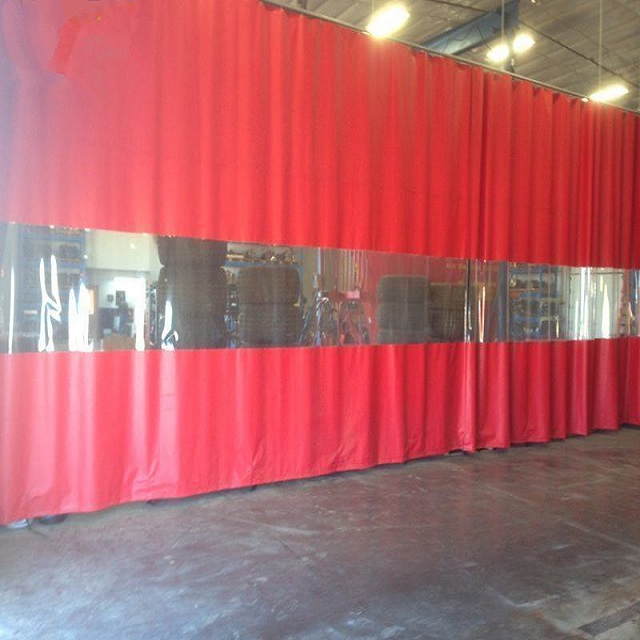
Different warehouses need different barrier behavior. The most practical specification starts with the operational objective and then selects the curtain structure, seals and access system.
Use welded PVC panels, floor overlap or a weighted hem, side returns and controlled access openings to reduce dust migration between processes.
Choose a single-layer airflow barrier for basic separation or an insulated composite where the temperature difference and operating hours justify added thermal resistance.
Define packaging, maintenance, assembly, storage or inspection areas while retaining the option to open the full bay for machinery and material movement.
Add a clear PVC window band at a project-specific height so operators can check traffic and activity on the opposite side before crossing.
Color, window proportions, panel joins, bottom treatment and access points can be configured around the building and daily traffic pattern.
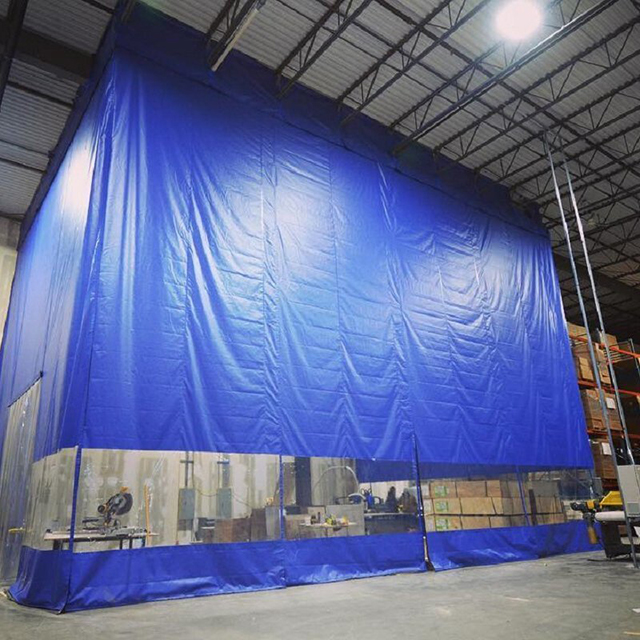
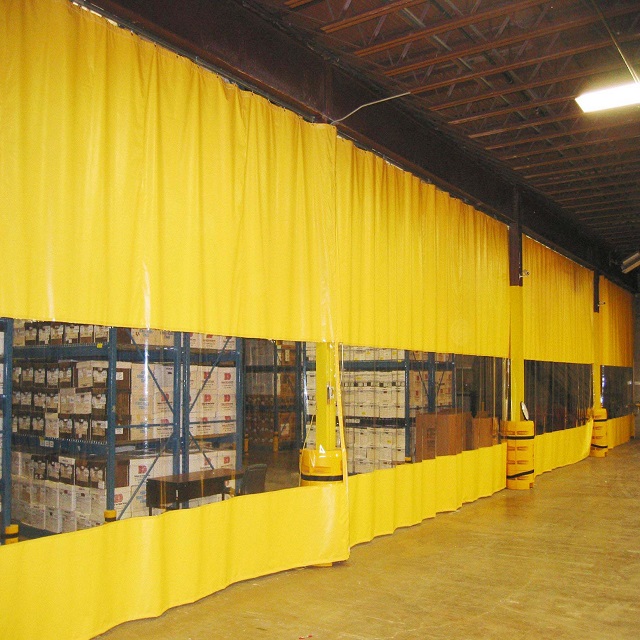
Standard warehouse divider tarp construction uses a polyester base fabric coated with flexible PVC on both sides. The polyester scrim contributes tensile and tear strength, while the PVC surfaces provide a washable barrier and allow seams to be joined by hot-air or high-frequency welding.
General zoning curtains may use a lighter body for easier handling. Tall panels, frequent opening cycles, high air movement or rough industrial use normally call for a heavier scrim, stronger edge webbing and more robust top suspension. Clear PVC is commonly combined with the coated fabric body rather than used as the entire high-load panel.
For cold rooms or meaningful noise-control goals, a multi-layer composite should be specified. A standard single-layer PVC curtain can restrict direct airflow and line-of-sight noise, but it should not be represented as a high-performance thermal or acoustic barrier without the appropriate core and tested assembly.
The final result depends on the complete curtain assembly—including panel material, seals, hardware and installation—not the fabric alone.
Reinforced scrim, welded panel joints, perimeter hems and webbing help manage repeated opening, contact and tall suspended spans.
PVC-coated faces resist water penetration and support washdown. Overall sealing still depends on seams, edges, floor contact and penetrations.
Opaque panels and controlled overlaps help isolate dusty or messy processes from storage, packaging and inspection zones.
Track-mounted curtains can stack to the side, preserving wide forklift or equipment access when the zone must be opened.
Custom-height clear PVC sections maintain supervision, light transmission and awareness of cross-traffic.
Flame-retardant formulations and third-party test support can be discussed against the exact standard named by the buyer or authority.
The following ranges are common starting points for custom development. Final values are confirmed by sample, drawing, test request and production specification.
| Primary material | PVC-coated polyester fabric; optional clear PVC film, insulated composite or specialty functional layer |
|---|---|
| Typical fabric weight | Approximately 450–900 gsm for common single-layer curtain bodies; heavier or composite structures available by project |
| Clear vision panel | Typical clear PVC thickness around 0.5–1.0 mm, selected by panel size, cold conditions and flexibility requirement |
| Base fabric options | Polyester scrim grades selected by required tensile strength, curtain height, wind/air movement and opening frequency |
| Panel width | Roll-width panels or large welded assemblies; multi-panel construction supports long warehouse runs |
| Color and finish | Blue, gray, white, yellow, red, black and project colors; matte or gloss directions subject to material grade |
| Seam construction | Hot-air welding, high-frequency welding or combined welded/sewn details according to the component and project |
| Edge reinforcement | Folded welded hems, polyester webbing, reinforced top bands, corner patches and project-specific load points |
| Mounting interfaces | Grommets, roller hooks, track carriers, keder edges, clamps, hook-and-loop closures, magnets or frame attachment |
| Bottom control | Chain-weighted pocket, floor sweep, flexible overlap, batten pocket or tensioned attachment |
| Access options | Sliding opening, roll-up bay, zipper doorway, strip-curtain opening, overlapping personnel pass-through or full retractable run |
| Optional functions | UV stabilization, anti-mildew direction, cold-flexibility, anti-static formulation, flame-retardant direction, printing and identification labels |
DERFLEX can support wholesale material supply, fabricated curtain panels and OEM projects based on drawings or measured openings.
Mounting concept should be selected before panel production because the top reinforcement, hardware spacing and finished height depend on it.
Suitable where the opening must retract frequently. Track may be supported from a ceiling, beam, threaded rod or engineered suspension.
A practical choice for long-term zoning where only personnel doors or localized access points need to open.
Manual or assisted roll-up sections preserve a full-width equipment passage without sliding the curtain along a track.
Hook-and-loop edges, zipper joins or overlapping flaps allow phased installation, replacement and seasonal reconfiguration.
Flexible dividers are useful wherever a facility needs a defined boundary but still values access, reconfiguration and shorter installation time than a permanent wall.
Separate inventory categories, quarantine areas, returns, high-value goods or tenant spaces.
Reduce dust and workflow interference around packing lines, inspection cells and light assembly areas.
Contain chips, dirt and visual clutter around maintenance bays, grinding areas and equipment service zones.
Limit direct air mixing at cooler entrances, loading zones and temperature-managed processing areas.
Use cleanable waterproof curtain surfaces to protect adjacent dry areas; hygiene suitability must be confirmed for regulated operations.
Create a removable enclosure for pilot lines, seasonal capacity, contract manufacturing or changing floor plans.
DERFLEX combines coated-fabric manufacturing knowledge with converting support for custom industrial curtain projects. Buyers can discuss roll goods, cut panels, welded assemblies, clear-window integration, reinforcement and export-ready packaging within one supply program.
This approach is suited to warehouse divider tarp suppliers, wholesalers, industrial curtain contractors, OEM brands and facility projects that need repeatable specifications rather than a one-off retail curtain.
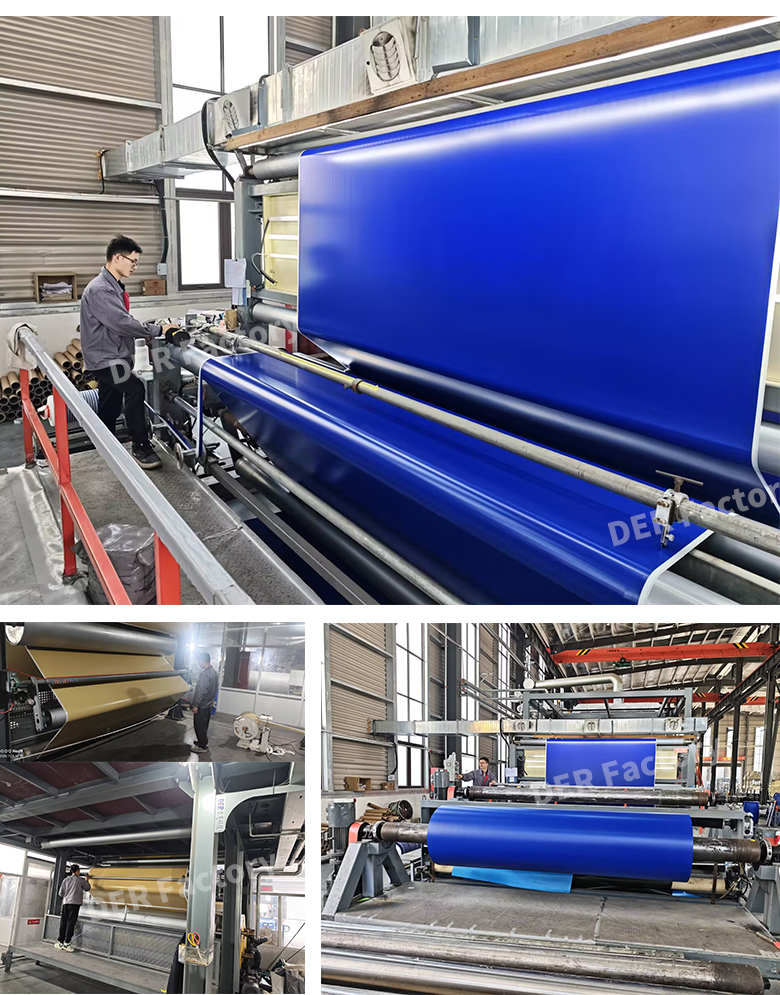
Quality review should follow the approved project specification and focus on the details that affect installation, use and repeat orders.
Use these related pages to compare material structures, special functions and custom fabrication options.
Answers for facility managers, contractors, importers, distributors and custom curtain buyers.
A divider tarp is flexible, lighter and easier to reconfigure. It can be fixed or retractable and usually requires less structural work than a permanent wall. A permanent wall may provide higher security, fire separation, acoustic isolation or building-code performance, so the correct choice depends on the project objective.
Yes. Custom development can cover finished width and height, panel segmentation, window position, color, access openings, edge reinforcement, joining method and mounting interface. A drawing or measured opening is recommended for large projects.
The PVC-coated panel surface and welded seams can provide a waterproof barrier. However, the installed system is not automatically watertight because water may pass at the floor, wall edges, access openings or hardware penetrations. Tell DERFLEX whether you need splash control, washdown separation or a more fully sealed enclosure.
Yes, a flexible curtain can reduce direct air mixing and help define temperature zones. For larger temperature differences or long operating hours, an insulated composite curtain is more appropriate than a standard single-layer PVC panel. Overall performance depends on openings, floor seal, side seal and traffic frequency.
Yes. Clear PVC vision bands, full windows, strip-door passages, zipper openings, overlapping personnel doors, roll-up sections and full sliding bays can be incorporated. The access design should reflect the traffic type and required opening frequency.
Flame-retardant material directions can be discussed. The buyer should provide the exact standard, authority or end-use requirement before sampling. “Fire retardant” does not mean fireproof, and a divider curtain is not a substitute for a rated fire wall or a dedicated high-temperature welding blanket.
Send the opening size, photos or drawing, operating objective, preferred mounting style, access requirements, quantity and destination. DERFLEX will review the material and fabrication direction for quotation.