


CUSTOM TARP PROGRAMS
OEM procurement · Technical guide
Heavy Duty Tarp Production Tolerances:Size, GSM, Thickness, Color & Hardware Placement
A tarp can match its label and still miss the anchor points. Define the limits that make a bulk order fit, match and pass inspection.
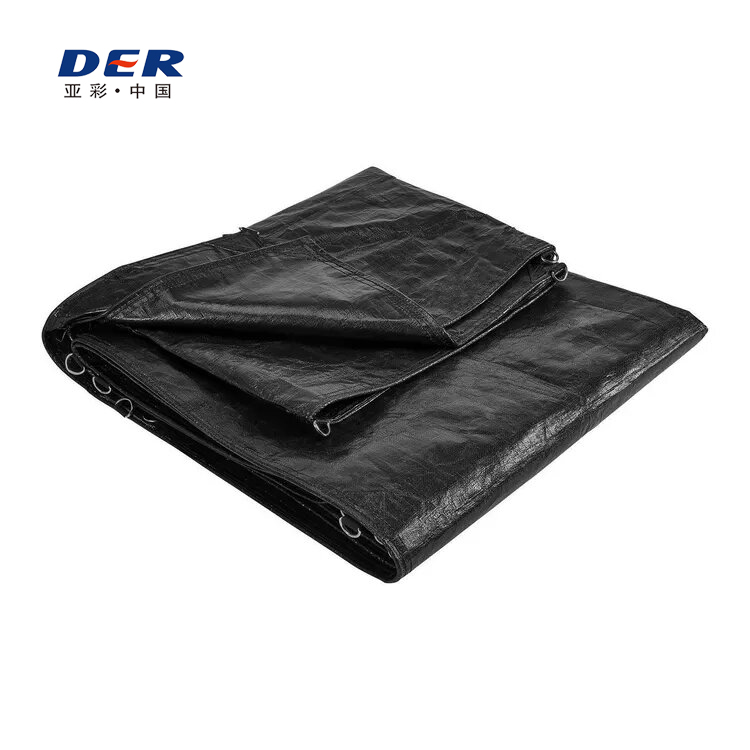
For truck-cover distributors, equipment-cover OEMs and industrial buyers, heavy duty tarp production tolerances connect the approved sample to the delivered cover. DERFLEX supplies PVC coated polyester material and custom tarp programs with options for welded seams, reinforced hems, eyelets, D-rings, color and packing. Use this guide to turn your drawing and material requirements into a measurable purchase specification.
Finished covers · PVC tarp material · Repeat OEM and wholesale orders
Updated · By DERFLEX
The practical answer
Which tolerances should a heavy duty tarp order specify?
Specify finished length and width, total fabric GSM, single-layer thickness, color acceptance and hardware coordinates as separate requirements. Each needs an acceptance band, measurement method, sampling basis and agreed action for a failure. There is no universal tolerance that makes every PVC tarp, fitted cover and replacement panel interchangeable.
Before bulk production
Build one control sheet for five different decisions.
A production tolerance is an allowed departure from an agreed value. It becomes usable when both buyer and manufacturer can reproduce the measurement and reach the same release decision. Keep the material specification, finished drawing, color reference and inspection plan under the same revision.
Swipe sideways to view all table columns.
| Control | Define on the order | Inspect against | Problem it prevents |
|---|---|---|---|
| Finished size | Length, width, shape, lower/upper limits, measurement state and named reference edges. | Completed tarp after welds, hems, pockets and reinforcement; agreed flat or installed condition. | Insufficient coverage, poor fit and replacement panels that cannot be installed. |
| GSM | Total coated fabric mass in g/m2; limits for individual specimens and/or the specified average. | Identified, conditioned flat specimens with a known area and agreed test method. | Underweight material hidden by an acceptable batch average or misleading finished-piece weight. |
| Thickness | Nominal or minimum gauge, tolerance, pressure, test-point plan and texture treatment. | Single-layer coated area; measurements at the agreed instrument conditions. | Disputes caused by different gauges, compression or measurements through a doubled hem. |
| Color | Approved physical reference, face, finish, viewing conditions and any instrumental difference limit. | Production shade and uniformity using matched settings and the retained reference. | Different shades in one delivery or replacements that look mismatched beside an older panel. |
| Hardware | Type, count, centres, reference origin, offsets, orientation and permitted position deviation. | Finished grommet or D-ring attachment geometry; paired rows and mating anchors where required. | Misaligned tie-downs, cumulative pitch error and incorrect corner counting. |
Keep tolerance and performance separate. A tarp inside its size, weight and color limits can still need separate verification of seam strength, tear resistance, coating adhesion or hardware pull-out performance. Dimensional conformity does not qualify a load-bearing attachment.
Choose the construction before assigning limits: review DERFLEX’s PVC coated polyester tarpaulin options.
01 / Finished dimensions
What size is being controlled: cut, finished or installed?
For a cover that must fit, control its finished dimensions after fabrication. Cut size is the panel size before edge folds and seam overlaps consume material. Installed size adds another variable: the frame, tension, fasteners and the way the flexible cover is supported.
Measure the completed tarp on a suitable surface in the agreed relaxed condition, or on the agreed reference fixture. State the units, reference edges and measurement timing after fabrication. Do not pull the material until the tape reaches the target.
- Control length and width independently; do not replace them with an area tolerance.
- For fitted covers, identify drops, pockets, openings and attachment interfaces as separate dimensions.
- If squareness matters, add diagonal or geometry limits and name the measurement points.
- Measure again after rework that can change hems, welds or attachment locations.
For coverage and drop planning, use the custom tarp measurement guide.
Choose the notation that protects the fit.
Symmetric: a dimension may move above or below the target.
One-sided: under-size is prohibited when minimum coverage is essential.
Fixed units: an attachment or pocket has a defined millimetre allowance.
Do not apply a large-sheet percentage to a small buckle, opening or eyelet position simply because the overall cover uses a percentage.
Do not count the allowance twice.
A required side drop or installation overlap belongs in the nominal design. Manufacturing tolerance describes variation around that design. Adding a “shrink allowance” to a finished-size order without changing the drawing can create an oversized cover instead of protecting the required fit.
02 / Material mass
How should GSM tolerance be checked on a heavy duty tarp?
Check the mass of known-area, single-layer material specimens under an agreed method. GSM means grams per square metre. Total coated-fabric GSM includes the textile base and coating system; it is not the weight of the polyester yarn alone.
For illustration, a 100 cm2 specimen weighing 9.00 g corresponds to 900 g/m2. The specimen size is arithmetic only; use the preparation and sampling requirements of the selected test method.
ISO 2286-2 covers coated-fabric mass measurements. It provides a method; the buyer and supplier still need to agree the acceptance limits.
Separate local variation from the average.
Plan sample positions across the width and along identified rolls or production batches. State whether every specimen must comply, whether each roll mean must comply, and how the lot is judged. An average cannot override a failed individual limit unless the specification explicitly allows that acceptance basis.
A finished tarp is not a GSM specimen.
Hems, overlaps, webbing, patches and metal fittings add weight. Dividing a complete tarp’s weight by its overall area does not isolate the single-layer fabric GSM. Use piece weight as a separate packing or handling control when needed.
GSM also does not establish tensile or tear strength by itself. Keep the agreed substrate, coating construction and required performance in the material specification.
03 / Material gauge
Thickness limits need a pressure and a point plan.
Measure single-layer thickness at the specified pressure and agreed locations. A flexible, textured PVC coated fabric can give different readings when the contact geometry, force or measurement procedure changes.
ISO 2286-3 addresses coated-fabric thickness under specified pressure. Use the full agreed method rather than naming a standard beside a reading made under unrelated conditions.
- Record the calibrated instrument and relevant measuring settings.
- Avoid hems, welded overlaps and patches when checking the body fabric.
- Agree how embossed or textured surfaces will be evaluated.
- Keep individual point readings so local coating variation remains visible.
Use millimetres and mils consistently.
One mil equals 0.0254 mm. Therefore 0.80 mm is approximately 31.5 mil. “Mil” does not mean millimetre.
Do not infer an exact GSM from thickness. Different substrates, formulations, finishes and measurement conditions can change the relationship between the two. If both affect your product, specify and inspect both.
Record the inspected layer.
A body-fabric gauge, a folded hem gauge and a reinforced corner gauge describe different constructions. Label each result so a doubled edge is not compared with a single-layer material limit.
04 / Color and finish
How do you control shade across bulk and repeat tarp orders?
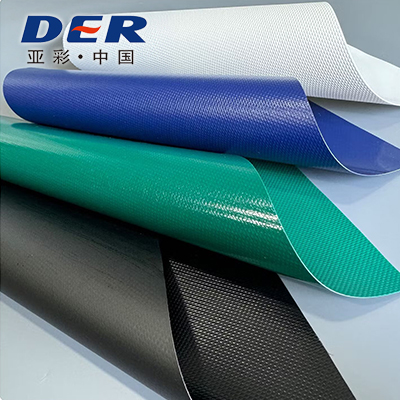
Approve a physical coated-fabric reference and define the comparison conditions. A RAL or Pantone code can communicate the intended color, but it does not capture coating texture, gloss or how the surface looks under different lighting.
Code and retain the approved sample. Identify the inspected face, color, finish and revision. A screen image is useful for discussion, but it is a weak release reference.
If instrumental control is required, agree the color-difference formula, illuminant, observer, instrument geometry, specular setting and sample backing.
Check shade uniformity, gloss and visible streaks. Review panels together under agreed viewing light when they will be installed side by side.
“ΔE ≤ 2” is incomplete.
The formula matters. CIELAB ΔE*ab and CIEDE2000 ΔE00 are different calculations; the same numerical limit is not interchangeable between them. ASTM D2244 describes instrumental color-difference calculations. It does not create a universal allowable shade difference for PVC tarps.
Agree whether instrumental conformity and visual approval are both required, and how conflicting results are resolved. A sample can meet a numerical color limit while its gloss or surface finish still differs visibly.
Repeat orders need a retained master.
Compare new production with the controlled master, rather than only with the previous shipment. Otherwise successive acceptable differences can move the color away from the original target. For a replacement curtain, also discuss the appearance of the installed material: weathered fabric may no longer match the original reference.
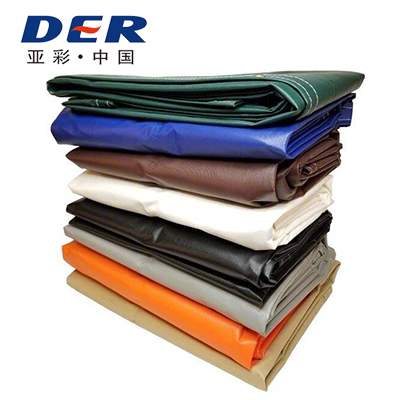
DERFLEX custom color and finish discussions should include the sample reference, order quantity, target market and any specific measurement or paired-panel requirement.
05 / Eyelets, D-rings and anchor interfaces
Hardware placement needs coordinates, not just “every 600 mm.”
Specify centres from a common reference when the tarp must meet fixed anchors. Regular pitch on each edge does not guarantee that opposing rows, adjoining panels or replacement covers line up.
- Name the origin. Mark a finished corner and the two reference directions; use the same drawing orientation during inspection.
- Locate each feature. Show first and last centres, row offsets, count, corner treatment and any exact anchor coordinates.
- State the position tolerance. Decide whether it applies to each coordinate from the origin or to local spacing. These are different acceptance rules.
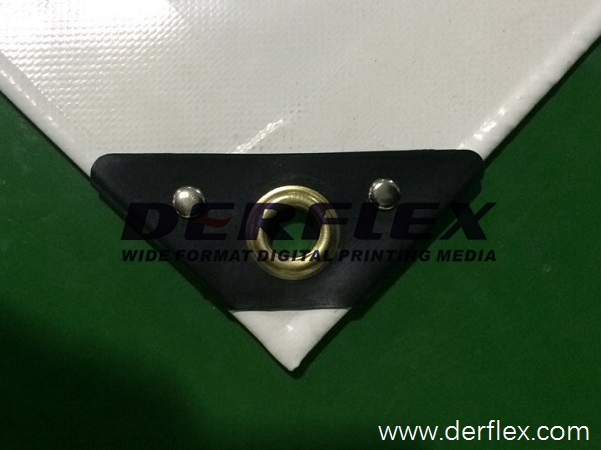
- Define the hardware. Include eyelet opening, material, patch or webbing details; for D-rings define the inspected attachment reference and ring orientation.
- Specify paired interfaces. Explicitly require aligned opposing rows or interchangeable panels when needed.
Review reinforced tarps with grommets when specifying eyelets, and D-ring tarp attachment options when defining ring rows.
Why local spacing errors can accumulate
If every interval is permitted to be 5 mm long, ten consecutive intervals could put the last centre 50 mm beyond its intended location. Checking coordinates from a shared origin controls each attachment’s location independently.
For flexible covers, also define the measurement state. Moving or stretching the tarp while checking hardware can change the apparent error.
Plan an evenly spaced eyelet row.
Use this arithmetic tool for a free-layout row with a maximum permitted gap. A, fitted anchor pattern must use the actual anchor coordinates.
Adjacent centres could move in opposite directions. The calculation reserves twice the position allowance before dividing the span into equal intervals. Recheck gaps after rounding coordinates on the final drawing.
598 mm maximum adjacent gap before coordinate rounding.
Positions from the same nominal origin (mm)
60, 648, 1236, 1824, 2412, 3000, 3588, 4176, 4764, 5352, 5940
Worked acceptance example
Turn an OEM tarp request into a release decision.
Assume a buyer is planning a 6000 × 4000 mm PVC coated polyester cover. The following hypothetical specification shows how five controls work together. These values are examples only, not DERFLEX standard tolerances, measured results or confirmed manufacturing capability.
Swipe sideways to view all table columns.
| Property | Illustrative requirement | Inspection basis | Decision example |
|---|---|---|---|
| Finished size | Length 6000 ±20 mm; width 4000 ±20 mm. | Flat, relaxed finished cover; reference edges A; limits 5980–6020 and 3980–4020 mm. | Width 4024 mm is outside the example limit even if the cover’s area is close to nominal. |
| Fabric GSM | 900 g/m2 ±4%; each inspected specimen within 864–936 g/m2. | Agreed coated-fabric method and specimen plan; exclude seams and accessories. | Readings 850, 890, 900, 910, 950 average 900. Two specimens fail the individual limits. |
| Body thickness | 0.80 ±0.04 mm; inspected points within 0.76–0.84 mm. | Defined pressure and point plan on flat, single-layer areas. | A 0.85 mm result exceeds the upper limit. A hem reading cannot substitute for the body reading. |
| Color and finish | Approved master; example ΔE00 ≤2.0 plus agreed visual uniformity. | Matched instrumental settings, face and backing; agreed viewing light and finish reference. | ΔE00 of 1.8 meets the numerical example; a visible streak still needs the separate visual decision. |
| Eyelet location | Approved centre coordinates from A, each coordinate ±5 mm; matching rows explicitly required. | Same finished-cover condition; check count, location, hardware and reinforcement. | A centre 8 mm from its specified x-coordinate fails even if the average row pitch is correct. |
What the product is called
“900 GSM, 6 × 4 m, grey” helps identify the item. It does not define whether 900 is a target or a minimum, what size stage is measured, or what shade difference is acceptable.
What a reading must satisfy
Write lower and upper limits with units. Distinguish per-specimen limits from average limits. Keep local attachment positions separate from overall tarp dimensions.
How the shipment is judged
Approve the sampling unit, sample size, defect classification and disposition rule before inspection. One failed sample is a recorded result; its effect on the lot follows that agreed plan.
Spend precision where it affects use
Which controls deserve the most attention for your application?
Tighter limits can increase setup, sampling, inspection and rejection costs. Ask the tarp supplier to quote the construction and inspection scope that protect the actual interface rather than applying the narrowest band to every property.
Swipe sideways to view all table columns.
| Buyer / application | Prioritize | Approve before bulk production |
|---|---|---|
| Fleet replacements and truck curtains | Attachment coordinates, finished geometry, paired rows and visual matching. | Interface drawing or reference frame, first-piece fit and controlled color/finish reference. |
| Fitted machinery covers | Critical openings, pockets, drop lengths, orientation and fastening clearances. | Dimensioned drawing, agreed measurement state and sample fit on the intended geometry. |
| Construction or stockpile covers | Minimum useful coverage, seams, reinforced tie-downs and material consistency. | Finished-size basis, seam layout, material limits and attachment construction; a separate wind/load review where needed. |
| OEM brands and wholesale distributors | Lot consistency, product identity, shade reference and repeat-order change control. | Item revision, retained master, agreed sampling scope and packing/label records. |
Inspection and change control
What happens when one measurement is outside tolerance?
Hold the affected production, preserve the reading and apply the agreed release rule. First check the method, instrument condition, sample identity and drawing revision. Do not change the acceptance rule after the results are known.
Confirm the evidence
Keep individual readings, units, instrument details and photographs of the reference points. If the procedure was wrong, document the reason and repeat it correctly while retaining the original record.
Define the affected scope
Identify the relevant roll, fabrication batch, color lot or packed pieces. Determine whether expanded inspection is required under the approved plan. Do not assume the entire delivery passes or fails from an isolated reading.
Record the authorized action
Rework, replacement, sorting or a buyer-approved concession must be traceable. After rework, recheck affected dimensions and workmanship. Keep approval linked to the shipment and specification revision.
For lot sampling and defect classification, review the tarpaulin pre-shipment inspection guide.
First-piece approval is a useful checkpoint.
For new fitted covers or changed attachment patterns, confirm the first finished sample against the drawing before the run proceeds. A material swatch cannot prove finished fit, seam location or grommet alignment.
Keep repeat orders under change control.
Identify material code, drawing revision, color master, hardware reference and packing label together. Agree how changes to the construction, finish or layout are approved; “same as last time” is not a complete production instruction.
DERFLEX project review
Send an inspectable specification with your inquiry.
DERFLEX’s material and custom tarp scope lets buyers discuss the coated fabric and finished construction in the same inquiry: GSM, thickness direction, color, finish, seams, hems, webbing, eyelets, D-rings and export packing.
A useful quotation should distinguish the proposed material, fabrication work and inspection requirements. Final tolerances need production feasibility review and approval in the agreed specification.
Include these details
- Application, exposure and required fit.
- Finished drawing, units, reference origin and revision.
- Material construction, GSM/thickness limits and required performance.
- Color reference, finish and comparison method.
- Hardware type, count, coordinates and reinforcement.
- Quantity, destination, required delivery date and any test/report scope.
Need a fuller inquiry pack? Use the tarpaulin RFQ specification template.
Procurement questions
Heavy duty tarp production tolerance FAQ
What is the normal size tolerance for a heavy duty tarp?
There is no universal size tolerance for every heavy duty tarp. Agree the finished dimensions, lower and upper limits, measurement condition and critical interfaces before production. A stock cover and a fitted truck curtain may need different limits; the supplier must confirm feasibility for the selected construction.
Is 900 GSM minimum the same as 900 GSM with a tolerance?
No. A minimum of 900 g/m2 prohibits readings below that limit under the agreed acceptance rule. A target of 900 g/m2 with a symmetric tolerance allows some lower readings. State whether limits apply to individual specimens, each roll average or a defined lot statistic.
Can a RAL or Pantone code guarantee identical tarp color?
No. A color code identifies a target, but coating texture, gloss, backing and viewing light affect the result. Approve a physical coated-fabric reference and define the color-difference formula, measurement settings, viewing conditions and acceptable shade variation for repeat orders.
How should PVC tarp thickness be measured?
Use the agreed coated-fabric method, a suitable calibrated instrument and specified measurement pressure. Measure identified flat areas away from hems, seams and reinforcement, with a defined point plan. A reading through a doubled hem is not the single-layer fabric thickness.
Does regular grommet spacing guarantee that opposite rows line up?
No. Regular spacing on each edge does not establish paired coordinates. Mark the same reference origin, first and last centres, row offsets, hardware count and permitted position deviation on the drawing. Explicitly request matching rows or matching replacement panels when that interface matters.
What should a buyer do when a tarp is outside tolerance?
Identify and hold the affected pieces or lot, preserve the original readings and confirm the method and drawing revision. Apply the agreed sampling and release rule. Rework, replacement, expanded inspection or a documented concession must follow an authorized disposition; extra averaging must not erase a failed individual limit.
Start with the drawing
Make the next bulk tarp order easier to approve.
Send DERFLEX your finished drawing, quantity, destination, material requirements, color reference and attachment layout. Identify the dimensions that control fit and the records you need at release. The team can review the proposed construction, sampling route and quotation scope.
Review the fit and limits.Request Quote ↗