


Tarp Stretch and Creep: Why Covers Lose Tension Over Time
A cover that fitted tightly on day one can sag later. Tarp stretch, time-dependent creep and stress relaxation may contribute—but so can slipping straps, moving anchors and settling cargo.
For fabricators, fleet buyers and industrial procurement teams, this guide explains how to identify the cause and turn tension retention into a useful purchase specification. DERFLEX supplies PVC coated polyester fabric and custom tarps with project-based dimensions, reinforcement, seams and fastening options. Share the application, drawing and service conditions to discuss a suitable construction and sample approval plan.
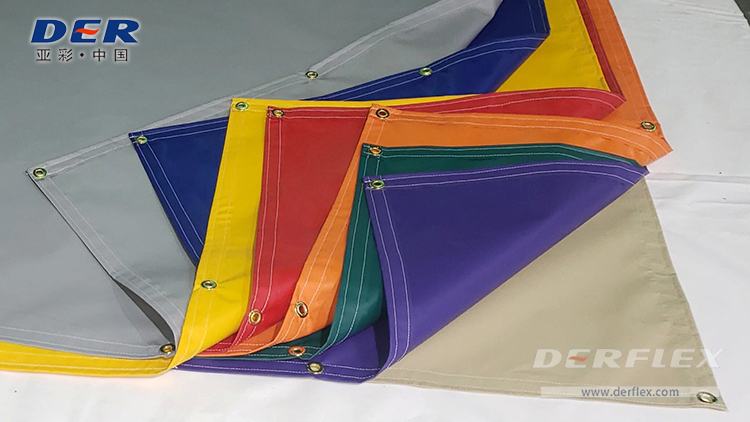
Why does a tarp keep getting loose?
Check the whole cover systemA tarp loses tension when its fabric or fastening system changes under load. Creep is increasing fabric extension under a sustained load; stress relaxation is decreasing force while the extension is held. Strap slippage, anchor movement and cargo settlement can produce the same visible sag without proving fabric creep.
Restore drainage and inspect the attachment points before tightening again. Repeatedly adding force can overload an already distorted hem, seam or grommet. A lasting solution combines a suitable textile construction, controlled installation, supported geometry and an agreed inspection routine.
Tarp stretch, creep and stress relaxation are different
The distinction matters because each mechanism needs different evidence. An installed cover usually has mixed boundary conditions: some anchors hold position, while cords, buckles and the fabric can all move.
Stretch under load
The fabric extends as it is pulled. Part of that movement can be recoverable elastic extension; part can involve weave straightening or other structural change. Stretch is a description of movement, not a diagnosis of its cause.
Fabric creep
At a controlled, sustained load, extension develops with time. After unloading, some strain may recover immediately, some may recover slowly and some may remain. Creep is not automatically the same as permanent damage.
Stress relaxation
If a specimen is held at a fixed extension, the tensile force can fall over time. A cover can therefore feel less taut even when its attachment positions have barely changed.
Keep shrinkage separate. Heat-related shrinkage or manufacturing dimensional change is a different question from elongation under sustained tension. Temperature can influence both. Record temperature and loading conditions before comparing dimensions.
Published coated-fabric research examines creep, recovery and relaxation under defined loads and temperatures. Results from one tested construction cannot be assigned to every PVC tarp. See technical references.
Where is the extra slack coming from?
Compare photographs and measurements taken under similar conditions. Witness marks on strap tails and repeatable reference points help separate fabric movement from movement elsewhere in the system.
| What you observe | What to check | Useful next action |
|---|---|---|
| A buckle tail has moved | Strap routing, buckle engagement, contamination and the marked tail position. | Correct the fastening arrangement or replace worn components; fabric creep has not yet been demonstrated. |
| An anchor or support has shifted | Ground settlement, frame movement, fixing position and cargo height. | Restore stable support and coverage geometry before altering the material specification. |
| The panel grows under a controlled load | Gauge length, elapsed time, textile direction, temperature and load stability. | Evaluate creep using a repeatable test on the actual construction. |
| Force falls at a held extension | Force measurement, held displacement and possible grip or anchor slip. | Review stress relaxation separately from a constant-load creep test. |
| Only the corner or hem is distorted | Grommet ovality, patch movement, webbing strain and pull direction. | Review the local load path and reinforcement; avoid increasing tension on a damaged attachment zone. |
| Sag follows rain or cargo movement | Water pockets, unsupported spans, load settlement and changing support height. | Remove the added load safely and correct support or drainage. Reassess the cover after unloading. |
Local edge deformation needs a finished-cover assessment. DERFLEX’s grommet pull-out and reinforcement guide explains why a strong fabric can still fail at an attachment point.
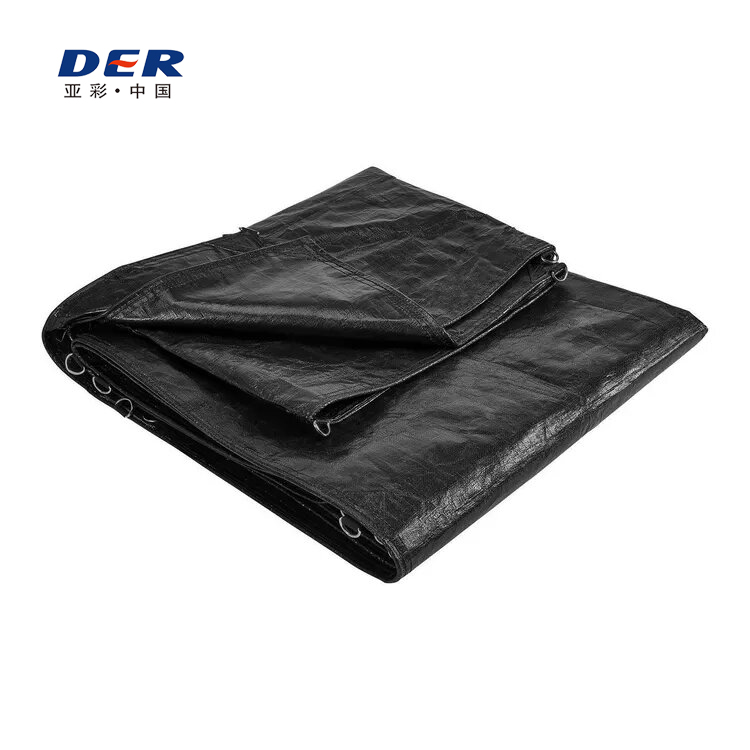
Separate panel movement from attachment movement
Photograph the broad panel, the seam, the hem and the hardware as separate inspection zones. A crease near a ring does not establish whole-panel creep; it may indicate concentrated local loading.
Record whether the ring, backing patch, strap or anchor moved. That evidence makes a material review more useful than a single photograph of a loose cover.
Why tension loss becomes more noticeable in service
Heat, load and exposure time
Coated textiles respond to the combination of stress, temperature and time. Research on specific PVC-coated fabrics found greater viscoelastic effects at higher temperature and initial stress. That supports testing for the intended environment; it does not provide a universal creep percentage or a safe installation tension.
Measure fabric surface temperature where practical. A sun-exposed cover may experience conditions that differ from the reported air temperature.
Direction, fit and repeated movement
Warp, weft and diagonal loading can produce different responses. A panel cut across an unsuitable direction, a seam placed in a demanding load path or a narrow corner fixing may concentrate movement.
Wind-driven cycles and abrasion can also change the cover over time. Track growing damage separately from time-dependent extension so that an ageing or fatigue problem is not recorded simply as “stretch.”
Water creates an additional load. As a simple illustration, a 2 m² pocket with an average water depth of 20 mm holds about 40 litres—approximately 40 kg of water. This is a volume calculation, not a permissible tarp load. The pocket can deepen as the panel sags.
Which tarp material holds tension better?
There is no reliable answer from a material name or GSM alone. For a PVC coated polyester tarp, the reinforcing textile, coating interaction, fabric direction and manufacturing history all affect the response. Ask for comparable data under the intended service conditions.
| Your application | Specification priority | What to validate |
|---|---|---|
| Long-term equipment storage | Shaped fit, supported drainage, UV requirement and adjustable fixing points. | Water pockets, changes in support geometry and fabric movement during a representative hold. |
| Truck or trailer covers | Suitable reinforced fabric, seam position, repeated handling and a compatible attachment system. | Finished edges, straps and hardware after representative opening, closing and tensioning cycles. |
| Frame-supported shelter skins | Directional load-extension data, panel orientation and an engineered tensioning allowance. | Finished panel behaviour and the approved frame, anchor and membrane design. |
| Temporary construction covers | Real anchor layout, span support, abrasion protection and drainage. | Local stress zones, field fit and adjustments after changing site or weather conditions. |
| OEM or wholesale repeat orders | Defined product code, textile construction, finished dimensions and agreed tolerances. | Approved reference samples and repeatable acceptance data from the same test basis. |
Review DERFLEX PVC tarpaulin material options alongside the finished-cover requirements. A heavier coating may meet a surface or durability need, but extra weight does not establish lower creep.
Reinforced fabric and clear film
Reinforced PVC fabric has a textile load-bearing layer. Unsupported clear PVC film does not share that construction. Avoid transferring creep expectations, cutting allowances or tension settings between them without validation.
PE, canvas and other alternatives
Woven poly tarps, treated canvas and coated polyester require separate comparisons. Compare the actual products for moisture response, temperature, load-extension and fabrication details. Material labels do not guarantee a “no-stretch” cover.
Breaking strength is not a tension-retention rating
Elongation at break describes a rupture test. Working elongation describes extension at a stated service-related load. Creep adds the time dimension. These results answer different questions.
| Data-sheet entry | What it tells you | What it cannot establish alone |
|---|---|---|
| GSM / thickness | Finished mass per area or material thickness. | Extension, recovery or force retention during prolonged use. |
| Tensile strength | Breaking resistance under the named specimen and test procedure. | A safe field load, installation tension or creep limit. |
| Elongation at break | Extension at rupture under the specified test. | How much an intact cover will stretch at its working tension. |
| Extension at a stated load | A point on the load-extension response under stated conditions. | How that extension will evolve over days or months. |
| Creep, relaxation and recovery | Time-dependent movement, force retention or recovery for the tested conditions. | Every climate, panel size, load direction or finished hardware arrangement. |
Use the tensile strength vs tear strength buyer guide to keep rupture and local-damage requirements separate from the additional tension-retention checks.
How to reduce sagging without over-tensioning
Use the cover or system supplier’s installation instructions. Adjust in small, balanced increments, and treat changing support geometry as a separate problem. There is no universal ratchet setting, tie-down spacing or pretension for all tarps.
Confirm fit and drainage
Check finished dimensions against the actual frame or cargo. Provide a continuous drainage path and supported spans. Leave the adjustment travel required by the approved design.
Inspect the load path
Align anchors with reinforced attachment zones. Check seams, hems, webbing and hardware before applying tension. Address sharp contact and chafing points.
Apply balanced tension
Follow a consistent sequence across opposing attachment points. Stop if corners, eyelets or seams visibly distort. Additional force cannot repair an unsuitable fit.
Record the starting condition
Photograph the cover and strap positions. Log temperature, load state and fixing arrangement. Make later measurements repeatable rather than relying on how taut it feels.
Recheck after settling and changes
Use the supplier’s inspection interval. Check after cargo movement, significant rain or wind, and temperature changes. Adjust only after identifying the source of slack.
Escalate recurring slack
If the same panel repeatedly loosens or residual deformation grows, review the construction and geometry. Replace damaged components before returning them to service.
For wind-driven movement, see how to control tarp flapping and tie-down layout. Elastic ties and rigid straps have different roles; use the attachment system specified for the application.
Translate a small percentage into visible movement
Measured extension (%) = (later gauge length − initial gauge length) ÷ initial gauge length × 100.
Use the same marked endpoints and agreed reference tension. Record time, temperature and loading history. This calculation measures a change in length; it does not identify creep or set an acceptance limit.
The default numbers are an arithmetic example, not DERFLEX product test data or a recommended allowance.
What should buyers test before bulk approval?
Agree the construction, test setup and acceptance limits before ordering. The plan below is a procurement framework for discussion with DERFLEX and a qualified laboratory; it is not a claim that every listed test is included with every order.
| Check | Conditions to agree | Evidence to request |
|---|---|---|
| Material identity | Product code, reinforcement, coating, GSM, finish and conditioning. | Traceable approved sample and a written construction specification. |
| Load-extension response | Specimen geometry, warp/weft orientation, loading rate and relevant load points. | Directional curves or extension values at the agreed loads. |
| Constant-load hold | Force, gauge length, grip arrangement, temperature, duration and logging points. | Extension versus time, initial extension and additional hold-period extension identified separately. |
| Held-extension relaxation | Initial extension, temperature, duration and displacement control. | Force versus time with the initial force and retained-force calculation defined. |
| Recovery after unloading | Unloading procedure, recovery time and consistent measurement tension. | Immediate recovery, delayed recovery and remaining deformation at the agreed observation time. |
| Finished-cover behaviour | Seams, hems, hardware, panel orientation, support geometry and representative cycles. | Recorded movement and condition at each critical zone, including attachment slip. |
A tensile standard is not a creep report. ISO 1421 covers coated-fabric tensile testing; its strip method determines tensile strength and elongation at break. A claim of compliance alone does not supply a long-duration creep or relaxation result. Specify those additional conditions explicitly.
Use DERFLEX’s tarpaulin technical specification guide to connect these checks with the material, finished size and batch acceptance requirements.
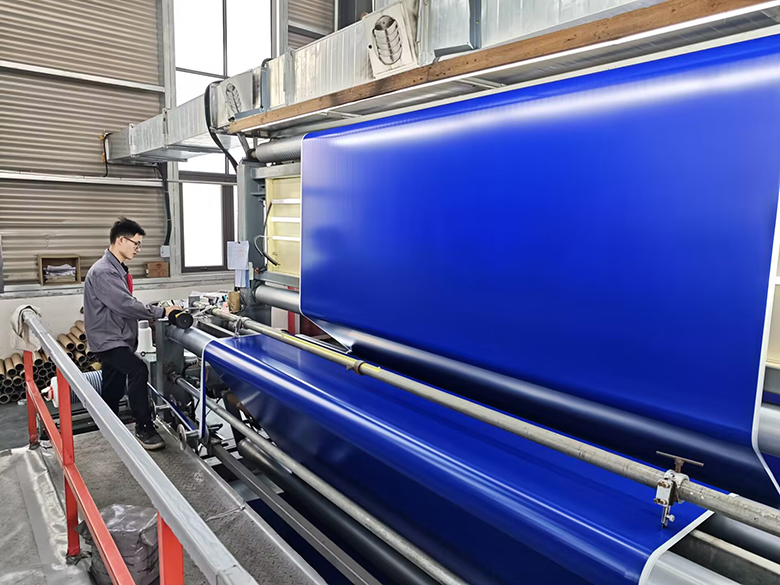
Make the finished cover part of the specification
The panel, seams, reinforcement and fasteners form one load path. A suitable roll fabric can still be paired with an unsuitable cutting direction or an edge design that concentrates force.
- Panel orientation: identify warp and weft on drawings where directional behaviour matters.
- Seam layout: review joins against the main pulling direction and repeated flexing zones.
- Edges and patches: define reinforcement, hardware position and intended pull direction.
- Adjustment travel: provide controlled take-up for the approved installation; avoid a fixed percentage copied from another cover.
- Repeat production: retain the agreed drawing, reference sample and acceptance rules.
Discuss dimensions, material, reinforcement, printing and OEM packaging through the DERFLEX custom tarp manufacturing program. MOQ, sample arrangements, test scope and lead time require confirmation for the selected order.
Request tension retention with a defined load case
“Heavy duty” and “low stretch” are not complete purchase specifications. A supplier needs to know how the cover is supported, attached and used before suggesting a fabric or a validation route.
Send these details
- Application and service duration: transport, storage, shelter or repeated installation.
- Finished size, drawing, anchor coordinates and unsupported spans.
- Material preference, GSM or thickness, colour and supply format.
- Seams, hems, webbing, grommets, D-rings, straps or pockets.
- Load information, surface temperature range, UV exposure and wet conditions.
- Failure photos, time to visible slack and the amount of repeated adjustment.
- Quantity, destination, delivery schedule and any required compliance documentation.
Application / service duration:
Finished dimensions / drawing:
Support and anchor layout:
Material / GSM / colour:
Fastening and reinforcement:
Load and temperature conditions:
Observed slack / time / photos:
Required validation / acceptance limits:
Quantity / destination / schedule:
Avoid buying by breaking strength alone
A high rupture number does not quantify movement at service load. Ask for relevant extension data and a time-dependent check when dimensional stability matters.
Avoid specifying “zero stretch”
Define what amount of movement the application can tolerate, at which load, temperature and time. Agree the measurement and acceptance rule instead of relying on an absolute label.
Send the installation details. Get a more useful specification.
Share the cover drawing, fastening arrangement and conditions behind the tension loss. DERFLEX can discuss PVC coated fabric, finished-tarp options and the sample or documentation requirements to confirm before bulk supply.
Tarp stretch and creep FAQ
Answers for material selection, recurring sag and repeat-order specifications.
Do PVC tarps stretch over time?
PVC coated polyester tarps can extend under load and show time-dependent creep or stress relaxation. The amount depends on construction, direction, load, temperature and time. “PVC” alone does not define tension-retention performance.
What is the difference between creep and stress relaxation?
Creep is increasing extension over time while load is held. Stress relaxation is decreasing force over time while extension is held. An installed cover may combine both because fabric, ties and anchors have different stiffness and movement.
Does a heavier tarp always stretch less?
No. GSM describes finished mass per area, not long-term extension. Reinforcing yarn, weave, coating interaction and direction also matter. Compare the actual constructions using the same load, temperature, duration and measurement procedure.
How often should a tarp be retensioned?
Use the cover or system supplier’s inspection schedule. Recheck after initial settling and after significant changes in weather, cargo or supports. If repeated adjustment is needed, identify the cause before adding more tension; there is no universal interval for every tarp.
Can a stretched tarp recover its original size?
Some extension can recover immediately or gradually after unloading. Remaining deformation may persist after excessive loading or structural change. Measure at a defined recovery time and consistent reference tension; do not assume every stretched cover will recover fully.
Is elongation at break a useful creep specification?
It is useful for understanding a rupture test, but it does not establish working elongation or long-duration creep. Add extension at stated loads, a controlled hold and recovery measurements when tension retention is important.
Can straps cause sagging even if the tarp fabric is stable?
Yes. Strap or buckle slip, changing elastic-tie extension, moving anchors and settling cargo can introduce slack. Mark fastening positions and compare panel measurements before attributing the whole change to fabric creep.