


Tarp vs Plastic Sheeting: What’s Best for Jobsite Protection?
Use a reusable reinforced tarp for covers that face repeated handling and tie-down loads. Use suitable plastic sheeting for draping, masking or a specified enclosure system. The right purchase starts with the protection zone, material construction and fixing method.
For contractors, distributors and project buyers, this guide compares poly film, reinforced sheeting, PE tarps and PVC-coated polyester. DERFLEX can review tarp materials and custom cover details against your site layout.
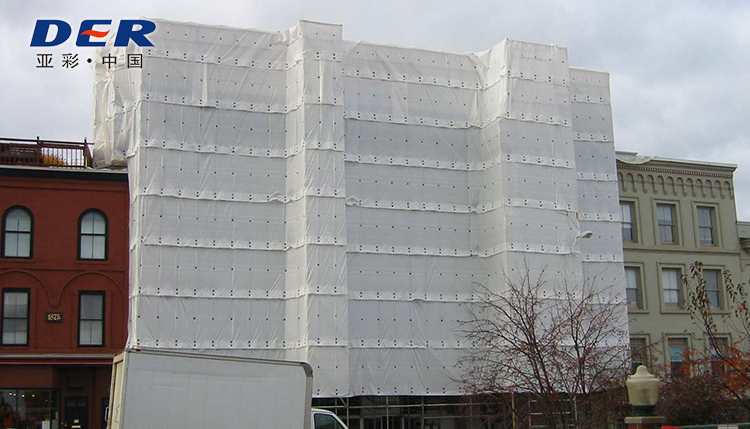
Choose by duty, then by material.
Tarps usually suit reusable outdoor covers; ordinary plastic film usually suits lightweight draping and masking. Reinforced plastic sheeting is a separate option for temporary enclosures and more demanding coverage. Neither name guarantees strength, UV resistance or service life. Compare the actual reinforcement, seams, fixing points and exposure requirements.
“Plastic” is not a useful strength specification.
Many tarps are themselves plastic-based. The useful distinction is between an unreinforced film, a reinforced sheet and a fabricated cover. Two products with the same nominal thickness can behave differently at a puncture, seam or fixing point.
Drape, mask and screen
Polyethylene film has no woven load-carrying fabric. Lightweight grades are convenient for covering fixtures and isolating light mess. Specify the film grade, thickness and compatible fixing system rather than assuming every roll is suitable outdoors.
Build a planned enclosure
A scrim or reinforcement grid improves the structure of the sheet. Products may include designated fixing bands or reinforced zones. Outdoor suitability still depends on the grade, UV specification and complete installation.
Remove, refit and reuse
PE woven tarps and PVC-coated polyester tarps combine reinforcement with a protective surface. Fabricated hems, corner patches and attachments make the finished cover different from an unfinished roll of film.
For the wider material families, see the DERFLEX tarp material guide. Keep the cover’s construction and the installation system in the same purchase specification.
| Decision | Ordinary poly film | Reinforced sheeting / PE tarp | PVC-coated polyester tarp |
|---|---|---|---|
| Structure | Unreinforced polyethylene film. | Scrim-reinforced sheet or woven PE with protective layers; identify which. | Polyester reinforcement with PVC coating or lamination. |
| Common role | Light dust screening, paint masking and draped temporary coverage. | Temporary enclosure or general weather cover, depending on grade and finishing. | Reusable equipment covers, material covers and fabricated industrial panels. |
| Fixing | Compatible tape, clamps or a supported system; avoid isolated holes in thin film. | Use designated bands, reinforced edges or finished tarp eyelets as specified. | Project-defined hems, webbing, grommets, loops or other fabricated details. |
| Repeated handling | Check whether refolding and reuse are intended for the particular grade. | Evaluate reinforcement, crease damage and fixing-zone wear. | A useful direction for repeated use; evaluate flexing, abrasion and seam condition. |
| Rain exclusion | Intact film may shed water; joints and punctures determine installed performance. | Verify sheet continuity, seams, overlap details and drainage. | Verify coating, welded joints, openings, edges and drainage. |
| Outdoor exposure | Do not assume UV stabilization from color or thickness. | Request grade-specific outdoor-use guidance and UV information. | Confirm the formulation and exposure requirements for the ordered grade. |
| Handling weight | Often convenient for lightweight coverage; roll size still matters. | Depends on mass, panel area and reinforcement. | Large panels can be heavy; calculate finished weight before ordering. |
| Repair route | Compatible tape may suit a small temporary repair; replace unsuitable damaged film. | Use the supplier’s compatible patch or repair system. | Compatible patches or welding may be possible after material and damage review. |
One jobsite can need three different cover systems.
Separate indoor surface protection, outdoor material storage and facade enclosure before buying. A single blanket specification can make light tasks unnecessarily expensive while leaving exposed zones under-specified.
| Jobsite task | Practical starting point | Why it fits | Critical detail |
|---|---|---|---|
| Indoor painting or fixture masking | Suitable poly masking film. | Easy to drape and cut around irregular objects. | Surface-safe tape, edge sealing and removal requirements. |
| Renovation dust partition | Film or reinforced sheeting with a compatible partition system. | Supports planned screening and access openings. | Seal the perimeter and doors; assess whether extraction or a specialist containment system is required. |
| Lumber, pipe or equipment storage | Reinforced PE tarp or PVC tarp, selected by exposure and handling. | Finished edges and attachments help with repeated covering. | Sharp-edge padding, drainage, ventilation and tie-down layout. |
| Daily removal and refitting | Custom reusable PVC-coated polyester cover as a candidate. | Allows access details, reinforced pull zones and a repeatable fit. | Panel weight, attachment durability and contact-zone protection. |
| Scaffold or facade enclosure | Specified reinforced sheeting or fabricated enclosure panels. | Can integrate modular panels and designated fixing zones. | Structure, wind effects, ties, access and the approved attachment system. |
| Temporary roof coverage | Purpose-selected reinforced waterproof panel system. | Material and seams can be selected together for water shedding. | Support, slope, runoff, perimeter details and safe installation. |
| Walked-on finished floors | Dedicated traffic-rated surface protection system. | Traffic, impact and finish compatibility need their own assessment. | Do not choose loose smooth film or a tarp on waterproofing alone. |
For repeat-use covers, review PVC tarpaulin material options. For enclosure and runoff planning, use the construction weather-protection guide.
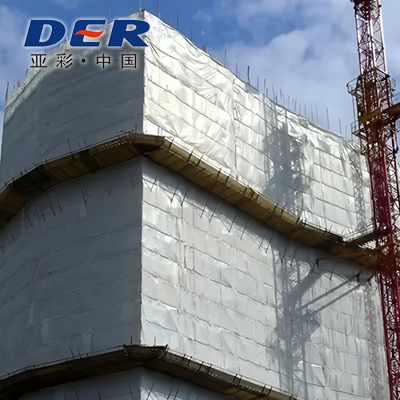
Enclosure coverage
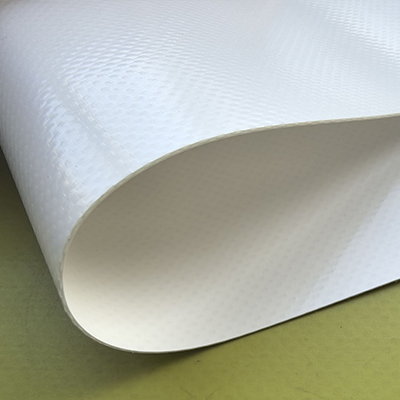
Material selection
Thickness is a dimension. Strength needs evidence.
“Heavy duty,” “6 mil” and “waterproof” do not describe the same property. A purchasing specification should separate the sheet’s physical dimensions from the performance of the finished cover.
1 mil = 0.0254 mm = 25.4 μm
Here, mil means one-thousandth of an inch, not a millimeter. For example, 6 mil = 0.1524 mm = 152.4 μm. These are unit conversions, not recommended jobsite grades.
GSM measures mass per area.
Approximate fabric weight in kg = area in m² × GSM ÷ 1,000. A 4 × 6 m sheet at 650 GSM contains about 15.6 kg of fabric, before hems, hardware and packing. This is an illustration, not a DERFLEX product specification.
| Specification item | Procurement requirement |
|---|---|
| Material construction | Name the polymer, reinforcement and coating or lamination route. Identify unreinforced film, reinforced sheeting, woven PE tarp or PVC-coated polyester. |
| Thickness & GSM | State the measurement units, method and agreed tolerance. Do not convert between GSM and mil without reliable density and construction data. |
| Finished dimensions | Approve the usable finished size, not just the cut size. Allow for seams, hems, overlap, wrapping depth and access openings. |
| Mechanical performance | Request relevant tensile, tear or puncture data using an agreed method, both material directions where applicable and the selected construction. |
| Seams & water control | Approve joint type, seam layout and suitable inspection or testing. Keep drainage and interface design in the installation plan. |
| Attachments | Define fixing location, edge reinforcement, hardware and pull direction. Review the finished fixing zone, not only the sheet strength. |
| UV & temperature | Provide expected outdoor duration and site conditions. Confirm grade-specific supporting information; do not assume a fixed lifespan. |
| Fire requirements | If required by the project, state the exact test method, construction and documentation needed. “FR” alone is incomplete. |
| Commercial approval | Confirm the sample, quantity, packing, destination, MOQ and lead time with DERFLEX for the agreed specification. |
A short explanation of the substrate and protective layer is available in what makes a PVC tarp different. Final values should come from the specification approved for your order.
The cover is only as useful as its edges and joints.
Most material comparisons stop at the sheet. The next step is to define how crews will fasten it, open it, shed rain and keep it clear of damaging contact points.
Spread the fixing load
Do not punch isolated tie-down holes into ordinary thin film. Use the product’s intended support or clamping system. For finished tarps, review reinforced hems and corner zones together with the hardware and pull direction; there is no universal grommet spacing for all sites.
Specify the seam route
Compatible taped laps, welded joints and sewn seams serve different materials and duties. Establish the method for the selected product. A stitch line may need an additional sealing detail where water exclusion is required.
Make daily access repeatable
Plan a removable edge, flap, door or modular panel before fabrication. Repeatedly cutting or peeling an improvised opening can damage the sheet and make sealing less consistent.
Keep water moving
Provide support and a planned drainage path. Orient overlaps for runoff and check low points, penetrations and perimeter interfaces. Waterproof material cannot compensate for a cover that collects water or allows rain through its joints.
Control rubbing and trapped moisture
Pad sharp edges and remove abrasive debris. A waterproof cover is not a drying system: plan ventilation around moisture-sensitive stock, and prevent the cover from rubbing directly against finishes that could be marked.
Approve a usable panel size
Large panels reduce joint count but may be difficult to carry, position and control. Check panel weight, crew handling, access and the site’s installation plan before choosing the largest available width.
For custom hems, seams, hardware and panel geometry, review DERFLEX tarpaulin fabrication options with a sketch of the protection area.
Is plastic sheeting cheaper than a tarp?
Basic film can have a lower initial cost for light, short-duration tasks. A reusable tarp may make more economic sense when repeated replacement and installation labor become significant. Specialty reinforced sheeting can have a different cost profile from ordinary painter’s film.
Compare cost per completed protection cycle
(Material + installation + replacement + repair + cleaning + disposal) ÷ completed usable cycles
Use quotations for the same covered area, exposure and acceptance criteria. Include overlaps, offcuts, spare panels and time spent reopening the cover. Assess potential water damage or downtime separately rather than hiding those assumptions in a material price.
Buying only by the label
Replace “heavy-duty plastic” with an agreed construction and performance checklist. Color and thickness alone do not establish outdoor suitability.
Ignoring the fixing system
A strong sheet with unsuitable attachment details can still be a poor purchase. Include the finished edge and joint design in the comparison.
Assuming every cover is reusable
Define the intended number of deployments as a requirement to review, then inspect condition between uses. Do not promise a cycle count without supporting evidence.
What DERFLEX needs to review your cover.
DERFLEX supplies PVC tarpaulin materials and can discuss custom cover programs for industrial and construction applications. A clear drawing helps connect material choice with hems, seams, attachments and packing. Available options and feasibility depend on the selected construction.
- Protection zone: indoor masking, storage cover, equipment cover, facade enclosure or temporary roof.
- Finished size: length, width, wrapping depth, overlaps, openings and the usable coverage required.
- Exposure: outdoor duration, rain, UV, temperature, wind conditions and contact hazards.
- Handling: expected removal frequency, crew access, panel weight limits and storage method.
- Material: preferred construction, reference sample, target GSM or thickness and finish.
- Fixing layout: frame or support, edge reinforcement, hardware positions and pull direction.
- Acceptance: specified tests, documentation, dimensional tolerances and sample approval.
- Order details: quantity, repeat demand, labeling, packing and delivery destination.
Ask for separate confirmation of sample availability, MOQ, lead time and production feasibility. For distributors and OEM buyers, include private-label or identification needs in the brief rather than adding them after sample approval.
Tarp vs plastic sheeting FAQ
Is a tarp the same as plastic sheeting?
The names overlap, but the construction may differ. A tarp usually describes a finished reinforced cover with hems and fixing points. Plastic sheeting may be unreinforced polyethylene film, reinforced roll sheeting or a specialist membrane. Ask for the material structure, edge finish and intended use rather than relying on the name.
Can I use plastic sheeting instead of a tarp outside?
Yes, if the selected sheeting is suitable for the exposure, duration and fixing method. UV-stabilized reinforced sheeting can serve outdoor enclosure applications. Thin painter’s plastic is a poor default for a repeatedly tensioned outdoor cover. Check reinforcement, outdoor-use guidance, seams and attachment details before substitution.
Is 6 mil plastic sheeting stronger than a tarp?
Thickness alone cannot answer that question. Six mil equals 0.1524 mm, but a strength comparison also needs reinforcement, tensile and tear test results, puncture behavior, seams and fixing-point strength. Compare results using the same test method and specimen construction; GSM and mil are different measurements.
Which is better for keeping rain off building materials?
A reinforced waterproof tarp with suitable seams and attachments is often a practical choice when the cover is removed and reused. Appropriate construction sheeting can also work for temporary coverage. In either case, provide slope and drainage, protect sharp contact points and manage ventilation around moisture-sensitive materials.
Can a tarp replace a permanent vapor barrier?
Do not make that substitution based only on waterproof appearance. A permanent vapor-control or below-slab membrane needs the specified vapor transmission, durability, joint system and installation details. Select the membrane against the project specification; a general-purpose tarp is a separate product category.
What should I send for a custom jobsite tarp quotation?
Send the protection zone, finished dimensions, quantity, exposure duration, handling frequency, fixing layout, preferred material, required test documents and delivery destination. Include site photos or a sketch, openings, overlap allowances and packing requirements. Ask DERFLEX to confirm the sample, MOQ and lead time for the agreed specification.
Material terminology checked against manufacturers’ published information: Poly-America construction film and Visqueen temporary protective sheeting. Application recommendations here are selection guidance; approve the specific product and installation details for the project.
Send a sketch. Define a cover your crew can use.
Share dimensions, exposure, quantity, fixing details and destination. Ask DERFLEX to review a suitable material and custom tarp specification for your jobsite, distributor program or OEM cover range.